AEA Astronomy Club Newsletter, April
2012
Contents
AEA Astronomy Club News & Calendar p.1
Video(s) & Picture(s) of the Month p. 2
Astronomy News p. 4
General Calendar p. 6
Colloquia, lectures, mtgs. p. 6
Observing p. 8
Useful Links p. 9
About the Club p. 10
Club News & Calendar.
Calendar
AEA Astronomy Club News & Calendar p.1
Video(s) & Picture(s) of the Month p. 2
Astronomy News p. 4
General Calendar p. 6
Colloquia, lectures, mtgs. p. 6
Observing p. 8
Useful Links p. 9
About the Club p. 10
Club News & Calendar.
Calendar
19 April
|
Monthly Meeting
|
“Human
Exploration of Mars,” Mark Benton, Boeing. A1/ 1026
|
17 May
|
Monthly Meeting
|
“IR
Airglow Images,” Lynette
Gelinas, Aerospace. A1/ 1026
|
20 May
|
Annular Solar Eclipse
|
Central
line thru
|
5 June
|
Venus Transit of the Sun
|
In
|
AEA Astronomy Club meetings are on 3rd Thursdays at 11:45am. For 2012, April-May we meet in A1/1026; June-Aug. & Oct.-Dec. in A1/1029A/B; and Sept. in A3/1607A/B.
News:
Musical
Meeting Rooms. For 2012, April-May we meet in A1/1026;
June-Aug. & Oct.-Dec. in A1/1029A/B; and Sept. in A3/1607A/B. Hopefully next year we’ll get a stable room
again.
“Dark
Matters”
The club
has suffered some significant losses this month. One a death – David Glackin, as reported by
email earlier (it was a very upbeat memorial service). And 6 we’ve lost to the RIF
last week. Including our current
secretary, David Wright, and treasurer, Jim Edwards. Also former treasurer, Vic Christensen and an
officer from the previous club incarnation, Dan Peplinski. They will truly be missed, not only for their
service that has made this club what it is, but for their expertise with
observational equipment, and their fellowship.
We will hopefully still see some at star parties. And we wish them well. Vic continues to send me his astronomy news
emails, which I’ll try to continue forwarding to members.
Help
Wanted
This means
that per the constitution the president (myself) needs to appoint a treasurer
& secretary to fill those vacancies until our regular election in
November-December. Most urgent is the
treasurer position. Volunteers are most
welcome. Are there any civic-minded
volunteers out there who can keep us going at least the rest of the year? If none, we may approach you. The former officers kept excellent records
(also posted to our Aerolink folder), and are available locally for questions.
Messier Marathon Report by David Wright
March 24th
Saturday was Messier Marathon night at the LAAS Lockwood Valley
I got a late start with putting Gabriel to bed and fiddling with the imager and stuff. I didn't end up taking any images but did start into the Messier objects by around 10. I got about 20 before the clouds came in.
I didn't have the Messier list since Mark wasn't there with the book we got [Mark & Paul chickened out at the last minute due to weather forecasts], but I used the Messier Marathon tour on the LX200, which seemed to start in the West for whatever was up.
We did bring a surprise that we wanted to show you guys, Gabriel and I made a Bahtinov focusing mask for the LX200 out of black mat board paper, and it works great! It's in the case with the telescope. It has a circular cutout in the center so that it rests on the secondary mirror and around the edge of the corrector plate mounting rim (not on the glass), and the Bob's Knobs stick out through the hole. Anyway, you'll just have to wait until next time to see how it works..
I got a late start with putting Gabriel to bed and fiddling with the imager and stuff. I didn't end up taking any images but did start into the Messier objects by around 10. I got about 20 before the clouds came in.
I didn't have the Messier list since Mark wasn't there with the book we got [Mark & Paul chickened out at the last minute due to weather forecasts], but I used the Messier Marathon tour on the LX200, which seemed to start in the West for whatever was up.
We did bring a surprise that we wanted to show you guys, Gabriel and I made a Bahtinov focusing mask for the LX200 out of black mat board paper, and it works great! It's in the case with the telescope. It has a circular cutout in the center so that it rests on the secondary mirror and around the edge of the corrector plate mounting rim (not on the glass), and the Bob's Knobs stick out through the hole. Anyway, you'll just have to wait until next time to see how it works..
We’re
still deciding on an astronomical video camera – inputs are invited. They’d basically triple or quadruple our
effective aperture for real-time imaging (e.g., group viewing), image capture
& live video internet streaming (for armchair observers). Finalists include the downscale (~$500-700)
Orion StarShoot, Mallincam Jr. & GSTAR-EX2; the more upscale (~$900-1200)
StellaCam 3 basic & Mallincam Hyper; or the top scale ($1500+) StellaCam 3
Peltier cooled & Mallincam VSS or Extreme.
For anyone interested, I can send my few pages of research &
links.
Astronomy
Video(s) & Picture(s) of the Month
(from Astronomy Picture of
the Day, APOD: http://apod.nasa.gov/apod/archivepix.html) Video(s)
NASA video of the evolution of the moon (3 minutes): http://apod.nasa.gov/apod/ap120320.html
The Scale of the Universe (interactive flash video, like the Powers of 10
movie, from 10^-35m to 10^24m – yoctometers to yottameters) http://apod.nasa.gov/apod/ap120312.html
A weekly 5 minute video about what’s up in the night sky: www.skyandtelescope.com/skyweek.

2012 March 25
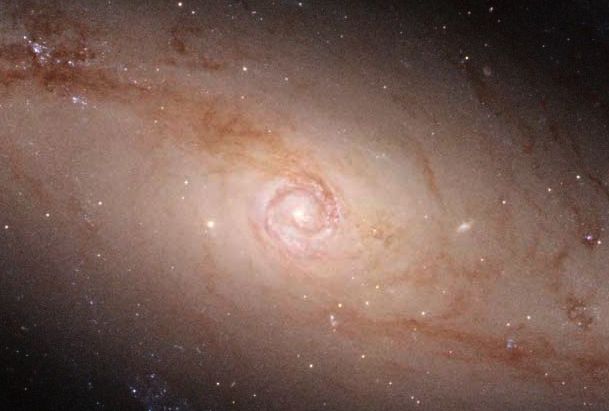
Explanation: Big, beautiful, barred spiral galaxy
NGC 1300 lies some 70 million light-years
away on the banks of the constellation Eridanus. This Hubble Space Telescope composite view of the gorgeous island universe is
one of the largest Hubble images ever made of a complete galaxy. NGC 1300 spans over 100,000 light-years and
the Hubble image reveals striking details of
the galaxy's dominant central bar and majestic spiral arms. In fact, on close inspection the nucleus of this classic barred spiral itself shows a remarkable
region of spiral structure about 3,000 light-years across.
Unlike other spiral galaxies, including our own Milky Way, NGC 1300 is not presently known to have a massive central black hole. 
2012 March 15
Explanation: What shines in the gamma-ray sky? The answer is usually the most exotic and
energetic of astrophysical environments, like active galaxies powered by supermassive black
holes, or incredibly dense pulsars, the spinning remnants of exploded
stars. But on March 7, a powerful solar flare, one of a series of recent solar eruptions, dominated the gamma-ray sky at
energies up to 1 billion times the energy of visible light photons. These two panels illustrate the
intensity of that solar flare in all-sky images recorded by the orbiting Fermi Gamma-ray Space Telescope. On March 6, as on most days, the Sun was almost invisible to Fermi's imaging detectors. But during the energetic X-class flare, it became nearly 100 times
brighter than even the Vela Pulsar at gamma-ray energies. Now faded in
Fermi's view, the Sun will likely shine again in
the gamma-ray sky as the solar activity cycle approaches its maximum.
Astronomy News:
In keeping with the theme
of a dark month, the following are excerpts on recent developments on dark
energy & cosmology. Read more at the
links.
South Pole Telescope provides new insights
into dark energy and neutrinos

Daniel
Luong-Van
“Analysis of data from the
10-meter South Pole Telescope is providing new support for the most widely
accepted explanation of dark energy -- the source of the mysterious force that
is responsible for the accelerating expansion of the universe. The results also
are beginning to hone in on the masses of neutrinos, the most abundant
particles in the universe, which until recently were thought to be without
mass.“The data strongly support the leading model for dark energy, Albert Einstein's cosmological constant -- a slight modification to his theory of general relativity -- even though the analysis was based on only a fraction of the SPT data collected and only 100 of the more than 500 galaxy clusters detected so far.
"With the full SPT data set, we will be able to place extremely tight constraints on dark energy and possibly determine the mass of the neutrinos," said Bradford Benson, a postdoctoral scientist at the University of Chicago's Kavli Institute for Cosmological Physics. Benson presented the SPT collaboration's latest findings on April 1 at the American Physical Society meeting in Atlanta.
“A series of papers led by Christian Reichardt detailing the SPT findings have been submitted to The Astrophysical Journal.
“The results are based on a new method that combines measurements taken by the SPT and X-ray satellites, and extends these measurements to larger distances than previously achieved using galaxy clusters.
“The most widely accepted property of dark energy is that it leads to a pervasive force acting everywhere and at all times in the universe. This force could be the manifestation of Einstein's cosmological constant, which effectively assigns energy to empty space, even when it is free of matter and radiation. Einstein introduced the cosmological constant into his theory of general relativity to accommodate a stationary universe, the dominant idea of his day. He later considered it to be his greatest blunder after the discovery of an expanding universe.
“In the late 1990s, astronomers discovered that the expansion of the universe appeared to be accelerating, according to cosmic distance measurements based on the brightness of exploding stars. Gravity should have been slowing the expansion, but instead it was speeding up.
“Einstein's cosmological constant is one explanation of the observed acceleration of the expanding universe, now supported by countless astronomical observations. Others hypothesize that gravity could operate differently on the largest scales of the universe. In either case, the astronomical measurements are pointing to new physics that have yet to be understood......[more at the above link]
Clocking an accelerating universe: First
results from BOSS
Published:
Friday, March 30, 2012 - 10:07 in
Astronomy & Space
“Some six billion light
years ago, almost halfway from now back to the big bang, the universe was
undergoing an elemental change. Held back until then by the mutual
gravitational attraction of all the matter it contained, the universe had been
expanding ever more slowly. Then, as matter spread out and its density
decreased, dark energy took over and expansion began to accelerate. Today BOSS,
the Baryon Oscillation Spectroscopic Survey, the largest component of the third
Sloan Digital Sky Survey (SDSS-III), announced the most accurate measurement
yet of the distance scale of the universe during the era when dark energy
turned on.......“What if dark energy isn't an unknown force or substance, but instead a shortcoming of Albert Einstein's General Theory of Relativity, our best-yet theory of gravity? General Relativity predicts how fast galaxies should be moving toward one another in galaxy clusters, and, in the aggregate, how fast the structure of the universe should be growing. Any departure from its predictions would mean the theory is flawed......
“Baryon acoustic oscillation measures the angle across the sky of structures of known size, the peaks where galaxies cluster most densely in the network of filaments and voids that fill the universe. Since these density peaks recur regularly, the angle between appropriate pairs of galaxies as precisely measured from Earth reveals their distance -- the narrower the apparent angle, the farther away they are.
“Knowing the distance to an object tells its age as well, since its light travels from there to here at known speed. And the redshift of the light reveals how the universe has expanded since that time, as expansion stretches space itself; the wavelength of light traveling through space toward Earth stretches proportionally, becoming redder and revealing the expansion of the universe since the light left its source.......
"We depend on redshift to know expansion rates and how structure was growing at different times in the past," says Beth Reid, a Hubble Fellow at Lawrence Berkeley National Laboratory who directed the BOSS study of redshift space distortions. "But redshifts aren't uniform. Galaxies are carried along in the Hubble flow as the universe expands, but they also have their own velocities. They tend to fall toward denser regions, for example. Because the ones on the far side of a dense region are coming toward us, their redshift makes them look closer than they really are; the opposite is true for the galaxies on the near side, which are falling away from us -- they look farther away."
“Statistical analysis of the redshifts of the hundreds of thousands of galaxies in the BOSS dataset can take into account the peculiarities of local variation and still produce a dependable measure of distance, the Hubble expansion rate, and the growth rate of structure in the universe. With these techniques, Reid and her colleagues have measured gravity on a scale of 100 million light years, far larger than the most accurate gravity measure yet, which is based on the distance from Earth to the moon. Their conclusion: Einstein was right.
General Calendar:
Colloquia, Lectures, Seminars, Meetings, Open Houses & Tours:
Note: The South Bay Astronomical Society website (www.sbastro.org.) is temporarily not functional (due to recent death of the
webmaster). Nor have I received the usual hardcopy mailing recently. So I have no dates for their current
observing events.
Colloquia: Carnegie (Tues. 4pm), UCLA,
Caltech (Wed. 4pm), IPAC (Wed. 12:15pm) & other Pasadena (daily 12-4pm):
http://obs.carnegiescience.edu/seminars/
| Carnegie astronomy lectures – only 4 per year in the Spring www.obs.carnegiescience.edu. Visit www.huntington.org for directions. March 12, March 26, April 16, and April 30, 2012 Friend's Hall, Huntington Library, Art Collections, and Botanical Gardens All lectures are free and open to the public, but seating is limited. Please arrive early. Lectures start at 7:30pm, with light refreshments in advance. Parking is free. To access the parking lot, please enter The Huntington via the Allen Avenue gate. For more information about the Carnegie Observatories or this lecture series, please contact Reed Haynie. |
6
April
|
SBAS Monthly
General Meeting at El Camino College planetarium. 7:30 PM
Topic: TBD Guest Speaker:. www.sbastro.org.
|
9
April
|
Griffith
Observatory
Event Horizon Theater 8:00 PM to 10:00 PM |
April 12 & 13 -- The von Kármán Lecture Series: 2012 -- Gale Crater: Exploring the Mars Science Laboratory Landing Site
The selection of Gale crater as the Mars Science Laboratory landing site took over 5 years, involved broad participation of the science community via five open workshops, and narrowed an initial >50 sites (25 by 20 km) to four finalists (Eberswalde, Gale, Holden and Mawrth) based on science and safety. Science criteria important for the selection include the ability to assess past habitable environments, which include diversity, context, and biosignature (including organics) preservation. All of the final four sites have layered sedimentary rocks with spectral evidence for phyllosilicates that clearly address the science objectives of the mission. Engineering constraints important to the selection included: latitude (±30°), elevation (<-1 km), relief at baselines of 1 km, slopes at baselines of 2-5 m, rock abundance, and a radar-reflective, load-bearing, and trafficable surface that is safe for landing and roving. Sites were evaluated in detail using targeted data from instruments on all active orbiters, and especially Mars Reconnaissance Orbiter. Sophisticated entry, descent and landing simulations that include detailed information on all of the engineering constraints indicate all of the final four sites are safe for landing. Evaluation of the traversability of the landing sites and target “go to” areas outside of the ellipse using slope and material properties information indicates that all are trafficable and “go to” sites can be accessed within the lifetime of the mission. In the final selection, Gale crater was favored over Eberswalde based on its greater diversity and potential habitability.
Speaker:
|
Dr. Matthew Golombek Senior Research Scientist Mars Exploration Program Landing Site Scientist Jet Propulsion Laboratory |
Locations:
|
Thursday, April
12, 2012, 7pm The von Kármán Auditorium at JPL 4800 Oak Grove Drive Pasadena, CA › Directions Friday, April 13, 2012, 7pm The Vosloh Forum at Pasadena City College 1570 East Colorado Blvd. Pasadena, CA › Directions |
Webcast:
|
For the webcast on
Thursday at 7 p.m. PST, click here  If you don't have RealPlayer, you can download the free RealPlayer 8 Basic. |
16 Feb
2012
|
AEA Astronomy Club Monthly Meeting
|
"Doing Real Astronomical Imaging Science
Using Modest Equipment (e.g., our new ATIK imager & LX-200 telescope),”
Jim Edwards, Aerospace. A1/1029
|
April 16
Carnegie Lecture (see general info above)
Cognitive Astrophysics: A View from Nowhere
Dr. Barry Madore Staff Astronomer, Carnegie Observatories
How do astronomers come to any understanding of the Universe given its sublime complexity? We will explore the various paths; probe the limits of what we can know, and illustrate what makes this ultimately and essentially a very human pursuit.
Dr. Rik Williams Postdoctoral Research Associate, Carnegie Observatories
Even though galaxies rapidly form most of their stars early in their lives, they are not finished growing. In Part 2 of our story, we explore the processes that transform galaxies from the amorphous blobs in the early universe to the diverse array of spirals and ellipticals we
see today.
Observing:

Internet Links:
Link(s) of the Month
Membership. For information, current dues & application, contact TBD, or see the club website where a form is also available. Benefits will include use of club telescope(s) & library/software, discounts on Sky & Telescope magazine and Observer’s Handbook, field trips, great programs, having a say in club activities, acquisitions & elections, etc.
Committee Suggestions & Volunteers. Feel free to contact: Paul Rousseau, Program Committee Chairman (& club VP), TBD, Activities Committee Chairman (& club Secretary), or TBD, Resource Committee Chairman (over equipment & library, and club Treasurer).
Mark Clayson,
AEA Astronomy Club President
Dr. Barry Madore Staff Astronomer, Carnegie Observatories
How do astronomers come to any understanding of the Universe given its sublime complexity? We will explore the various paths; probe the limits of what we can know, and illustrate what makes this ultimately and essentially a very human pursuit.
19 April
|
AEA Astronomy Club Monthly Meeting
|
“Human
Exploration of Mars,” Mark Benton, Boeing. A1/ 1026
|
April 30
Carnegie Lecture (see general info above)
Bright Galaxies, Dark Universe Part II: Adulthood to RetirementDr. Rik Williams Postdoctoral Research Associate, Carnegie Observatories
Even though galaxies rapidly form most of their stars early in their lives, they are not finished growing. In Part 2 of our story, we explore the processes that transform galaxies from the amorphous blobs in the early universe to the diverse array of spirals and ellipticals we
see today.
Observing:
The following
data are from the 2012 Observer’s Handbook, and Sky & Telescope’s 2012 Skygazer’s
Almanac & monthly Sky at a Glance.
A weekly 5 minute video about what’s up in the night sky: www.skyandtelescope.com/skyweek.
Sun,
Moon & Planets for April:

Planets:
Jupiter sets between 10 & 8:30pm.
Mars sets a couple hours before dawn, so is up most of the night. Saturn rises at sunset, sets at sunrise,
overhead at midnight. Mercury rises an
hour before dawn. Venus sets 4 hrs after sunset. Neptune & Uranus are visible low just
before dawn.
Other
Events:
3 April – Venus 0.5 deg S of Pleiades (M45)
15 April – Saturn at opposition (overhead at midnight)
18 April – Mercury at greatest elongation W (27 deg)
21
April
|
LAAS Dark Sky Night: Lockwood Valley (Steve Kufeld
Astronomical Site;
LAAS members and their guests only)
|
| ? | SBAS Star Party (weather permitting): RPV at Ridgecrest Middle School 28915 North Bay Rd. |
22 April
– Lyrid meteors
peak, Jupiter 2 deg S of Moon
28
April
|
LAAS Public Star Party: Griffith Observatory
Grounds 2-10pm
|
?
|
SBAS
out-of-town observing – contact Greg Benecke www.sbastro.org.
|
20 May
|
Annular Solar Eclipse
|
Center
line thru Reno & Albuquerque – closest ~ Zion NP, Utah – max eclipse ~
6:40pm (elevation ~10 deg), begins ~5:30pm, ends at sunset (~ 8pm)
|
5 June
|
Venus Transit of the Sun
|
In L.A. 3:06pm
(58 deg elevation) to sunset (8:07pm) – greatest transit 6:25pm, 18 deg
elevation
|
Internet Links:
Link(s) of the Month
General
Mt. Wilson Institute (www.mtwilson.edu/), including status for visits & roads
About the Club
Club Websites: Internal (Aerospace): https://aeropedia.aero.org/aeropedia/index.php/Astronomy_Club It is updated to reflect this newsletter, in addition to a listing of past club mtg. presentations, astronomy news, photos & events from prior newsletters, club equipment, membership & constitution. We expect to link some presentation materials from past mtgs. Our club newsletters are also being posted to an external blog, “An Astronomical View” http://astronomicalview.blogspot.com/.
Club Websites: Internal (Aerospace): https://aeropedia.aero.org/aeropedia/index.php/Astronomy_Club It is updated to reflect this newsletter, in addition to a listing of past club mtg. presentations, astronomy news, photos & events from prior newsletters, club equipment, membership & constitution. We expect to link some presentation materials from past mtgs. Our club newsletters are also being posted to an external blog, “An Astronomical View” http://astronomicalview.blogspot.com/.
Membership. For information, current dues & application, contact TBD, or see the club website where a form is also available. Benefits will include use of club telescope(s) & library/software, discounts on Sky & Telescope magazine and Observer’s Handbook, field trips, great programs, having a say in club activities, acquisitions & elections, etc.
Committee Suggestions & Volunteers. Feel free to contact: Paul Rousseau, Program Committee Chairman (& club VP), TBD, Activities Committee Chairman (& club Secretary), or TBD, Resource Committee Chairman (over equipment & library, and club Treasurer).
Mark Clayson,
AEA Astronomy Club President