The Hubble Ultra Deep Field Image (see description on the right, below)

The Hubble Ultra Deep Field Image
(10,000 galaxies in an area 1% of the apparent size of the moon -- see description on the right, below)

Friday, October 12, 2012

2012 October


AEA Astronomy Club Newsletter                      October  2012

Contents
AEA Astronomy Club News & Calendar p.1
Video(s) & Picture(s) of the Month p. 5
Astronomy News p. 8
General Calendar p. 10
    Colloquia, lectures, mtgs. p. 10
    Observing p. 11
Useful Links p. 12

About the Club p. 12

Club News & Calendar.

Calendar

Club Meeting Schedule:

18-Oct-12
High/Wide Dynamic Range CMOS Imagers
Blake Jacquot (and Hung Ngo)
Aerospace

A1/1029A/B


15-Nov-12
Upper Atmospheric Disturbances Using RAIDS and Ground-Based Measurements
Rebecca Bishop & Andrew Christensen
Aerospace


A1/1029A/B


19-Dec-12
Beyond Next Generation Access To Space
Scott Martinelli and Jay Penn
Aerospace


A1/1029A/B


AEA Astronomy Club meetings are on 3rd Thursdays at 11:45am.  For 2012, April-May we meet in A1/1026; June-July & Oct.-Dec. in A1/1029A/B;
Aug. in A1/2143 and Sept. in A3/1607A/B.

News:  

16-Inch Truss Dobs Assembly & First Light
Wed. Sept. 12 Jason Fields, a friend & I met in D8 to assemble the new 16-inch Truss Dobsonian (see photos).  After about an hour and a half, without much trouble, we had it assembled and collimated w. the eyepiece laser collimator.  First light came 2 nights later in the parking lot of D8 (photo). 


Here is my [Jason Fields’] report from Saturday night [Sept. 15, 2012]. Feel free to abridge for the newsletter. [I chose not to, to show what a REAL observing report can look like]

9/15/12 Mt Pinos
end of astronomical twilight
midnight
temp [deg F]
59
47
RH [%]
36
27
seeing diam [arcsec]
1.1
0.8
seeing (1-10)
5
4
transparency (1-10)
7
5
zenith limiting [mag]
6.2
5.9
zenith sky bg [mag/arcsec**2]
19.9
19.4

As you can see in the table, it was a rather subpar night. In my experience a dark mountaintop site should expect a sky brightness below 21 mag/arcsec**2 and a zenith limiting mag of 7 or fainter. For reference, the sky brightness with a full moon is close to 18 mag/arcsec**2. Even though the Orion Nebula would be up within an hour, due to clearly deteriorating sky conditions I packed up around 1 am. Neither the zodiacal glow nor Gegenschein were ever apparent and even the Milky Way was difficult to see much north of Cepheus. Throughout the night the seeing was poor but highly confined: small blur circles with rapid variation in starlight intensity and color.  The transparency was also quite low and worsened as the night progressed. It was obvious at sunset that there was a lot of dust and smoke in the air from various fires and the Santa Ana winds; by midnight, the sky transparency noticeably decreased after sunset: by midnight there was clearly an additional magnitude loss on both Polaris and Vega (both at a zenith angle of about 60 by then). On a good night, a high-altitude site would have an extinction coefficient of say 0.17 - 0.20 and it was more like 0.70 - 0.80.

All this to say that testing the telescope was challenging.

Collimation was challenging, in great part due to the poor seeing, evidenced quite clearly in both in-focus, slightly out-of-focus, and grossly out-of-focus star testing, each focus position telling me something about the collimation of the telescope, the stability of the atmosphere, thermal currents within the telescope (an impressive sight if you've never looked for it), etc.

There is some flex in the spider vanes and in the secondary mirror holder which makes precise collimation of the secondary more time-consuming than I expected. Getting used to the primary mirror cell collimation screws (white thumbscrews) and collimation lock screws (black thumbscrews) took a bit of time as well. It is not difficult to find oneself putting strain on the back of the primary mirror if one is not careful. Based on star testing, there is some evident primary mirror sag and as well as some flex in the truss supports (the secondary cage droops) when looking at low elevation angles.

Meade 16" f/4.5 1829 mm fl
magnification
actual FOV (calculated)
apparent FOV
26 mm Meade QX
70
1.00
70

16 mm TeleVue Nagler
114
0.72
83

7 mm TeleVue Nagler
261
0.31
83


There is some coma when looking near the edge of field with the supplied 26-mm eyepiece. It is not yet clear to me if this is due to the primary mirror or the eyepiece as I did not use the drift method to measure the actual FOVs -- it was my sense that the FOV with the 26 mm was more like 1.1 or 1.2 degrees as, for instance, the double cluster easily fits in the FOV. The focus appeared very flat across the entire FOV through my 16 mm Nagler. Due to the poor seeing, the view through the 7 mm was troubled by star twinkling. Focus remained soft throughout the night due to both atmospheric seeing and lack of precise collimation.

Stray light: even at a dark site, the background sky brightness from most of the overhead sky is contributing to the background observed in the eyepiece. I experimented a little bit with a large black cloth but results were inconclusive other than a slightly darker background in the eyepiece. I think the easiest baffle would either be a mask at the top of the rocker box and/or a shroud for the open truss.

On to the fun stuff: here is a partial list of objects observed.

object
type
notes
M26
open cluster
very rich starfield

M11
open cluster
"

M20 Trifid
nebula
very faint color; expected more vivid color; star colors were quite evident though!

M8 Lagoon
nebula
very bright but pale; one knot of obvious pink

M24 starcloud
open cluster
numerous star colors; very nice!

Veil Nebula
supernova remnant
both halves very easy; light puple color; knots and strands very obvious

M57
planetary nebula
Ring Nebula; very bright with little color; obvious structure and wisps on long axis; central star mag=14.8 seen

M27
planetary nebula
Dumbbell Nebula; very bright, pink and purple; many faint stars across disk; central star mag=13.5 seen easily

M71
globular cluster
unconcentrated; nice star colors

M10
globular cluster
well resolved

M12
globular cluster
bright center

M5
globular cluster
very nice

M13
globular cluster
bright; nice star colors

6207
galaxy
easy with apparent structure and obvious dust lane; mag=12

IC 4617
galaxy
very difficult; mag=14.6; 1.2"x0.4" 550 M ly

891
galaxy
nice edge-on galaxy; fainter than expected

M31
galaxy
Andromeda Galaxy; two dust lanes very obvious; some HII and globulars observed

M32 & 110
galaxy
Andromeda satellite galaxies; easy, apparent structure

M33
galaxy
Triangulum Galaxy; rather faint; vague teal color; some HII and globulars observed

Double Cluster
open cluster
framed very nicely in 26 mm eyepiece

M45
open cluster
Pleiades; obvious blue reflection nebula

Jupiter
planet
too bright! need a neutral density and/or color filter; cloud bands evident despite poor seeing


Final thoughts:

The telescope should not be assembled or disassembled without a second person to assist. With a capable assistant who knows the telescope, one can set up and be observing in minutes. Meade has done a very fine job with both the balance and the smoothness of motion: moving the telescope while looking through the eyepiece is very pleasant, even when tracking an object at high power. The is extremely minimal telescope jitter or rebound when one stops moving the telescope.

The results of my optical testing were incomplete / inconclusive due to the poor viewing conditions; I still have some questions about the primary mirror figure. I suggest that a highly educational club activity would be to test the primary mirror (Foucault knife edge test, Ronchi test, etc).

Cheers,

[Following are in answer to M. Clayson’s question as to how he estimated/measured all those metrics]

Briefly, the weather data was obtained online from several sites nearby (temp, RH, and dewpoint) and site RH was determined from the dewpoint of those sites, altitude corrected. A rule of thumb is 3 deg F / 1,000' of elevation change in humid air and as much as 5 deg F / 1,000' in extremely dry air. On Saturday, based on weather data from multiple directions and elevations, the slope was 4.7 deg F / 1,000' -- very dry air indeed. I used to carry a small, old analog temp, RH, pressure gauge and if I start "seriously" observing again, I may return to that practice.

Seeing diameter was determined by looking at quite a few closely spaced double stars of known separation. Near midnight, I was able to split several 0.9" doubles and one 0.8" double near zenith (each star of which was twinkling rapidly but in place) but nothing at 0.7" or below.

Seeing (1-10) and transparency (1-10) are subjective and based on nearly three decades of observing experience. Likewise, I estimated the (naked eye) limiting zenith magnitude and the apparent brightnesses of Polaris and Vega around midnight as they had become noticeably fainter than normal, noted their approximate zenith angle (Z = ~60 degrees), determined the airmass (X = sec Z = 2), and from that came up with an approximate extinction coefficient k from m = m0 + kX.

In three decades of observing, I've experienced only two nights where the seeing and transparency both rated a 10. On those nights with my 10", blue color in the arms and yellow cores were clearly apparent in hundreds of galaxies, the colors of hundreds of blue reflection nebula and pink emission nebula were apparent in our Milky Way as well as several galaxies in the local group (M31, M33, ...), Saturn was razor sharp and steady at 650x, the zodiacal light and Gegenschein were as obvious as the Milky Way all night long, etc. For faint, extended sources like galaxies, the seeing can be as low as 5 as long as the transparency is 8 or better; conversely, for closely separated double stars, planetary observing, etc, the seeing is paramount and the transparency can be as bad as a 2. In fact, nights with high, thin altostratus clouds, which usually belie a very stable atmosphere, can be spectacular nights for visually observing doubles and planets but are of course terrible nights for photometry and for visually observing faint, extended sources. So, I find it important to gauge both the seeing and transparency as they both affect what kind of observing can be done.

As far as mirror testing, it is inexpensive and not too difficult to assemble various test setups; again, it might be useful and instructive for the club to do this.

Not listed in my observations from Saturday night were probably a dozen other Messier objects, probably a dozen Cr (Collinder) open clusters, a few Barnard dust clouds in Sagittarius and Ophiuchus, a few more globular clusters, and numerous galaxies mostly in Pegasus.

Jason


Mallincam Extreme Video Camera First Light
Friday Sept. 21 I was on the road to Las Vegas when the Shuttle was flying over L.A.  That evening I set up the LX-200 & videocamera for a 1-hour presentation to about 15 young Boy Scouts & their leaders at my brother’s request.  I'd arranged for someone to also bring a large-screen TV, table & generator (amazingly quiet & long cord) for it, and we set up in a parking lot.  

Shortly before the boys arrived at 8pm, and after making all the connections, doing the LX-200 alignment & commanding to go to the moon, I was pleasantly amazed to see a huge, sharp (after focusing) image of about one-eighth of the moon filling the large screen monitor (& a small preview window on my laptop).  See attached photo.  It was like looking out of the window of an orbiting spacecraft as I slewed w. the directional buttons on the LX-200 controller.  


The boys were amazingly well-behaved (according to their leaders, and I agree) -- clearly impressed w. the moon image upon arrival, asking astronomical questions but also about the equipment cost, etc.  I first oriented them in the sky using the laser pointer (Polaris & diurnal motions, constellations & bright stars, ecliptic & Milky Way, etc.).   Then I took them on a GoTo tour (the LX-200 was hitting objects spot on in the FOV), showing examples (Messier & NGC) of open & globular clusters, nebula, & galaxy (no visible planets), and explaining the astronomy merit badge requirements (I’m a certified counselor).  I need to learn to finesse the gain/exposure on the DSO's, as there was difficulty getting sharp images w. them -- possibly also an artifact of the monitor (I understand CRT monitors are better), as well as the thin cirrus and heat turbulence?  And I thought I'd captured a screen shot, but think I forgot a menu item or 2.  But all within an hour, w/out long lines at an eyepiece.  

Looking forward to a great large-screen show of the sun w. the H-alpha scope at the AEA October Festival.

Green Flash!
After a lifetime of failed attempts, Mark Clayson finally saw the green flash Sat. Sept. 29 from Crystal Cove Beach in Newport Beach.  Unfortunately, no photo for proof, but my sister & brother-in-law visiting from Cody, Wyoming, can vouch as they also saw it.


Astronomy Video(s) & Picture(s) of the Month
(from Astronomy Picture of the Day, APOD: http://apod.nasa.gov/apod/archivepix.html)
Video(s)

Aurora and Fireball Over Norway
Image Credit & Copyright:
Ole C. Salomonsen (Arctic Light Photo)
Explanation: What's happening behind that mountain? A convergence of variable sky spectacles. One night in mid-September near Tromsø, Norway, high red aurora could be seen shimmering through lower green aurora in a way that created a striking and somewhat unusual violet glow. Suddenly, though, the sky flashed with the brightest fireball the astrophotographer had ever seen, as a small pebble from outer space violently crashed into the Earth's atmosphere. The glow illuminated the distant mountain peak known as Otertinden of the Lyngen Alps. The bright meteor, which coincidently disappeared behind the same mountain, was also reflected in the foreground Signalelva River. Although you might consider yourself lucky to see either an aurora or a bright meteor, pictures of them together have been recorded several times previously.


A Space Shuttle Over Los Angeles
Image Credit & Copyright:
Stephen Confer
Explanation: It's not every day that a space shuttle lands at LAX. Although this was a first for the major Los Angeles airport hub, it was a last for the space shuttle Endeavour, as it completed its tour of California skies and landed, albeit atop a 747, for the last time. During its last flight the iconic shuttle and its chase planes were photographed near several of California's own icons including the Golden Gate Bridge in San Francisco, the Hollywood Sign, and the skyline of Los Angeles. Previously, in May, the space shuttle Enterprise was captured passing behind several of New York City's icons on its way to the Intrepid Sea, Air, & Space Museum. Pictured above, the piggybacking shuttle was snapped on approach last week to LAX as it crossed above and beyond a major Los Angeles street. Now retired, the space shuttles are all museum pieces, with the above shuttle scheduled to be towed along the streets of LA to the California Science Center.


An Ancient Stream Bank on Mars
Image Credit:
NASA, JPL-Caltech, MSSS
Explanation: Fresh evidence of an ancient stream has been found on Mars. The robotic rover Curiosity has run across unusual surface features that carry a strong resemblance to stream banks on Earth. Visible in the above image, for example, is a small overhanging rock ledge that was quite possibly created by water erosion beneath. The texture of the ledge appears to be a sedimentary conglomerate, the dried remains of many smaller rocks stuck together. Beneath the ledge are numerous small pebbles, possibly made smooth by tumbling in and around the once-flowing stream. Pebbles in the streambed likely fell there as the bank eroded. Circled at the upper right is a larger rock possibly also made smooth by stream erosion. Curiosity has now discovered several indications of dried streambeds on Mars on its way to its present location where it will be exploring the unusual conjunction of three different types of landscape.


Astronomy News:

NASA's Chandra shows Milky Way is surrounded by halo of hot gas

Published: Monday, September 24, 2012 - 14:33 in Astronomy & Space

NASA/CXC/M.Weiss; NASA/CXC/Ohio State/A.Gupta et al.

Astronomers have used NASA's Chandra X-ray Observatory to find evidence our Milky Way Galaxy is embedded in an enormous halo of hot gas that extends for hundreds of thousands of light years. The estimated mass of the halo is comparable to the mass of all the stars in the galaxy. If the size and mass of this gas halo is confirmed, it also could be an explanation for what is known as the "missing baryon" problem for the galaxy.
Baryons are particles, such as protons and neutrons, that make up more than 99.9 percent of the mass of atoms found in the cosmos. Measurements of extremely distant gas halos and galaxies indicate the baryonic matter present when the universe was only a few billion years old represented about one-sixth the mass and density of the existing unobservable, or dark, matter. In the current epoch, about 10 billion years later, a census of the baryons present in stars and gas in our galaxy and nearby galaxies shows at least half the baryons are unaccounted for.

In a recent study, a team of five astronomers used data from Chandra, the European Space Agency's XMM-Newton space observatory and Japan's Suzaku satellite to set limits on the temperature, extent and mass of the hot gas halo. Chandra observed eight bright X-ray sources located far beyond the galaxy at distances of hundreds of millions of light-years. The data revealed X-rays from these distant sources are absorbed selectively by oxygen ions in the vicinity of the galaxy. The scientists determined the temperature of the absorbing halo is between 1 million and 2.5 million kelvins, or a few hundred times hotter than the surface of the sun.


Other studies have shown that the Milky Way and other galaxies are embedded in warm gas with temperatures between 100,000 and 1 million kelvins. Studies have indicated the presence of a hotter gas with a temperature greater than 1 million kelvins. This new research provides evidence the hot gas halo enveloping the Milky Way is much more massive than the warm gas halo.


"We know the gas is around the galaxy, and we know how hot it is," said Anjali Gupta, lead author of The Astrophysical Journal paper describing the research. "The big question is, how large is the halo, and how massive is it?"


To begin to answer this question, the authors supplemented Chandra data on the amount of absorption produced by the oxygen ions with XMM-Newton and Suzaku data on the X-rays emitted by the gas halo. They concluded that the mass of the gas is equivalent to the mass in more than 10 billion suns, perhaps as large as 60 billion suns.


"Our work shows that, for reasonable values of parameters and with reasonable assumptions, the Chandra observations imply a huge reservoir of hot gas around the Milky Way," said co-author Smita Mathur of Ohio State University in Columbus. "It may extend for a few hundred thousand light-years around the Milky Way or it may extend farther into the surrounding local group of galaxies. Either way, its mass appears to be very large."

The estimated mass depends on factors such as the amount of oxygen relative to hydrogen, which is the dominant element in the gas. Nevertheless, the estimation represents an important step in solving the case of the missing baryons, a mystery that has puzzled astronomers for more than a decade.

Although there are uncertainties, the work by Gupta and colleagues provides the best evidence yet that the galaxy's missing baryons have been hiding in a halo of million-kelvin gas that envelopes the galaxy. The estimated density of this halo is so low that similar halos around other galaxies would have escaped detection.

The paper describing these results was published in the Sept. 1 issue of The Astrophysical Journal. Other co-authors were Yair Krongold of Universidad Nacional Autonoma de Mexico in Mexico City; Fabrizio Nicastro of Harvard-Smithsonian Center for Astrophysics in Cambridge, Mass.; and Massimiliano Galeazzi of University of Miami in Coral Gables, Fla.

NASA's Marshall Space Flight Center in Huntsville, Ala., manages the Chandra program for NASA's Science Mission Directorate in Washington. The Smithsonian Astrophysical Observatory controls Chandra's science and flight operations from Cambridge.


For Chandra images, multimedia and related materials, visit: http://www.nasa.gov/chandra


General Calendar:

Colloquia, Lectures, Seminars, Meetings, Open Houses & Tours:

Colloquia:  Carnegie (Tues. 4pm), UCLA, Caltech (Wed. 4pm), IPAC (Wed. 12:15pm) & other Pasadena (daily 12-4pm):  http://obs.carnegiescience.edu/seminars/ 

Carnegie astronomy lectures – only 4 per year in the Spring www.obs.carnegiescience.edu.    Visit www.huntington.org for directions.  For more information about the Carnegie Observatories or this lecture series, please contact Reed Haynie.

5 Oct
SBAS Monthly General Meeting at El Camino College planetarium. 7:30 PM
Topic: “Looking for Life on Mars and Other Places”
Speaker: Dr. Max Coleman, JPL/CalTech:.  http://www.sbastro.net/.  

Oct. 11 & 12 The von Kármán Lecture Series: 2012


Herschel Opens Up the Cool Universe

The Herschel Space Observatory, launched on May 14, 2009, is designed to carry out astronomical observations at wavelengths from ~1mm to 100 microns. This region of the spectrum, between radio waves and heat radiation, is a unique probe of the “cool” universe, that is, of objects at temperatures between a few degrees and 100 degrees above absolute zero. This includes material out of which new stars are forming in locations ranging from distant galaxies to nearby cold clouds of gas. To carry out these observations, Herschel has the largest precision telescope launched for astronomy, and three very sensitive instruments. Among many projects, Herschel has followed the “water trail” – observing this molecule in a wide range of sources ranging from giant molecular clouds to protoplanetary disks around young stars to comets in the solar system. This talk will present some of the highlights of Herschel observations and describe how they are changing our picture of how new stars and planets form.
Speaker:
Dr. Paul Goldsmith

Locations:
Thursday, Oct 11, 2012, 7pm
The von Kármán Auditorium
at JPL
4800 Oak Grove Drive
Pasadena, CA
› Directions

Friday, Oct 12, 2012, 7pm
The Vosloh Forum at Pasadena City College
1570 East Colorado Blvd.
Pasadena, CA
› Directions
Webcast:
We offer two options to view the live streaming of our webcast on Thursday:
› 1) Ustream with real-time web chat to take public questions.
› 2)
Flash Player with open captioning
If you don't have Flash Player, you can download for free
here.

18-Oct-12
High/Wide Dynamic Range CMOS Imagers
Blake Jacquot (and Hung Ngo)
Aerospace
A1/1029A/B

22 Oct
Griffith Observatory
Event Horizon Theater
8:00 PM to 10:00 PM

Observing:
The following data are from the 2012 Observer’s Handbook, and Sky & Telescope’s 2012 Skygazer’s Almanac & monthly Sky at a Glance.

A weekly 5 minute video about what’s up in the night sky:  www.skyandtelescope.com/skyweek.

Sun, Moon & Planets for October:


Moon: Oct 8 last quarter, Oct 15 new, Oct 22 1st quarter, Oct 29 full                                 

Planets:  Mercury and Mars are visible just after sunset. Jupiter rises 10pm the first of the month, 8pm the last of the month. Venus is visible in the pre-dawn sky.  Saturn is hidden by the sun.
Other Events:

5 Oct. Jupiter 0.9 deg N. of moon

6 Oct
SBAS Star Party (weather permitting): RPV at Ridgecrest Middle School 28915 North Bay Rd.

8-9 October Draconid Meteor Shower
Expect a peak rate of 10 yellow meteors per hour under clear, moonless conditions. These are fairly
slow meteors, coming in at 12.5 miles per second. They radiate from the head of the constellation
Draco. This shower was once known as the Giacobinids.

13-27 Oct Zodiacal Light visible before morning twilight.

13 Oct
LAAS Dark Sky Night : Lockwood Valley (Steve Kufeld Astronomical Site; LAAS members and their guests only)
13 Oct
SBAS out-of-town observing – contact Greg Benecke http://www.sbastro.net/.  

17, 18 Oct – Mercury 1.3 deg S. of moon, Mars 2 deg S. of moon

20 Oct
Public  Star Party: Griffith Observatory Grounds 2-10pm

20-22 October Orionids Meteor Shower
This shower produces a peak rate of 20 yellow and green meteors per hour, which are fast moving
at 41.6 miles per second and are known to produce fireballs. They radiate from a point in the sky
not far from Orion’s red giant star Betelgeuse.  Best pre-dawn.

26 Oct Mercury  at greatest eastern elongation – 24 deg from the sun (in the evening)

Internet Links:

Link(s) of the Month

A weekly 5 minute video about what’s up in the night sky:  www.skyandtelescope.com/skyweek.

General
Regional (esp. Southern California)
Mt. Wilson Institute (www.mtwilson.edu/), including status for visits & roads


About the Club

Club Websites:  Internal (Aerospace): https://aeropedia.aero.org/aeropedia/index.php/Astronomy_Club  It is updated to reflect this newsletter, in addition to a listing of past club mtg. presentations, astronomy news, photos & events from prior newsletters, club equipment, membership & constitution.  We have linked some presentation materials from past mtgs.  Our club newsletters are also being posted to an external blog, “An Astronomical View” http://astronomicalview.blogspot.com/. 
 
Membership.  For information, current dues & application, contact Jim Johansen, or see the club website where a form is also available.  Benefits will include use of club telescope(s) & library/software, discounts on Sky & Telescope magazine and Observer’s Handbook, field trips, great programs, having a say in club activities, acquisitions & elections, etc.
Committee Suggestions & Volunteers.  Feel free to contact:  Paul Rousseau, Program Committee Chairman (& club VP), TBD, Activities Committee Chairman (& club Secretary), or Jim Johansen, Resource Committee Chairman (over equipment & library, and club Treasurer).

Mark Clayson,
AEA Astronomy Club President

Tuesday, September 11, 2012

2012 September


AEA Astronomy Club Newsletter                      September  2012

Contents
AEA Astronomy Club News & Calendar p.1
Video(s) & Picture(s) of the Month p. 3
Astronomy News p. 7
General Calendar p. 9
    Colloquia, lectures, mtgs. p. 9
    Observing p. 12
Useful Links p. 13

About the Club p. 13

Club News & Calendar.

Calendar

Club Meeting Schedule:
20-Sep-12
Star Trackers
Art Okawauchi
Aerospace
A3/1607A/B
18-Oct-12
High/Wide Dynamic Range CMOS Imagers
Blake Jacquot (and Hung Ngo)
Aerospace
A1/1029A/B
15-Nov-12
Upper Atmospheric Disturbances Using RAIDS and Ground-Based Measurements
Rebecca Bishop & Andrew Christensen
Aerospace
A1/1029A/B
19-Dec-12
Beyond Next Generation Access To Space
Scott Martinelli and Jay Penn
Aerospace
A1/1029A/B


AEA Astronomy Club meetings are on 3rd Thursdays at 11:45am.  For 2012, April-May we meet in A1/1026; June-July & Oct.-Dec. in A1/1029A/B;
Aug. in A1/2143 and Sept. in A3/1607A/B.

News:  

The Mallincam Extreme astronomical video eyepiece camera has arrived and is ready for use.  I believe Jason Fields has assembled and had first light with the new 16-inch Dobsonian, and we are anxious to hear his report (I believe he’s on travel now).

From Jim Edwards:
Hey Mark...

Well, I'm gone but hopefully not (fully) forgotten!   ;-)

On this sizzlingly hot day I decided that I needed to break out the Coronado again and see what Big Sol is up to, causing all this trouble.  As you can see from the (tuned) image, he's very active today!  I've also included a couple of shots of the equipment setup for the uninitiated.  Please feel free to share any/all/none of this with the club as you see fit.


Btw, I am loving the motorized mini-equatorial mount that I got thru Orion.  Its just like the one that I had borrowed (for several years) from a friend and which you've seen in the past.  It works very well and is very affordable.  You should consider getting one of these for the club to go with the solar scope.

Best to you all there, pass on my regards.
Jim

From Paul Rousseau:

I joined Alan and his family at the Griffith Observatory star party on Saturday night. I brought my new camera and Alan brought his 8-inch Dobsonian telescope. Before sunset, there was some excitement due to a helicopter rescue of someone at Griffith Park. The exciting items in the sky that we enjoyed were the Moon and Saturn. In the first photo, you can see the Moon above the observatory. In the second photo, if you look carefully, you can see Mars, Saturn and Spica. You can find a few more photos that I captured yesterday in this Flickr set:


Astronomy Video(s) & Picture(s) of the Month
(from Astronomy Picture of the Day, APOD: http://apod.nasa.gov/apod/archivepix.html)
Video(s)

A Flight Through the Universe: http://apod.nasa.gov/apod/ap120813.html  

Mars in the Loop:  http://www.twanight.org/newTWAN/photos.asp?ID=3003742                                                                     (also http://apod.nasa.gov/apod/ap120809.html)

DNA: The Molecule that Defines You:  http://apod.nasa.gov/apod/ap120821.html


Spiral Galaxy NGC 4038 in Collision
Image Credit: Data Collection:
Hubble Legacy Archive; Processing: Danny Lee Russell
Explanation: This galaxy is having a bad millennium. In fact, the past 100 million years haven't been so good, and probably the next billion or so will be quite tumultuous. Visible on the upper left, NGC 4038 used to be a normal spiral galaxy, minding its own business, until NGC 4039, toward its right, crashed into it. The evolving wreckage, known famously as the Antennae, is pictured above. As gravity restructures each galaxy, clouds of gas slam into each other, bright blue knots of stars form, massive stars form and explode, and brown filaments of dust are strewn about. Eventually the two galaxies will converge into one larger spiral galaxy. Such collisions are not unusual, and even our own Milky Way Galaxy has undergone several in the past and is predicted to collide with our neighboring Andromeda Galaxy in a few billion years. The frames that compose this image were taken by the orbiting Hubble Space Telescope by professional astronomers to better understand galaxy collisions. These frames -- and many other deep space images from Hubble -- have since been made public, allowing an interested amateur to download and process them into this visually stunning composite.


Curiosity on Mars: Still Life with Rover
Image Credit:
NASA, JPL-Caltech
Explanation: What does the Curiosity rover look like on Mars? To help find out, NASA engineers digitally synthesized multiple navigation camera images taken last week into what appears to be the view of a single camera. Besides clods of Martian dirt, many of Curiosity's science instruments are visible and appear in good shape. Near the middle of the rover is an augmented reality tag intended to enable smartphones to provide background information. Far in the distance is a wall of Gale Crater. As Curiosity will begin to roll soon, its first destination has now been chosen: an intriguing intersection of three types of terrain named Glenelg.


Curiosity on Mars: A Wall of Gale Crater
Image Credit:
NASA, JPL-Caltech, MSSS
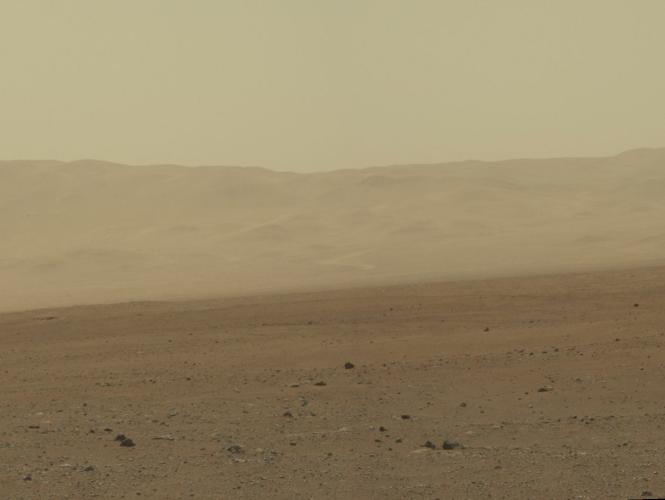
Explanation: If you could stand on Mars, what would you see? The above image is a digitally re-colored approximation of what you might see if the above Martian landscape had occurred on Earth. Images from Mars false-colored in this way are called white balanced and useful for planetary scientists to identify rocks and landforms similar to Earth. The image is a high resolution version of a distant wall of Gale Crater captured by the Curiosity rover that landed on Mars last week. A corresponding true color image exists showing how this scene actually appears on Mars. The robotic Curiosity rover continues to check itself over and accept new programming from Earth before it begins to roll across Mars and explore a landscape that has the appearance of being an unusually layered dried river bed.


A Filament Across the Sun
Image Credit & Copyright:
Bret Dahl
Explanation: Is that a cloud hovering over the Sun? Yes, but it is quite different than a cloud hovering over the Earth. The long light feature on the left of the above color-inverted image is actually a solar filament and is composed of mostly charged hydrogen gas held aloft by the Sun's looping magnetic field. By contrast, clouds over the Earth are usually much cooler, composed mostly of tiny water droplets, and are held aloft by upward air motions because they are weigh so little. The above filament was captured on the Sun about two weeks ago near the active solar region AR 1535 visible on the right with dark sunspots. Filaments typically last for a few days to a week, but a long filament like this might hover over the Sun's surface for a month or more. Some filaments trigger large Hyder flares if they suddenly collapse back onto the Sun.


Astronomy News:
(from AIAA Daily Launch & NASA JPL News)

WISE Reveals New Type Of Galaxy, More Supermassive Black Holes.


The CBS Evening News (8/29, story 11, 0:25, Pelley) reported, "NASA scientists today showed off their latest discovery. It's a type of galaxy they've never seen before. They call it a 'hot DOG.' It pumps out as much light as 100 trillion suns and there are thousands of these galaxies. They're very far away, about ten billion light years, which means they formed when the universe was in its infancy."
        Reuters (8/30, Klotz) notes the new hot DOGs, also called hot, dust-obscured galaxies, objects were found using the WISE telescope and could represent a missing stage in galaxy evolution. Scientists are unsure whether the early universe was special or hot DOGs can form today. WISE project scientist Peter Eisenhardt of the Jet Propulsion Laboratory said, "There is either just a weird set of circumstances that rarely comes up, or a common set of circumstances that comes up for only a very short period of time." Meanwhile, the article also notes WISE has found millions of supermassive black holes during its two years of observations in space.
        According to the Wired (8/30, Mann) "Wired Science" blog, astronomer Daniel Stern said during the press conference announcing the results, "This is a jackpot of black holes, two to three times more than have been found by any other survey."
        SPACE (8/30, Moskowitz) reports that although WISE is no longer making any observations, "scientists anticipate many more discoveries are still to come from its observations." Universe Today (8/30, Atkinson) also covered the story.

NASA's WISE Survey Uncovers Millions of Black Holes
The full version of this story with accompanying images is at:
http://www.jpl.nasa.gov/news/news.cfm?release=2012-265&cid=release_2012-265

PASADENA, Calif. -- NASA's Wide-field Infrared Survey Explorer (WISE) mission has led to a bonanza of newfound supermassive black holes and extreme galaxies called hot DOGs, or dust-obscured galaxies.

Images from the telescope have revealed millions of dusty black hole candidates across the universe and about 1,000 even dustier objects thought to be among the brightest galaxies ever found. These powerful galaxies, which burn brightly with infrared light, are nicknamed hot DOGs.

"WISE has exposed a menagerie of hidden objects," said Hashima Hasan, WISE program scientist at NASA Headquarters in Washington. "We've found an asteroid dancing ahead of Earth in its orbit, the coldest star-like orbs known and now, supermassive black holes and galaxies hiding behind cloaks of dust."

WISE scanned the whole sky twice in infrared light, completing its survey in early 2011. Like night-vision goggles probing the dark, the telescope captured millions of images of the sky. All the data from the mission have been released publicly, allowing astronomers to dig in and make new discoveries.

The latest findings are helping astronomers better understand how galaxies and the behemoth black holes at their centers grow and evolve together. For example, the giant black hole at the center of our Milky Way galaxy, called Sagittarius A*, has 4 million times the mass of our sun and has gone through periodic feeding frenzies where material falls towards the black hole, heats up and irradiates its surroundings. Bigger central black holes, up to a billion times the mass of our sun, may even shut down star formation in galaxies.

In one study, astronomers used WISE to identify about 2.5 million actively feeding supermassive black holes across the full sky, stretching back to distances more than 10 billion light-years away. About two-thirds of these objects never had been detected before because dust blocks their visible light. WISE easily sees these monsters because their powerful, accreting black holes warm the dust, causing it to glow in infrared light.

"We've got the black holes cornered," said Daniel Stern of NASA's Jet Propulsion Laboratory, Pasadena, Calif., lead author of the WISE black hole study and project scientist for another NASA black-hole mission, the Nuclear Spectroscopic Telescope Array (NuSTAR). "WISE is finding them across the full sky, while NuSTAR is giving us an entirely new look at their high-energy X-ray light and learning what makes them tick."

In two other WISE papers, researchers report finding what are among the brightest galaxies known, one of the main goals of the mission. So far, they have identified about 1,000 candidates.

These extreme objects can pour out more than 100 trillion times as much light as our sun. They are so dusty, however, that they appear only in the longest wavelengths of infrared light captured by WISE. NASA's Spitzer Space Telescope followed up on the discoveries in more detail and helped show that, in addition to hosting supermassive black holes feverishly snacking on gas and dust, these DOGs are busy churning out new stars.

"These dusty, cataclysmically forming galaxies are so rare WISE had to scan the entire sky to find them," said Peter Eisenhardt, lead author of the paper on the first of these bright, dusty galaxies, and project scientist for WISE at JPL. "We are also seeing evidence that these record setters may have formed their black holes before the bulk of their stars. The 'eggs' may have come before the 'chickens.'"

More than 100 of these objects, located about 10 billion light-years away, have been confirmed using the W.M. Keck Observatory on Mauna Kea, Hawaii, as well as the Gemini Observatory in Chile, Palomar's 200-inch Hale telescope near San Diego, and the Multiple Mirror Telescope Observatory near Tucson, Ariz.

The WISE observations, combined with data at even longer infrared wavelengths from Caltech's Submillimeter Observatory atop Mauna Kea, revealed that these extreme galaxies are more than twice as hot as other infrared-bright galaxies. One theory is their dust is being heated by an extremely powerful burst of activity from the supermassive black hole.

"We may be seeing a new, rare phase in the evolution of galaxies," said Jingwen Wu of JPL, lead author of the study on the submillimeter observations. All three papers are being published in the Astrophysical Journal.

The three technical journal articles, including PDFs, can be found at
http://arxiv.org/abs/1205.0811, http://arxiv.org/abs/1208.5517 and http://arxiv.org/abs/1208.5518 .

JPL manages and operates WISE for NASA's Science Mission Directorate, Washington. The principal investigator, Edward Wright, is at UCLA. The mission was competitively selected under NASA's Explorers Program managed by the Goddard Space Flight Center, Greenbelt, Md. The science instrument was built by the Space Dynamics Laboratory, Logan, Utah, and the spacecraft was built by Ball Aerospace & Technologies Corp., Boulder, Colo. Science operations and data processing and archiving take place at the Infrared Processing and Analysis Center at the California Institute of Technology in Pasadena. Caltech manages JPL for NASA.

More information is online at
http://www.nasa.gov/wise, http://wise.astro.ucla.edu and http://jpl.nasa.gov/wise .


General Calendar:

Colloquia, Lectures, Seminars, Meetings, Open Houses & Tours:


Colloquia:  Carnegie (Tues. 4pm), UCLA, Caltech (Wed. 4pm), IPAC (Wed. 12:15pm) & other Pasadena (daily 12-4pm):  http://obs.carnegiescience.edu/seminars/ 

Carnegie astronomy lectures – only 4 per year in the Spring www.obs.carnegiescience.edu.    Visit www.huntington.org for directions.  For more information about the Carnegie Observatories or this lecture series, please contact Reed Haynie.

7 Sept
SBAS Monthly General Meeting at El Camino College planetarium. 7:30 PM
Topic: “Dark Energy and Dark Matter” Dr. Michael Harrison:.  http://www.sbastro.net/.  

10 Sept
Griffith Observatory
Event Horizon Theater
8:00 PM to 10:00 PM

Sep. 4 The von Kármán Lecture Series:  Voyager Celebrates 35 Years in Space


The twin Voyager 1 and 2 spacecraft continue exploring where nothing from Earth has flown before. They each are more than 100 times as far as the distance between the Earth and the Sun. Both are now in the heliosheath – the outermost layer of the heliosphere where the solar wind is slowed by the presence of interstellar gas. The Voyagers will explore the outermost edge of the Sun’s domain… and beyond.
Speakers:
Dr. Ed Stone, Voyager Project Scientist
Cosmic Ray Subsystem Principal Investigator

Panel:
Stamatios (Tom) M. Krimigis, Principal Investigator
Low-Energy Charged Particles

Norman F. Ness, Principal Investigator
Magnetometer

John D. Richardson, Principal Investigator
Plasma Science

Donald A. Gurnett, Principal Investigator
Plasma Wave Subsystem
Location:
Tuesday, Sep. 4, 2012, 7pm
Save the dateClick here to add the date to your online calendar
The von Kármán Auditorium at JPL
4800 Oak Grove Drive
Pasadena, CA
› Directions
Webcast:
We offer two options to view the live streaming of our webcast on Thursday:
› 1)
Ustream with real-time web chat to take public questions.
› 2)
Flash Player with open captioning
If you don't have Flash Player, you can download for free
here.


Sep. 13 & 14 The Challenge of Mars Exploration
Mars is an enigmatic planet, and studying it is no easy task. All told, Mars missions have failed more often than they have succeeded, but the information gathered by those that have outwitted, out-engineered and out-lucked the planet has shown it to be an intriguing place where water likely existed in liquid form on the surface, and where one can imagine the possibility of all manner of bacteria living just below the surface. The remarkable success of the Mars Exploration Rovers, Spirit and Opportunity, gave impetus to the development of an even more capable spacecraft: The Mars Science Laboratory. If successful, this new spacecraft may open the door for a future mission with the potential to detect whether or not life may have ever existed on Mars.
Speaker:
Richard Cook
Mars Science Laboratory Deputy Project Manager, JPL

Locations:
Thursday, Sept 13, 2012, 7pm
The von Kármán Auditorium
at JPL
4800 Oak Grove Drive
Pasadena, CA
› Directions

Friday, Sept 14, 2012, 7pm
The Vosloh Forum at Pasadena City College
1570 East Colorado Blvd.
Pasadena, CA
› Directions
Webcast:
We offer two options to view the live streaming of our webcast on Thursday:
› 1) Ustream with real-time web chat to take public questions.
› 2)
Flash Player with open captioning
If you don't have Flash Player, you can download for free
here.

20 Sept
AEA Astronomy Club Mtg. Star Trackers
Art Okawauchi
Aerospace
A3/1607A/B

Observing:
The following data are from the 2012 Observer’s Handbook, and Sky & Telescope’s 2012 Skygazer’s Almanac & monthly Sky at a Glance.

A weekly 5 minute video about what’s up in the night sky:  www.skyandtelescope.com/skyweek.

Sun, Moon & Planets for August:


Moon: Sept 1 full, Sept 8 last quarter, Sept 15 new, Sept 22 1st quarter, Sept 30 full                                  

Planets:  Mercury is hidden in the Sun’s glow. Venus and Jupiter are visible in the pre-dawn sky.  Mars and Saturn are evening planets. 
Other Events:

1-2 September Alpha Aurigids Meteor Shower
The annual maximum ZHR may be as high as 9, but outbursts of over 30 occurred in 1935 and
1986.

7-8 September Gamma Aquarids Meteor Shower
This shower is active during September 1-14, with maximum occurring on September 7.
Its highest rates of activity only reach 1-4 meteors per hour.

8 Sept
SBAS Star Party (weather permitting): RPV at Ridgecrest Middle School 28915 North Bay Rd.

11-20 September Southern Piscids Meteor Shower
This weak and diffuse annual shower is active during the period of August 12 to October 7. The
peak intensity of about 5 per hour extends from about September 11 until about September 20.

12-13 September Eta Draconids Meteor Shower
No trace of this meteor shower can be found in the major lists of visual radiants. It seems to have
been discovered by the Radio Meteor Project in the 1960s. Whether this stream produces a strictly
telescopic shower is not currently known. The radiant is not well placed in the sky, as it crosses the
zenith during daylight hours. The best time for observations is during the early evening hours
following sunset---a period usually ignored by observers due to generally low meteor activity.


15 Sept
LAAS Dark Sky Night : Lockwood Valley (Steve Kufeld Astronomical Site; LAAS members and their guests only)
15 Sept
SBAS out-of-town observing – contact Greg Benecke http://www.sbastro.net/.  

22 Sept
Public  Star Party: Griffith Observatory Grounds 2-10pm

23-24 September Gamma Piscids Meteor Shower
Another meteor shower that was first discovered by the Radio Meteor Project in the 1960s. In the
1970s visual observation of this shower was made. It has been observed several times since then.
The hourly rate is typically given at 4.

Internet Links:

Link(s) of the Month

A weekly 5 minute video about what’s up in the night sky:  www.skyandtelescope.com/skyweek.

General
Regional (esp. Southern California)
Mt. Wilson Institute (www.mtwilson.edu/), including status for visits & roads


About the Club

Club Websites:  Internal (Aerospace): https://aeropedia.aero.org/aeropedia/index.php/Astronomy_Club  It is updated to reflect this newsletter, in addition to a listing of past club mtg. presentations, astronomy news, photos & events from prior newsletters, club equipment, membership & constitution.  We have linked some presentation materials from past mtgs.  Our club newsletters are also being posted to an external blog, “An Astronomical View” http://astronomicalview.blogspot.com/. 
 
Membership.  For information, current dues & application, contact Jim Johansen, or see the club website where a form is also available.  Benefits will include use of club telescope(s) & library/software, discounts on Sky & Telescope magazine and Observer’s Handbook, field trips, great programs, having a say in club activities, acquisitions & elections, etc.

Committee Suggestions & Volunteers.  Feel free to contact:  Paul Rousseau, Program Committee Chairman (& club VP), TBD, Activities Committee Chairman (& club Secretary), or Jim Johansen, Resource Committee Chairman (over equipment & library, and club Treasurer).

Mark Clayson,
AEA Astronomy Club President