The Hubble Ultra Deep Field Image (see description on the right, below)

The Hubble Ultra Deep Field Image
(10,000 galaxies in an area 1% of the apparent size of the moon -- see description on the right, below)

Tuesday, July 9, 2013

2013 July

AEA Astronomy Club Newsletter  July 2013

Contents
AEA Astronomy Club News & Calendar p.1
Video(s) & Picture(s) of the Month p. 2
Astronomy News p. 5
General Calendar p.7
    Colloquia, lectures, mtgs. p. 7
    Observing p. 8
Useful Links p. 9

About the Club p. 10

Club News & Calendar.

Calendar

Club Meeting Schedule:

18 July 2013
Club Meeting
A Video lecture sample (TBD) from the club library (see https://aeropedia.aero.org/aeropedia/index.php/Astronomy_Club/Library)

A1/1735

AEA Astronomy Club meetings are on 3rd Thursdays at 11:45am.  For all of 2013, the meeting room is A1/1735.

News:  

The annual AEA budget request is due July 15.  If you have any specific suggestions for equipment, lunches, field trip expenses, etc. to purchase in FY14, please send them to Mark Clayson by this Fri., July 12.  We will probably keep our request amount comparable with past years -- $4,200, but we need to itemize how we would spend it.

Equipment.  The Meade ETX-90 is still backordered.  I’m told if it doesn’t ship July 16, it wouldn’t until Sept. – in which case we may cancel the order & order from someone else.  It was ordered March 29.

Here’s an article on the status of Meade Instruments, Inc. & amateur observing in general:

Field Trip.  There have been few responses so far on the survey of interests in candidate club field trips for the year.  Unless additional responses come in, we will probably table it for now. Ideas include:  Mt. Palomar tour & star party/camping, JPL tour (or open house in June), Griffith Observatory, Calif. Science Museum (incl. Endeavor, IMAX,...), the Columbia Memorial Space Center in Downey (Apollo & Shuttle history),.... Other suggestions?

Membership Renewals.  Some still need to renew their club membership.  See the club website for the many benefits of membership.  Please submit the renewal form (available on Aerolink at https://aerolink.aero.org/cs/llisapi.dll?func=ll&objId=13659520&objAction=browse&viewType=1, or attached) with your payment ($12 check made out to AEA Astronomy Club) to Alan Olson at M1-107.


Astronomy Video(s) & Picture(s) of the Month
(from Astronomy Picture of the Day, APOD: http://apod.nasa.gov/apod/archivepix.html)


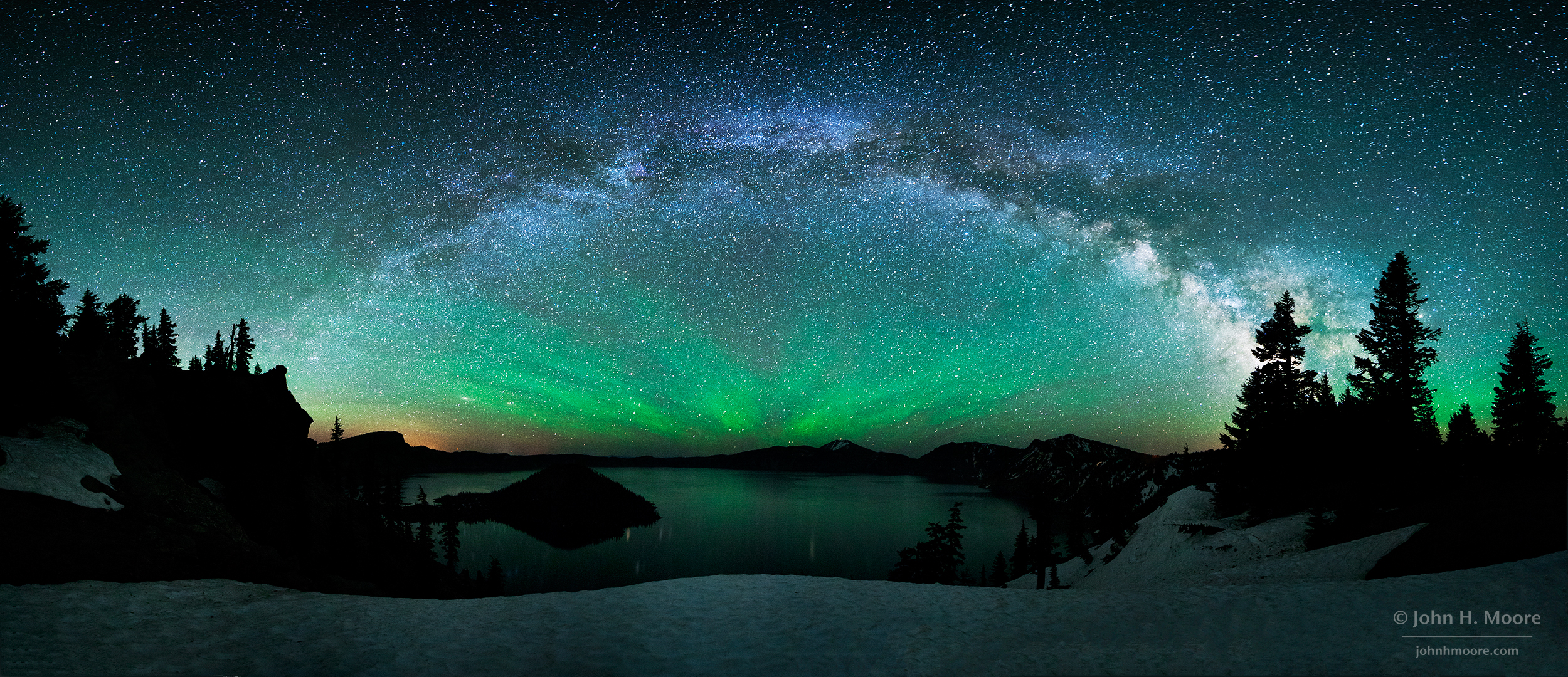
Milky Way Over Crater Lake with Airglow 
Image Credit & Copyright: 
John H. Moore; Annotation: Judy Schmidt
Explanation: How many different astronomical phenomena have come together to create the above vista? Several. First, in the foreground, is Crater Lake -- a caldera created by volcanism on planet Earth about 7,700 years ago. Next, inside the lake, is water. Although the origin of the water in the crater is melted snowfall, the origin of water on Earth more generally is unclear, but possibly related to ancient Earthly-impacts of icy bodies. Next, the green glow in the sky is airglow, light emitted by atoms high in the Earth's atmosphere as they recombine at night after being separated during the day by energetic sunlight. The many points of light in the sky are stars, glowing by nuclear fusion. They are far above the atmosphere but nearby to our Sun in the Milky Way Galaxy. Finally, the bright arch across the image is the central band of the Milky Way, much further away, on the average, than the nearby stars, and shaped mostly by gravity. Contrary to appearances, the Milky Way band glows by itself and is not illuminated by the airglow. The above image is a six-frame panorama taken during about two weeks ago in Oregon, USA.


Explanation: For the first time, the entire surface of planet Mercury has been mapped. Detailed observations of the innermost planet's surprising crust have been ongoing since the robotic MESSENGER spacecraft first passed Mercury in 2008 and began orbiting in 2011. Previously, much of the Mercury's surface was unknown as it is too far for Earth-bound telescopes to see clearly, while the Mariner 10flybys in the 1970s observed only about half. The above video is a compilation of thousands of images of Mercury rendered in exaggerated colors to better contrast different surface features. Visible on therotating world are rays emanating from a northern impact that stretch across much of the planet, while about half-way through the video the light colored Caloris Basin rotates into view, a northern ancient impact feature that filled with lava. MESSENGER has now successfully completed its primary and first extended missions.


Video:  Flowing Auroras Over Norway  http://apod.nasa.gov/apod/ap130609.html
Image Credit & 
Copyright: Tor Even Mathisen; Music: Per Wollen; Vocals: Silje Beate Nilssen
Explanation: Have you ever seen an aurora? Auroras are occurring again with increasing frequency. With the Sun peaking at its eleven year maximum in aurora-triggering activity, it is exhibiting a greater abundance of sunspots, flares, and coronal mass ejections. Solar activity like this typically expels charged particles into the Solar System, some of which impact Earth's magnetosphere and trigger Earthly auroras. In late 2010, the above timelapse displays of picturesque auroras were captured above Tromsø, Norway. Curtains of auroral light, usually green, flow, shimmer and dance as energetic particles fall toward the Earth and excite atoms of air high up in the Earth's atmosphere. There may even be opportunities to see auroras tonight, as recent solar explosions have triggered numerous aurora sightings over the past few days.


Video:  Circling a Black Hole at its Photon Sphere http://apod.nasa.gov/apod/ap130702.html
Image Credit & Copyright: 
Robert Nemiroff (MTU)
Explanation: What would it look like to go right up to a black hole? One particularly interesting place near a black hole is its photon sphere, where photons can orbit in circles, a sphere 50 percent further out than the event horizon. Were you to look out from the photon sphere of a black hole, half of the sky would appear completely black, half of the sky would appear unusually bright, and the back of your head would appear across the middle. The above computer-animated video depicts this view from the photon sphere. The reason that the lower region, as shown, appears black is because all light paths from this dark region comes up from the black hole -- which classically emits no light. The upper half of the sky now appears unusually bright, blueshifted, and shows increasingly many complete sky images increasingly close to the dark-light divide across the middle. That dark-light divide is the photon sphere -- your location -- and since photons can do circles there, light from the back of your head can circle the black hole and come to your eye. No place on the sky is hidden from you -- stars that would normally pass behind the black hole now appear to zip quickly around an Einstein ring, a ring that appears above as a horizontal line about a quarter of the way down from the video top. The above video is part of a sequence of videos visually exploring the space near a black hole's event horizon. (Disclosure: Video creator Robert Nemiroff is an editor for APOD.)


Video:  Orbiting a Black Hole  http://apod.nasa.gov/apod/ap130701.html
Image Credit & Copyright: 
Robert Nemiroff (MTU)
Explanation: What would it look like to orbit a black hole? Since the strong gravity of the black hole can significantly alter light paths, conditions would indeed look strange. For one thing, the entire sky would be visible, since even stars behind the black hole would have their light bent to the observer's eye. For another, the sky near the black hole would appear significantly distorted, with more and more images of the entire sky visible increasingly near the black hole. Most visually striking, perhaps, is the outermost sky image completely contained inside an easily discernible circle known as the Einstein ring. Orbiting a black hole, as shown in the above scientifically-accurate computer-created illustrative video, will show stars that pass nearly directly behind the black hole as zipping around rapidly near the Einstein ring. Although star images near the Einstein ring may appear to move faster than light, no star is actually moving that quickly. The above video is part of a sequence of videos visually exploring the space near a black hole's event horizon. (Disclosure: Video creator Robert Nemiroff is an editor for APOD.)


Video:  Star Size Comparisons http://apod.nasa.gov/apod/ap130606.html
Video Credit & Copyright: 
morn1415 (YouTube)
Explanation: How big is our Sun compared to other stars? In a dramatic and popular video featured on YouTube, the relative sizes of planets and stars are shown from smallest to largest. The above video starts with Earth's Moon and progresses through increasingly larger planets in our Solar System. Next, the Sun is shown along as compared to many of the brighter stars in our neighborhood of theMilky Way Galaxy. Finally, some of the largest stars known spin into view. Note that the true sizes of most stars outside of the Sun and Betelgeuse are not known by direct observation, but rather inferred by measurements of their perceived brightness, temperature, and distance. Although an inspiring learning tool that is mostly accurate, APOD readers are encouraged to complete the learning experience -- and possibly help make future versions more accurate -- by pointing out slight inaccuracies in the video.


Video:  A Supercell Thunderstorm Over Texas http://apod.nasa.gov/apod/ap130618.html
Video Credit & Copyright: 
Mike Olbinski; Music: Impact Lento (Kevin MacLeod, Incompetech)
Explanation: Is that a cloud or an alien spaceship? It's an unusual and sometimes dangerous type of thunderstorm cloud called a supercell. Supercells may spawn damaging tornados, hail, downbursts of air, or drenching rain. Or they may just look impressive. A supercell harbors a mesocyclone -- a rising column of air surrounded by drafts of falling air. Supercells could occur over many places on Earth but are particularly common in Tornado Alley of the USA. Pictured above are four time lapse sequences of a supercell rotating above and moving across Booker, Texas. Captured in the video are new clouds forming near the storm center, dust swirling on the ground, lightning flashing in the upper clouds, all while the impressively sculptured complex rotates ominously. Finally, after a few hours, as shown in the final sequence, dense rain falls as the storm begins to die out.
2013 June 11 

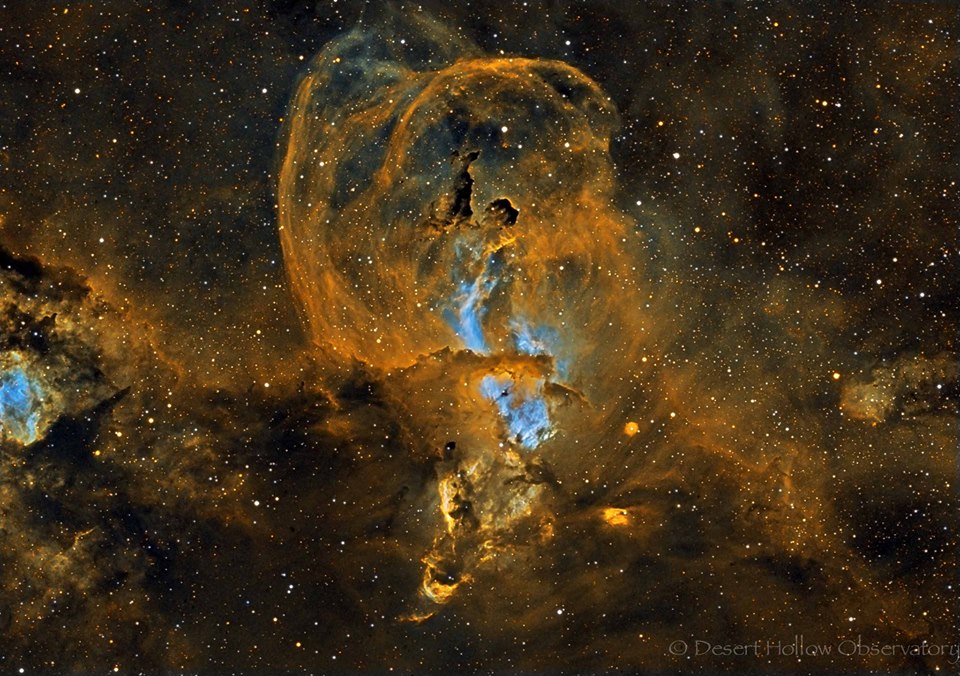
Star Forming Region NGC 3582 
Image Credit & Copyright: 
Desert Hollow Observatory
Explanation: What's happening in the NGC 3582 nebula? Bright stars and interesting molecules are forming. The complex nebula resides in the star forming region called RCW 57. Visible in this imageare dense knots of dark interstellar dust, bright stars that have formed in the past few million years, fields of glowing hydrogen gas ionized by these stars, and great loops of gas expelled by dying stars. Adetailed study of NGC 3582, also known as NGC 3584 and NGC 3576, uncovered at least 33 massive stars in the end stages of formation, and the clear presence of the complex carbon molecules known as polycyclic aromatic hydrocarbons (PAHs). PAHs are thought to be created in the cooling gas of star forming regions, and their development in the Sun's formation nebula five billion years ago may have been an important step in the development of life on Earth. The above image was taken at the Desert Hollow Observatory north of Phoenix, Arizona, USA.


Dry Ice Sled Streaks on Mars 
Image Credit: 
HiRISE, MRO, LPL (U. Arizona), NASA
Explanation: What creates these long and nearly straight grooves on Mars? Dubbed linear gullies, they appear on the sides of some sandy slopes during Martian spring, have nearly constant width, extend for as long as two kilometers, and have raised banks along their sides. Unlike most water flows, they do not appear to have areas of dried debris at the downhill end. A leading hypothesis -- actually being tested here on Earth -- is that these linear gullies are caused by chunks of carbon dioxide ice (dry ice) breaking off and sliding down hills while sublimating into gas, eventually completely evaporating into thin air. If true, these natural dry-ice sleds may well provide future adventurers a smooth ride on cushions of escaping carbon dioxide. The above recently-released image was taken in 2006 by the HiRISEcamera on board the NASA's Mars Reconnaissance Orbiter currently orbiting Mars.


Astronomy News:

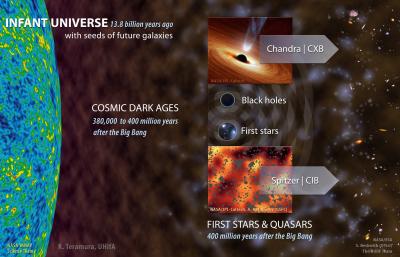
NASA Chandra, Spitzer study suggests black holes abundant among the earliest stars

Published: Wednesday, June 5, 2013 - 20:03 in Astronomy & Space
Karen Teramura, UHIfA

By comparing infrared and X-ray background signals across the same stretch of sky, an international team of astronomers has discovered evidence of a significant number of black holes that accompanied the first stars in the universe. Using data from NASA's Chandra X-ray Observatory and NASA's Spitzer Space Telescope, which observes in the infrared, researchers have concluded one of every five sources contributing to the infrared signal is a black hole.
"Our results indicate black holes are responsible for at least 20 percent of the cosmic infrared background, which indicates intense activity from black holes feeding on gas during the epoch of the first stars," said Alexander Kashlinsky, an astrophysicist at NASA's Goddard Space Flight Center in Greenbelt, Md.
The cosmic infrared background (CIB) is the collective light from an epoch when structure first emerged in the universe. Astronomers think it arose from clusters of massive suns in the universe's first stellar generations, as well as black holes, which produce vast amounts of energy as they accumulate gas.
Even the most powerful telescopes cannot see the most distant stars and black holes as individual sources. But their combined glow, traveling across billions of light-years, allows astronomers to begin deciphering the relative contributions of the first generation of stars and black holes in the young cosmos. This was at a time when dwarf galaxies assembled, merged and grew into majestic objects like our own Milky Way galaxy.
"We wanted to understand the nature of the sources in this era in more detail, so I suggested examining Chandra data to explore the possibility of X-ray emission associated with the lumpy glow of the CIB," said Guenther Hasinger, director of the Institute for Astronomy at the University of Hawaii in Honolulu, and a member of the study team.
Hasinger discussed the findings Tuesday at the 222nd meeting of the American Astronomical Society in Indianapolis. A paper describing the study was published in the May 20 issue of The Astrophysical Journal.
The work began in 2005, when Kashlinsky and his colleagues studying Spitzer observations first saw hints of a remnant glow. The glow became more obvious in further Spitzer studies by the same team in 2007 and 2012. The 2012 investigation examined a region known as the Extended Groth Strip, a single well-studied slice of sky in the constellation Bootes. In all cases, when the scientists carefully subtracted all known stars and galaxies from the data, what remained was a faint, irregular glow. There is no direct evidence this glow is extremely distant, but telltale characteristics lead researchers to conclude it represents the CIB.
In 2007, Chandra took especially deep exposures of the Extended Groth Strip as part of a multiwavelength survey. Along a strip of sky slightly larger than the full moon, the deepest Chandra observations overlap with the deepest Spitzer observations. Using Chandra observations, lead researcher Nico Cappelluti, an astronomer with the National Institute of Astrophysics in Bologna, Italy, produced X-ray maps with all of the known sources removed in three wavelength bands. The result, paralleling the Spitzer studies, was a faint, diffuse X-ray glow that constitutes the cosmic X-ray background (CXB).
Comparing these maps allowed the team to determine whether the irregularities of both backgrounds fluctuated independently or in concert. Their detailed study indicates fluctuations at the lowest X-ray energies are consistent with those in the infrared maps.
"This measurement took us some five years to complete and the results came as a great surprise to us," said Cappelluti, who also is affiliated with the University of Maryland, Baltimore County in Baltimore.
The process is similar to standing in Los Angeles while looking for signs of fireworks in New York. The individual pyrotechnics would be too faint to see, but removing all intervening light sources would allow the detection of some unresolved light. Detecting smoke would strengthen the conclusion at least part of this signal came from fireworks.
In the case of the CIB and CXB maps, portions of both infrared and X-ray light seem to come from the same regions of the sky. The team reports black holes are the only plausible sources that can produce both energies at the intensities required. Regular star-forming galaxies, even those that vigorously form stars, cannot do this.
By teasing out additional information from this background light, the astronomers are providing the first census of sources at the dawn of structure in the universe.
"This is an exciting and surprising result that may provide a first look into the era of initial galaxy formation in the universe," said another contributor to the study, Harvey Moseley, a senior astrophysicist at Goddard. "It is essential that we continue this work and confirm it."

Source: NASA/Goddard Space Flight Center


General Calendar:

Colloquia, Lectures, Seminars, Meetings, Open Houses & Tours:


Colloquia:  Carnegie (Tues. 4pm), UCLA, Caltech (Wed. 4pm), IPAC (Wed. 12:15pm) & other Pasadena (daily 12-4pm):  http://obs.carnegiescience.edu/seminars/ 

Carnegie astronomy lectures – only 4 per year in the Spring www.obs.carnegiescience.edu.  Visit www.huntington.org for directions.  For more information about the Carnegie Observatories or this lecture series, please contact Reed Haynie.

8 July
Griffith Observatory
Event Horizon Theater
8:00 PM to 10:00 PM

12 July
SBAS Monthly General Meeting at El Camino College planetarium. 7:30 PM
Topic: “Sounds of the Universe: Acoustic Astronomy”
Speaker: Dr. Fiorella Terenzi, Florida International University
Jul. 18 & 19  The von Kármán Lecture Series: 2013

Exploring the Extreme Universe with NuSTAR

The Nuclear Spectroscopic Telescope Array, or NuSTAR, launched on June 13, 2012, and is the first telescope to focus high energy X-ray light. Compared to the previous generation of non-focusing observatories working in this energy band, this change in technology provides NuSTAR with 10x sharper images and 100x improved sensitivity. High energy X-ray light provides a unique probe of the most energetic phenomena in the universe, from flares on the surface of the Sun, to the explosions of stars, to the extreme environments around neutron stars and black holes. This talk will present some of the highlights from the first year of NuSTAR observations and describe how they are changing our picture of the extreme universe.

Speaker:
Dr. Daniel Stern, NuSTAR Project Scientist
Jet Propulsion Laboratory

Locations:
Thursday, July 18, 2013, 7pm
The von Kármán Auditorium
at JPL
4800 Oak Grove Drive
Pasadena, CA
› Directions

Friday, July 19, 2013, 7pm
The Vosloh Forum at Pasadena City College
1570 East Colorado Blvd.
Pasadena, CA
› Directions
Webcast:
We offer two options to view the live streaming of our webcast on Thursday:
› 1) Ustream with real-time web chat to take public questions.
› 2)
Flash Player with open captioning
If you don't have Flash Player, you can download for free
here.


18 July 2013
Club Meeting


A1/1735


Observing:
The following data are from the 2013 Observer’s Handbook, and Sky & Telescope’s 2013 Skygazer’s Almanac & monthly Sky at a Glance.

A weekly 5 minute video about what’s up in the night sky:  www.skyandtelescope.com/skyweek.

Sun, Moon & Planets for July:

Moon: July 8 new, July 16 1st quarter, July 22 full, July 29 last quarter                   
PlanetsMercury is near greatest western elongation, visible before dawn after July 20.  Venus is in the West evening sky. Jupiter reappears low in the ENE dawn twilight early in the month. Saturn is in the western evening sky, setting after midnight.  Mars is low in the ENE dawn twilight. 
Other Events:

6 July
SBAS out-of-town observing – contact Greg Benecke http://www.sbastro.net/.  

6 July
LAAS Dark Sky Night : Lockwood Valley (Steve Kufeld Astronomical Site; LAAS members and their guests only)

13 July
Public  Star Party: Griffith Observatory Grounds 2-10pm

21 July  Moon at perigee, large tides.

22 July  Mars 0.8 deg. North of Jupiter

27 July
SBAS Star Party (weather permitting): RPV at Ridgecrest Middle School 28915 North Bay Rd.

28/29 July Southern Delta Aquarids Meteor Shower Peak
The duration of the southern Delta Aquarid meteor shower covers the period of July 14 to
August 18. Maximum currently occurs on July 29/30 (λ=125°), from an average radiant of
RA=339°, DEC=-17°. The maximum hourly rate typically reaches 15-20.

30 July Mercury greatest elongation West (20 deg.)

Internet Links:

Link(s) of the Month

A weekly 5 minute video about what’s up in the night sky:  www.skyandtelescope.com/skyweek.

Telescope, Binocular & Accessory Buying Guides


General

Regional (esp. Southern California)


About the Club

Club Websites:  Internal (Aerospace): https://aeropedia.aero.org/aeropedia/index.php/Astronomy_Club  It is updated to reflect this newsletter, in addition to a listing of past club mtg. presentations, astronomy news, photos & events from prior newsletters, club equipment, membership & constitution.  We have linked some presentation materials from past mtgs.  Our club newsletters are also being posted to an external blog, “An Astronomical View” http://astronomicalview.blogspot.com/

 
Membership.  For information, current dues & application, contact Alan Olson, or see the club website (or Aerolink folder) where a form is also available (go to the membership link/folder & look at the bottom).  Benefits will include use of club telescope(s) & library/software, discounts on Sky & Telescope magazine and Observer’s Handbook, field trips, great programs, having a say in club activities, acquisitions & elections, etc.

Committee Suggestions & Volunteers.  Feel free to contact:  Mark Clayson, Program Committee Chairman (& acting club VP), TBD, Activities Committee Chairman (& club Secretary), or Alan Olson, Resource Committee Chairman (over equipment & library, and club Treasurer).

Mark Clayson,
AEA Astronomy Club President 

Friday, June 7, 2013

2013 June

AEA Astronomy Club Newsletter June 2013

Contents
AEA Astronomy Club News & Calendar p.1
Video(s) & Picture(s) of the Month p. 2
Astronomy News p. 5
General Calendar p.6
    Colloquia, lectures, mtgs. p. 6
    Observing p. 8
Useful Links p. 9

About the Club p. 10

Club News & Calendar.

Calendar

Club Meeting Schedule:

20 June 2013
Club Meeting & Pizza Party
The Chemical Makeup of Exosolar Planets
Dr. Steven Naftilan, Claremont College
A1/1735

AEA Astronomy Club meetings are on 3rd Thursdays at 11:45am.  For all of 2013, the meeting room is A1/1735.

June 20 Pizza Party!  Place your order by Mon., June 17 – free for members, $5 for others.  Must RSVP with preferences -- give 1st & 2nd choices when you RSVP by June 17 (see below).   We’ll have to share pizzas so you may not get your first choice – hopefully at least your 2nd.

Menu options for June 20 lunch:
           
Pizzas:
Three Cheese Pizza
Margherita Pizza with Fresh Basil, Tomato and Mozzarella
The Works Pizza (sausage, pepperoni, mushrooms, onions, peppers, olives, mozzarella, oregano)
Grilled Vegetable Pizza (spinach, artichokes, zucchini, mushrooms, peppers, cheeses)
Barbecued Chicken Pizza

Custom Pizza (choose topping(s) from:  sausage, pepperoni, ham, black olives, pineapple, tomatoes, mushrooms, onions,   eggplant, peppers, jalapenos, garlic;  ideas:  Aloha Pizza (ham & pineapple), Pepperoni Pizza, Fresh Tomato and Pesto Pizza, Sausage and Onion Pizza

Drinks:
Bottled Juice
Bottled Water
Bottled Soda
Carton of Milk
Canned Soda
Icewater


News:  

Equipment.  The current Meade ETX-90 delivery date is June 24.

The RTMC Astronomy Expo Alan Olson & David Wright & their families attended.  They took the 10-inch,16-inch & giant binoculars.  I did hear that David won a door prize – a 10-inch Dobsonian, so there are various benefits in attending. 

Alan Olson’s report:

“I was at the RTMC for both Saturday and Sunday nights.  I had the club's 16-inch Dobsonian with me.  To be blunt, conditions were poor.  The most obvious problem was a near-full moon that came up within a few hours of sunset.  On top of that was just poor atmospheric conditions.  As moonrise drew near, light streaks began to appear in the sky, becoming steadily more numerous and brighter as the moon neared the horizon.  When the moon finally rose it brightly lit up these high clouds like some crazy spiderweb, very pretty in its own right, but not what I came to see.

“One of the coolest things I saw was Venus, Jupiter, and Mercury making a nice triangle above the western horizon just after sunset on Sunday.  But as one of those present noted, the fact that Venus was obviously twinkling was a harbinger of poor viewing conditions.  Other things I saw:

  - Saturn, extremely bright (a "retina burner" in the words of one viewer) in the 16-inch.  Easily able to pick out 4 moons without averted vision.

  - Comet PANSTARRS (i.e., C/2011 L4), beautiful, with a tail that stretched the width of the eyepiece field of view (1.5 degrees) and beyond.  I saw this through several other scopes and the 16-inch had the best view by far.  Apparently, aperture matters.  See the fun story about this comet below.

  - M51, spiral galaxy, arms clearly visible

  - M13, cluster, stars resolvable almost to core

  - M81 and M82 (in same field of view), galaxies, spiral structure of M81 clearly visible

  - M104, Sombrero galaxy, the famous dust lane clearly visible.  When switching to a smaller eyepiece (from 38mm to 26mm) one person reported being able to see detail in the dust lane.  I couldn't, but the person reporting this also claimed to be able to see PANSTARRS (magnitude 8+) unaided, so make of that what you will.

“So how did I like the 16-inch?  Again, to be blunt, I found it a little frustrating.  Most of the time I used my 2-inch 38mm Orion Q70 eyepiece, which on my telescope at home would have a 2.3 degree field of view, but on the 16-inch had only 1.5 degrees.  Also at home I have a finder scope with a 5 degree field of view, whereas the 16-inch has only a red dot finder.  This reduced field of view made star-hopping a little more challenging, and because the 16-inch sees far more stars than my 8-inch and they are far brighter (dark skies are also to "blame" here) I had a hard time recognizing the stars I was looking for.

“As an example, my son wanted to see his favorite object, M57.  M57 is normally easy to find even in LA - start at Vega, trace through the stars of Lyra, and M57 lies between Sulafat and Sheilak on the side of Lyra opposite Vega.  On Sunday night M57 was just above the horizon in the northeast shortly after sunset.  Vega was easy to find, and I soon found the double-double, and I worked out Zeta1/2 Lyrae largely on the basis of it being a double star in the correct spot in relation to Vega and the double-double.  Delta2 Lyrae was recognizable by the nearby open cluster.  The separation between these stars is only slightly larger than the field of view of my eyepiece, but Sulafat and Sheilak are at least two eyepiece widths away, and while at home I'm used to there being no bright stars in this area to distract me, I found with the 16-inch the eyepiece was constantly full of stars and the magnitude 3ish stars I was looking for didn't stand out the way I expected.  I managed to find Sheilak, but was never sure about Sulafat (which, to be fair, was just above the trees), nor did I locate M57 until it got dark enough and Lyra got high enough that I was able to locate Sulafat and Sheilak visually and could then put the red dot right where I knew M57 should be.  Later, when an experienced individual asked to try out the scope he was able to find many of the above objects on his first try by simply placing the red dot in the spot where he knew they must be in relation to the visible stars.

“A final, (perhaps) interesting anecdote.  At the general meeting on Sunday the speakers pointed out PANSTARRS was visible in the sky near Polaris and urged those present to take a look.  Later, around sunset, I was standing with a group of graybeards (literally!) and the topic of PANSTARRS came up.  Several of those present said that they were planning on looking for it, but "near Polaris" was pretty vague.  I pulled out my iPad, fired up SkySafari, and quickly had a list of PANSTARRS comets (there are 20 or so) and soon found one in Draco that had the right magnitude.  I showed several people the location, and got some polite nods in reply.  I was struck by the fact that nobody else had any such device.  One guy was trying to look it up on the web with his phone, but given the poor service at the camp, wasn't having much luck.  I wandered off, and came back later after I had found PANSTARRS to see if they had had any luck and to compare views.  Nobody had found it.  "Near Polaris" wasn't good enough.  I pulled out my iPad again and showed them that at that time, it was about 5 degrees to the right of Polaris (one guy argued with me that no, in fact it was only 3 fingers to the right of Polaris and proceeded to give me a detailed formula for converting fingers to degrees).  With that, everyone was able to quickly locate the comet.  Again, nobody had any tools to help them find the comet.  Of course, any of these guys could locate just about any other object in the sky in the time it would take me to look it up on the iPad, but I found the lack of interest in new tools interesting.”

[Yes, many older “purist” graybeards have not yet adopted the newer finder apps.   I note that we have a smartphone adapter for the new giant binoculars to facilitate use of sky apps in pointing and identifying.  Of course their FOV is even greater (4.4 deg), and star-hopping is even easier w. smaller limiting magnitude.  A great tool for novices, or for extended Milky Way regions.  And of course the 3 Meade instruments (10-inch, 80 and 90 mm) are GoTo, and the 8-inch Dobs is computer-guided, making finding easier.  So the 16-inch seems to be an instrument for the serious observer looking for faint, deep-sky objects.  Another observation:  don’t expect better observing than the moon and weather forecast will allow.]

Field Trip.  There have been few responses so far on the survey of interests in candidate club field trips for the year.  Unless additional responses come in, we will probably table it for now. Ideas include:  Mt. Palomar tour & star party/camping, JPL tour (or open house in June), Griffith Observatory, Calif. Science Museum (incl. Endeavor, IMAX,...), the Columbia Memorial Space Center in Downey (Apollo & Shuttle history),.... Other suggestions?

Membership Renewals.  Some still need to renew their club membership.  See the club website for the many benefits of membership.  Please submit the renewal form (available on Aerolink at https://aerolink.aero.org/cs/llisapi.dll?func=ll&objId=13659520&objAction=browse&viewType=1, or attached) with your payment ($12 check made out to AEA Astronomy Club) to Alan Olson at M1-107.


Astronomy Video(s) & Picture(s) of the Month
(from Astronomy Picture of the Day, APOD: http://apod.nasa.gov/apod/archivepix.html)

2013 International Earth & Sky Photo Contest winners video:  http://vimeo.com/65960743


Video:  Galaxy Collisions: Simulation vs Observations http://apod.nasa.gov/apod/ap130514.html
Images Credit:
NASA, ESA; Visualization: Frank Summers (STScI); Simulation: Chris Mihos (CWRU) & Lars Hernquist (Harvard).
Explanation: What happens when two galaxies collide? Although it may take over a billion years, such titanic clashes are quite common. Since galaxies are mostly empty space, no internal stars are likely to themselves collide. Rather the gravitation of each galaxy will distort or destroy the other galaxy, and the galaxies may eventually merge to form a single larger galaxy. Expansive gas and dust clouds collide and trigger waves of star formation that complete even during the interaction process. Pictured above is a computer simulation of two large spiral galaxies colliding, interspersed with real still images taken by the Hubble Space Telescope. Our own Milky Way Galaxy has absorbed several smaller galaxies during its existence and is even projected to merge with the larger neighboring Andromeda galaxy in a few billion years.

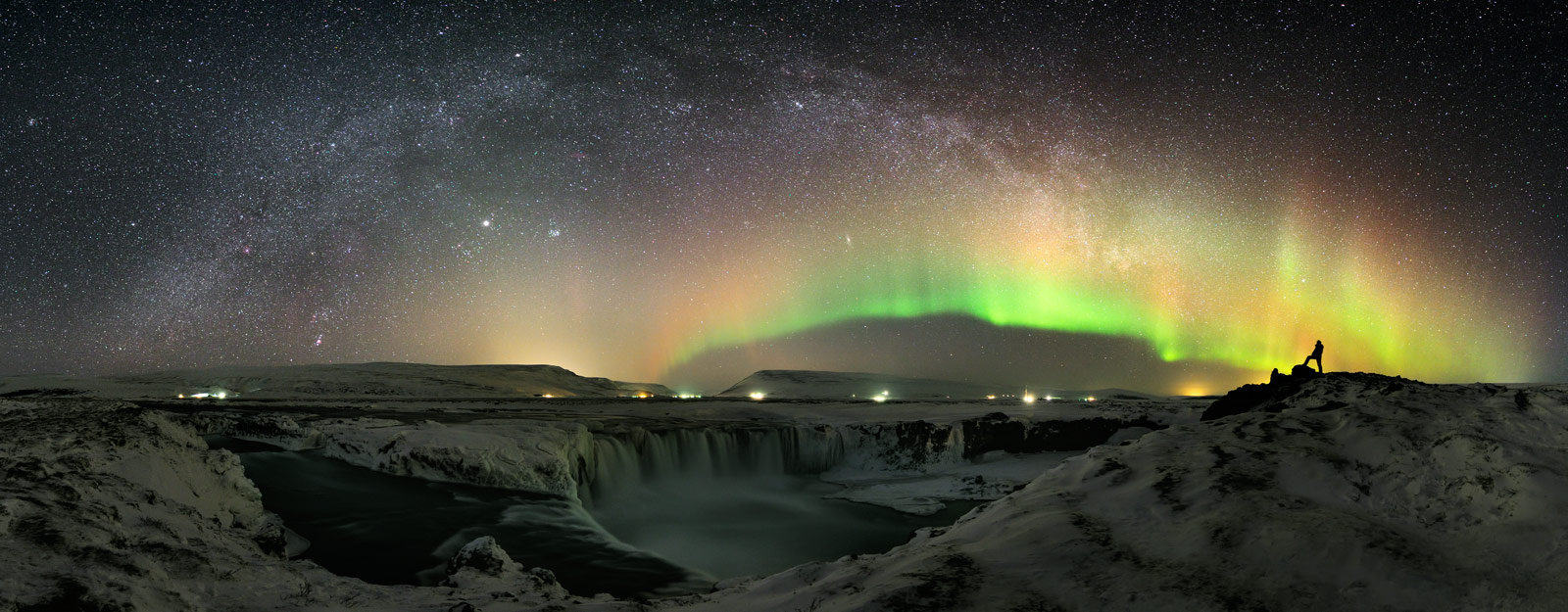
The Waterfall and the World at Night
Image Credit &
Copyright: Stéphane Vetter (Nuits sacrées)
Explanation: Above this boreal landscape, the arc of the Milky Way and shimmering aurorae flow through the night. Like an echo, below them lies Iceland's spectacular Godafoss, the Waterfall of the Gods. Shining just below the Milky Way, bright Jupiter is included in the panoramic nightscape recorded on March 9. Faint and diffuse, the Andromeda Galaxy (M31) appears immersed in the auroral glow. The digital stitch of four frames is a first place winner in the 2013 International Earth and Sky Photo Contest on Dark Skies Importance organized by The World at Night. An evocative record of the beauty of planet Earth's night sky, all the contest's winning entries are featured in this video.


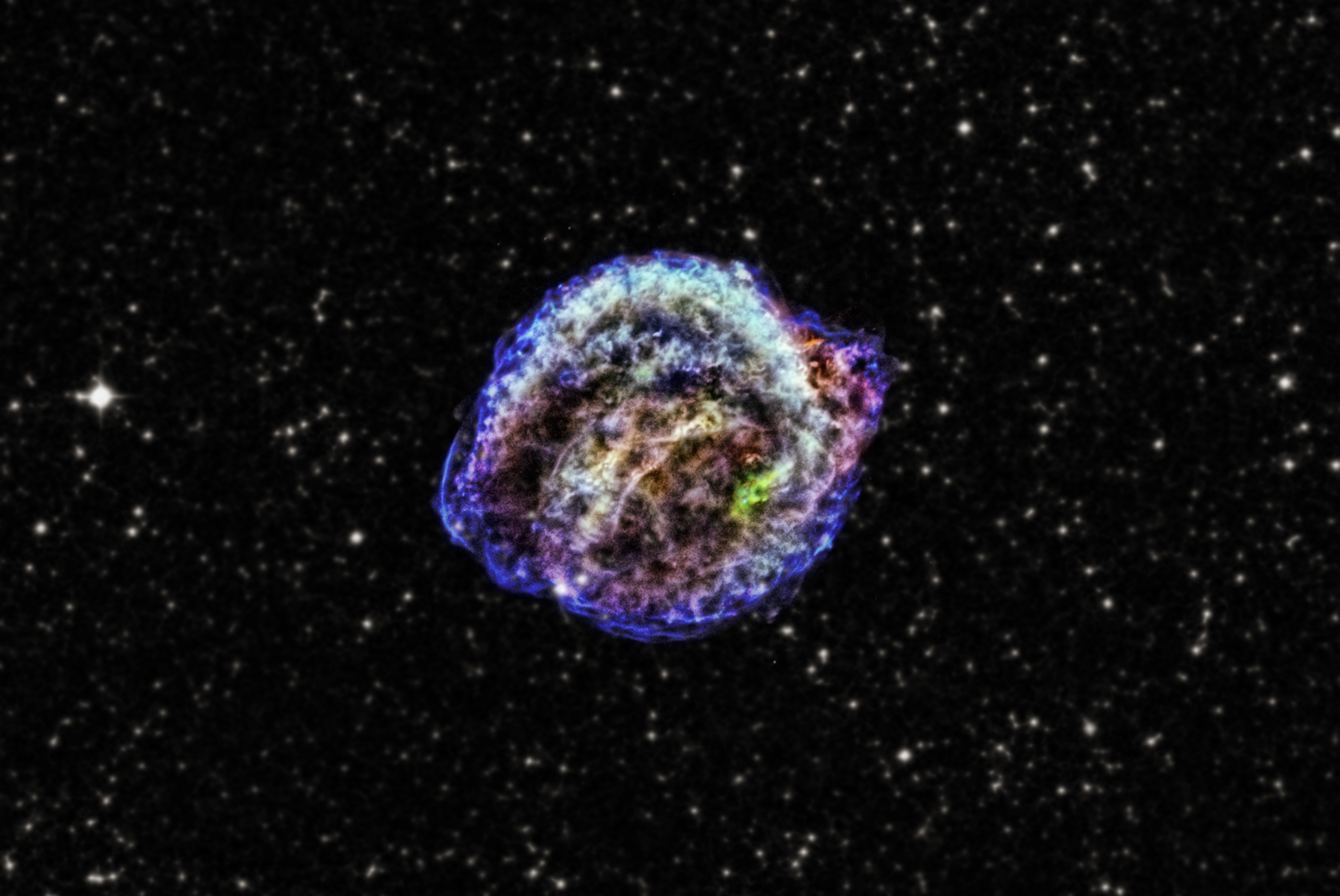
Kepler's Supernova Remnant in X-Rays
Image Credit: X-ray:
NASA/CXC/NCSU/M. Burkey et al. Optical: DSS
Explanation: What caused this mess? Some type of star exploded to create the unusually shaped nebula known as Kepler's supernova remnant, but which type? Light from the stellar explosion that created this energized cosmic cloud was first seen on planet Earth in October 1604, a mere four hundred years ago. The supernova produced a bright new star in early 17th century skies within the constellation Ophiuchus. It was studied by astronomer Johannes Kepler and his contemporaries, without the benefit of a telescope, as they searched for an explanation of the heavenly apparition. Armed with a modern understanding of stellar evolution, early 21st century astronomers continue to explore the expanding debris cloud, but can now use orbiting space telescopes to survey Kepler's supernova remnant (SNR) across the spectrum. Recent X-ray data and images of Kepler's supernova remnant taken by the orbiting Chandra X-ray Observatory has shown relative elemental abundances typical of a Type Ia supernova, and further indicated that the progenitor was a white dwarf star that exploded when it accreted too much material from a companion Red Giant star and went over Chandrasekhar's limit. About 13,000 light years away, Kepler's supernova represents the most recent stellar explosion seen to occur within our Milky Way galaxy.

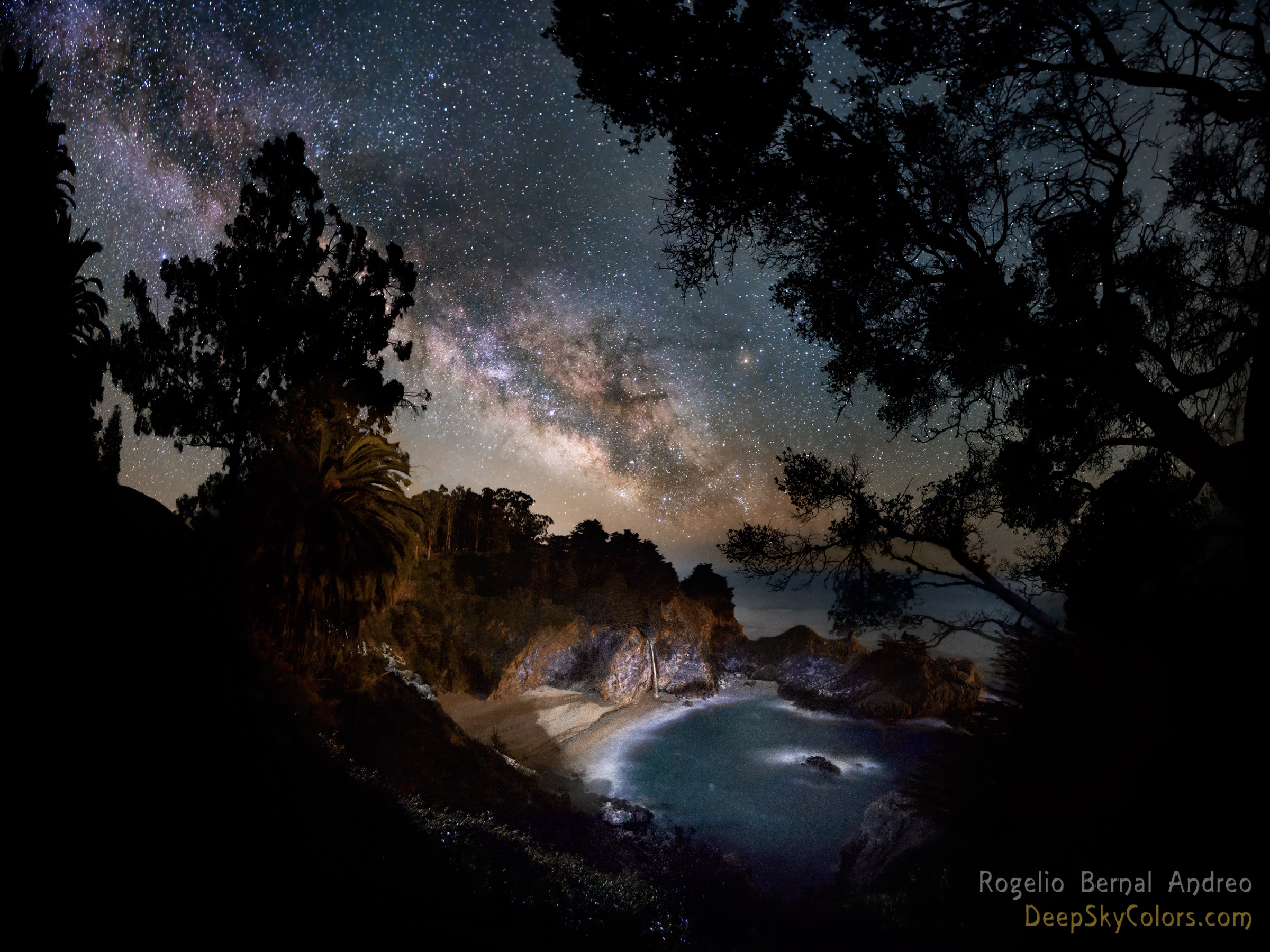
Galaxy Cove Vista
Image Credit & Copyright:
Rogelio Bernal Andreo (Deep Sky Colors)
Explanation: To see a vista like this takes patience, hiking, and a camera. Patience was needed in searching out just the right place and waiting for just the right time. A short hike was needed to reach this rugged perch above a secluded cove in Julia Pfeiffer Burns State Park in California, USA. And a camera was needed for the long exposure required to bring out the faint light from stars and nebulae in the background Milky Way galaxy. Moonlight and a brief artificial flash illuminated the hidden beach and inlet behind nearby trees in the above composite image taken about two weeks ago. Usually obscured McWay Falls is visible just below the image center, while the Pacific Ocean is in view to its right.


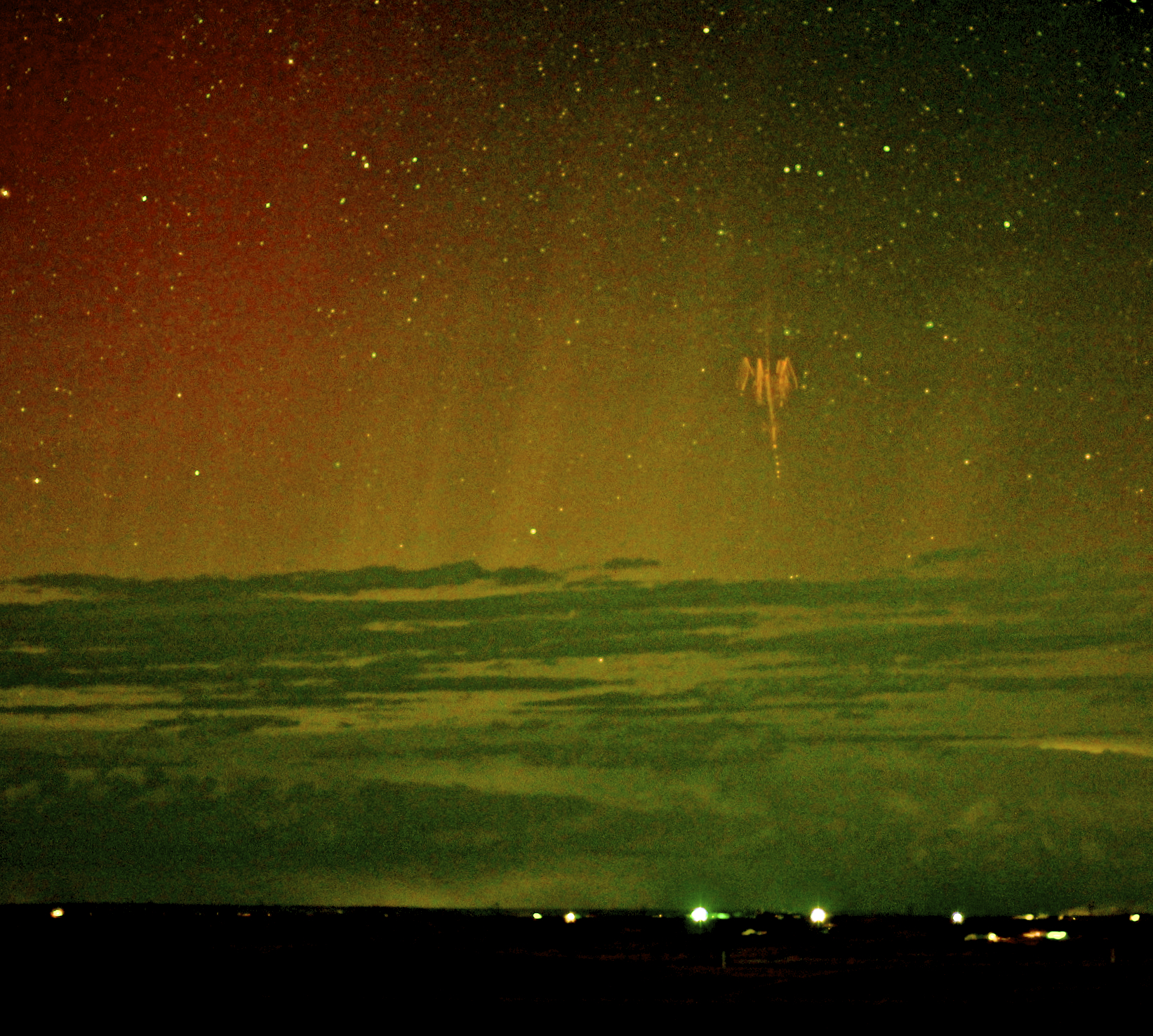
Red Sprite Lightning with Aurora
Image Credit & Copyright:
Walter Lyons (FMA Research), WeatherVideoHD.TV
Explanation: What's that in the sky? It is a rarely seen form of lightning confirmed only about 25 years ago: a red sprite. Recent research has shown that following a powerful positive cloud-to-ground lightning strike, red sprites may start as 100-meter balls of ionized air that shoot down from about 80-km high at 10 percent the speed of light and are quickly followed by a group of upward streaking ionized balls. The above image, taken a few days ago above central South Dakota, USA, captured a bright red sprite, and is a candidate for the first color image ever recorded of a sprite and aurora together. Distant storm clouds cross the bottom of the image, while streaks of colorful aurora are visible in the background. Red sprites take only a fraction of a second to occur and are best seen when powerful thunderstorms are visible from the side.

Astronomy News:

Fragile mega-galaxy is missing link in history of cosmos

Published: Wednesday, May 22, 2013 - 13:00 in Astronomy & Space

Two hungry young galaxies that collided 11 billion years ago are rapidly forming a massive galaxy about 10 times the size of the Milky Way, according to UC Irvine-led research published Wednesday in the journal Nature. Capturing the creation of this type of large, short-lived star body is extremely rare -- the equivalent of discovering a missing link between winged dinosaurs and early birds, said the scientists, who relied on the once-powerful Herschel space telescope and observatories around the world. The new mega-galaxy, dubbed HXMM01, "is the brightest, most luminous and most gas-rich submillimeter-bright galaxy merger known," the authors write.

HXMM01 is fading away as fast as it forms, a victim of its own cataclysmic birth. As the two parent galaxies smashed together, they gobbled up huge amounts of hydrogen, emptying that corner of the universe of the star-making gas.

"These galaxies entered a feeding frenzy that would quickly exhaust the food supply in the following hundreds of million years and lead to the new galaxy's slow starvation for the rest of its life," said lead author Hai Fu, a UC Irvine postdoctoral scholar.

The discovery solves a riddle in understanding how giant elliptical galaxies developed quickly in the early universe and why they stopped producing stars soon after. Other astronomers have theorized that giant black holes in the heart of the galaxies blew strong winds that expelled the gas. But cosmologist Asantha Cooray, the UC Irvine team's leader, said that they and colleagues across the globe found definitive proof that cosmic mergers and the resulting highly efficient consumption of gas for stars are causing the quick burnout.

"Finding this type of galaxy is as important as the discovery of the archaeopteryx was in understanding dinosaurs' evolution into birds, because they were both caught at a critical transitional phase," Fu said.
The new galaxy was initially spotted by UC Irvine postdoctoral scholar Julie Wardlow, also with Cooray's group. She noticed "an amazing, bright blob" in images of the so-called cold cosmos -- areas where gas and dust come together to form stars -- recorded by the European Space Agency's Herschel telescope with important contributions from NASA's Jet Propulsion Laboratory in Pasadena. "Herschel captured carpets of galaxies, and this one really stood out."

Follow-up views at a variety of wavelengths were obtained at more than a dozen ground-based observatories, particularly the W. M. Keck Observatory in Hawaii.

Source: University of California - Irvine


General Calendar:

Colloquia, Lectures, Seminars, Meetings, Open Houses & Tours:


Colloquia:  Carnegie (Tues. 4pm), UCLA, Caltech (Wed. 4pm), IPAC (Wed. 12:15pm) & other Pasadena (daily 12-4pm):  http://obs.carnegiescience.edu/seminars/ 

Carnegie astronomy lectures – only 4 per year in the Spring www.obs.carnegiescience.edu.  Visit www.huntington.org for directions.  For more information about the Carnegie Observatories or this lecture series, please contact Reed Haynie.

7 June
SBAS Monthly General Meeting at El Camino College planetarium. 7:30 PM
Topic: “The Sun,” Speaker: Dr. Steven Morris, SBAS and Los Angeles Harbor College

10 June
Griffith Observatory
Event Horizon Theater
8:00 PM to 10:00 PM

Jun. 20 & 21 The von Kármán Lecture Series: 2013

Forecasting Quakes: Facts, Myths and Possibilities

The recent news of Italian scientists convicted in a criminal court of failing to provide adequate warning of an impending earthquake has starkly highlighted some of the limitations and misunderstandings of the science behind earthquake forecasts and predictions. Are predictions even possible? What difference is there between a prediction and a forecast? What scientific principles allow (or rule out) useful earthquake forecasts? This talk will review the past history and basic principles behind efforts to anticipate the location, size and timing of seismic events. New techniques in data collection and improved understanding of how the Earth works is leading to ever-improving forecast capability, but will the "holy grail" of routine specific earthquake predictions ever be a reality? These questions will be explored and some thoughts about impending southern California quakes will be discussed.

Speaker:
Dr. Greg Lyzenga, Technical Staff, Solid Earth Group, Earth Sciences Section
Jet Propulsion Laboratory

Locations:
Thursday, June 20, 2013, 7pm
The von Kármán Auditorium
at JPL
4800 Oak Grove Drive
Pasadena, CA
› Directions

Friday, June 21, 2013, 7pm
The Vosloh Forum at Pasadena City College
1570 East Colorado Blvd.
Pasadena, CA
› Directions
Webcast:
We offer two options to view the live streaming of our webcast on Thursday:
› 1) Ustream with real-time web chat to take public questions.
› 2)
Flash Player with open captioning
If you don't have Flash Player, you can download for free
here.


20 June 2013
Club Meeting & Pizza Party
The Chemical Makeup of Exosolar Planets
Dr. Steven Naftilan, Claremont College
A1/1735


Observing:
The following data are from the 2013 Observer’s Handbook, and Sky & Telescope’s 2013 Skygazer’s Almanac & monthly Sky at a Glance.

A weekly 5 minute video about what’s up in the night sky:  www.skyandtelescope.com/skyweek.

Sun, Moon & Planets for March:


Moon: June 8 new, June 16 1st quarter, June 23 full, June 30 last quarter   
            
PlanetsMercury is near greatest eastern elongation, visible after sunset.  Venus remains near Mercury, visible in the West for about an hour after sunset. Jupiter sets with the sun mid-month. Saturn transits near sunset, and is visible all night.  Mars rises an hour before sunrise.


Other Events:
1 & 29 June
SBAS Star Party (weather permitting): RPV at Ridgecrest Middle School 28915 North Bay Rd.

12 June Mercury greatest elongation E (24 deg)

15 June Lyrid Meteor Shower Peak This shower is active during June 10 to 21, producing predominantly blue and white meteors at a maximum hourly rate of 8 per hour on June 15. At maximum the radiant is located at α=278°, δ=+35°. The average observed magnitude of this shower is near 3, while about 32% of the meteors leave trains.

8 June
SBAS out-of-town observing – contact Greg Benecke http://www.sbastro.net/.  

8 June
LAAS Dark Sky Night : Lockwood Valley (Steve Kufeld Astronomical Site; LAAS members and their guests only)

15 June
Public  Star Party: Griffith Observatory Grounds 2-10pm

20 June Mercury 1.9 deg S of Venus

21 June Summer Solstice


Internet Links:
Link(s) of the Month

A weekly 5 minute video about what’s up in the night sky:  www.skyandtelescope.com/skyweek.

Telescope, Binocular & Accessory Buying Guides


General
Regional (esp. Southern California)


About the Club

Club Websites:  Internal (Aerospace): https://aeropedia.aero.org/aeropedia/index.php/Astronomy_Club  It is updated to reflect this newsletter, in addition to a listing of past club mtg. presentations, astronomy news, photos & events from prior newsletters, club equipment, membership & constitution.  We have linked some presentation materials from past mtgs.  Our club newsletters are also being posted to an external blog, “An Astronomical View” http://astronomicalview.blogspot.com/

 
Membership.  For information, current dues & application, contact Alan Olson, or see the club website (or Aerolink folder) where a form is also available (go to the membership link/folder & look at the bottom).  Benefits will include use of club telescope(s) & library/software, discounts on Sky & Telescope magazine and Observer’s Handbook, field trips, great programs, having a say in club activities, acquisitions & elections, etc.

Committee Suggestions & Volunteers.  Feel free to contact:  Mark Clayson, Program Committee Chairman (& acting club VP), TBD, Activities Committee Chairman (& club Secretary), or Alan Olson, Resource Committee Chairman (over equipment & library, and club Treasurer).

Mark Clayson,
AEA Astronomy Club President