AEA Astronomy Club Newsletter November 2013
Contents
AEA Astronomy Club News & Calendar p.1
Video(s) & Picture(s) of the Month p. 2
Astronomy News p. 4
General Calendar p.5
Colloquia, lectures, mtgs. p. 5
Observing p. 7
Useful Links p. 8
About the Club p. 9
Club News & Calendar.
Calendar
AEA Astronomy Club News & Calendar p.1
Video(s) & Picture(s) of the Month p. 2
Astronomy News p. 4
General Calendar p.5
Colloquia, lectures, mtgs. p. 5
Observing p. 7
Useful Links p. 8
About the Club p. 9
Club News & Calendar.
Calendar
Club Meeting Schedule:
|
21 Nov 2013
|
Club Meeting & Officer Nominations
|
A Tour of the new
Aerospace E POD (A6) Telescope & Facility
|
Richard
Rudy
|
Gather in A6 Lobby then to E Pod
|
|
19 Dec 2013
|
Club Meeting & Officer Election
|
Mars Exploration
Concept
|
Matthew
Eby
|
A1/1735
|
|
16 Jan 2014
|
Club Pizza Party &
Presentation
|
“America the Beautiful
at Night” Astrophotogaphy ?
|
Wally
Pacholka?
|
A1/1735
|
AEA Astronomy Club meetings are on 3rd Thursdays at 11:45am. For all of 2013 except September, the meeting room is A1/1735.
News:
Nominations
for 2014 club officers are now open.
You can nominate yourself or someone else. Nominations will close at our Nov. 21 mtg.,
and the ballots will then go out and results will be announced at the Dec. 19
club mtg.
We are
now taking orders for the 2014 Observer’s Handbook. Discount price varies with the size of the
group order: $26.95 for 2-9, $23.95
for 10+ (normally $38.20). Contact Alan
Olson or Mark Clayson by Nov. 30.
Remember
to start or renew your club membership
for 2014 by sending the form (at membership
form link )
along with payment ($12 per year made out to AEA Astronomy Club) to Alan Olson,
M1-107. This will give you all the
benefits of membership, including free pizza, equipment & library borrowing
privileges, great programs & activities, discounts, etc.
Our
club’s booth at the AEA October Festival was manned by Mark Clayson & Alan Olson, with setup
help from Can Nguyen. We put on display
our new smaller optics: the Celestron
Maksutov, the giant binocs, Orion StarBlast & the H-alpha scope on the new
iOptron GoTo mount. The latter 2 were
viewing several sunspots. A big screen
slideshow was playing, and various literature & charts describing the club,
its equipment & activities were on display.
Several left their emails for more information.
For our Nov. 21 mtg., Rick Rudy of the Remote
Sensing Dept. will give us a tour of the
new in-house-built telescope in the A6 E Pod. See the Orbiter story on the new telescope
here: http://pages.aero.org/orbiter/2013/08/12/in-house-telescope-provides-new-capabilities/
On Dec. 19, Matthew Eby will share his work on "... the exploration of Mars and a research project
underway to develop and demonstrate an architecture for landing a small microprobe on Mars using a derivative of
Aerospace’s small reentry spacecraft. "
See a story on his IRAD & balloon drop test at http://pages.aero.org/orbiter/pdf-archival-view-month/?d=2
Don’t
miss our semi-annual pizza party Jan. 16. And we hope to also have Wally Pacholka’s
astrophotography presentation that had to be rescheduled from October.
Astronomy
Video(s) & Picture(s) of the Month
(from Astronomy Picture of
the Day, APOD: http://apod.nasa.gov/apod/archivepix.html)
2013 October 3

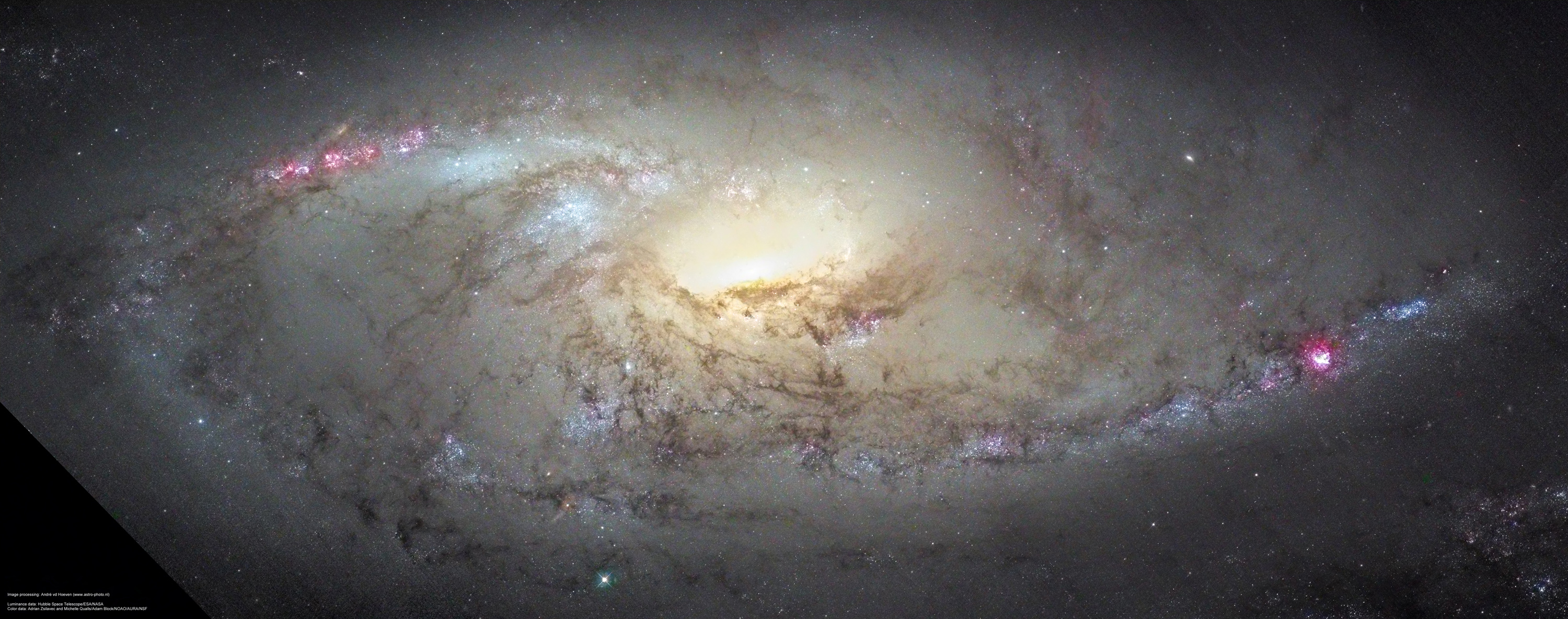
M106 Close Up
Credit: Composite Image Data - Hubble Legacy Archive; Adrian Zsilavec, Michelle Qualls, Adam Block / NOAO / AURA / NSF
Processing - André van der Hoeven
Explanation: Close to the Great Bear (Ursa Major) and surrounded by the stars of the Hunting Dogs (Canes Venatici), this
celestial wonder was discovered in 1781 by the metric French astronomerPierre Mechain. Later, it was added to
the catalog of his friend and colleague Charles Messier as M106. Modern deep telescopic views reveal it to be an island universe: a spiral galaxy around 30 thousand light-years
across located only about 21 million light-years beyond the stars of the Milky
Way. Along with prominent dust lanes and a bright central core, this colorful composite image highlights youthful blue star clusters and reddish stellar
nurseries that trace the galaxy's spiral arms. The high resolution galaxy portrait is
a mosaic of data from Hubble's sharp ACS camera combined with groundbased color
image data. M106 (aka NGC 4258) is a nearby example of the Seyfert class of active galaxies, seen across the spectrum from radio to X-rays. Energetic active galaxies are powered
by matter falling into a massive central black hole.Credit: Composite Image Data - Hubble Legacy Archive; Adrian Zsilavec, Michelle Qualls, Adam Block / NOAO / AURA / NSF
Processing - André van der Hoeven
2013 October 6

Hubble Remix: Active
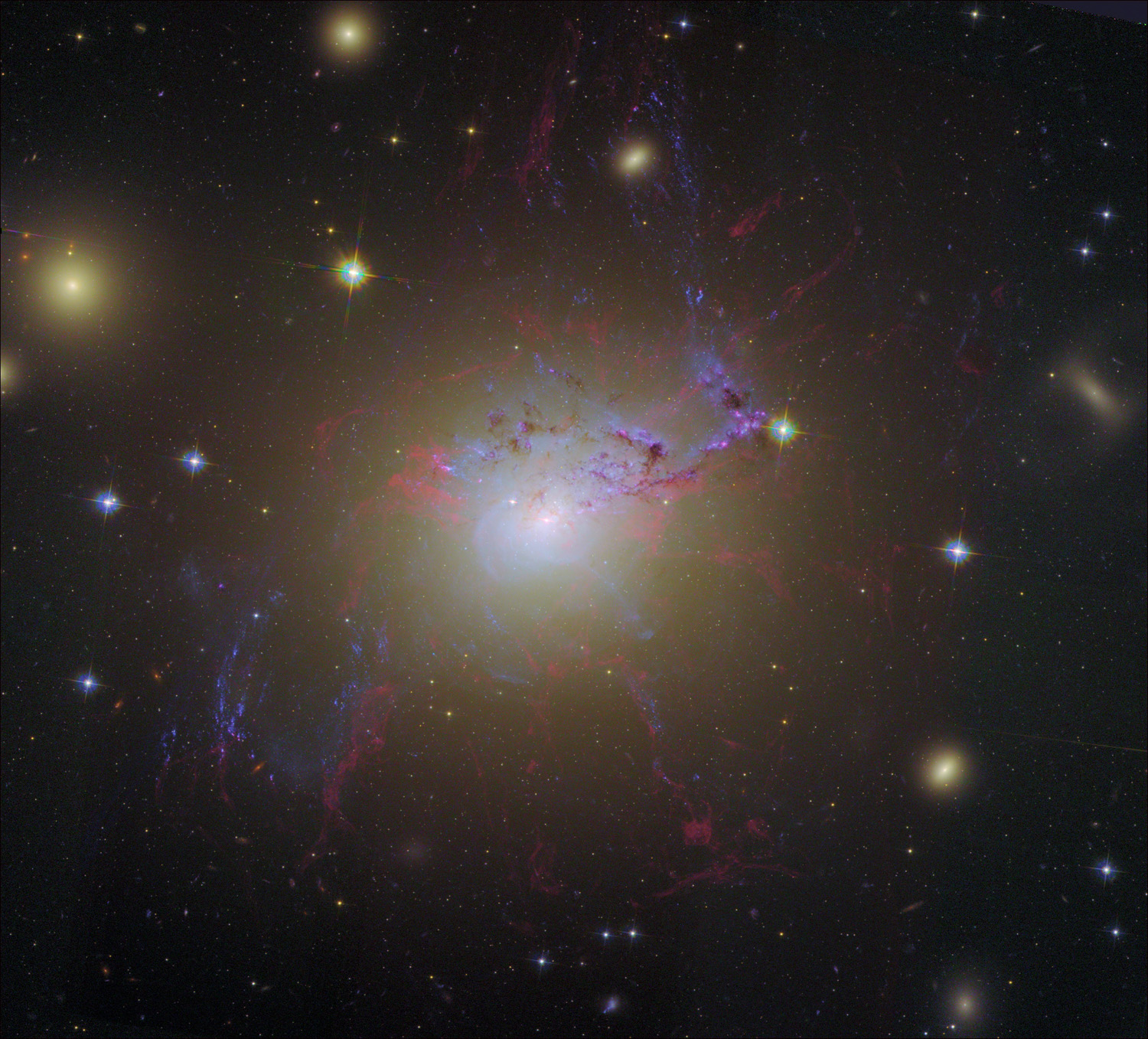
Galaxy NGC 1275
Image Credit: Data - Hubble Legacy Archive, ESA, NASA; Processing - Al Kelly
Explanation: Active galaxy NGC 1275 is the central, dominant member of the large and
relatively nearby Perseus Cluster of Galaxies. Wild-looking at
visible wavelengths, the active galaxy is also a prodigious source of x-rays and radio emission. NGC 1275 accretes matter as entire galaxies fall
into it, ultimately feeding a supermassive black hole at the galaxy's core.
This color composite image, recreated from archival
Hubble Space Telescope data, highlights the resulting galactic debris and filaments of glowing gas, some up
to 20,000 light-years long. The filaments persist in NGC 1275, even though the turmoil of galactic collisions
should destroy them. What keeps the filaments together? Observations indicate that the
structures, pushed out from the galaxy's center by the black hole's activity,
are held together by magnetic fields. Also known as Perseus A, NGC 1275 spans over 100,000 light years and lies about 230 million
light years away.Image Credit: Data - Hubble Legacy Archive, ESA, NASA; Processing - Al Kelly
2013 October 7

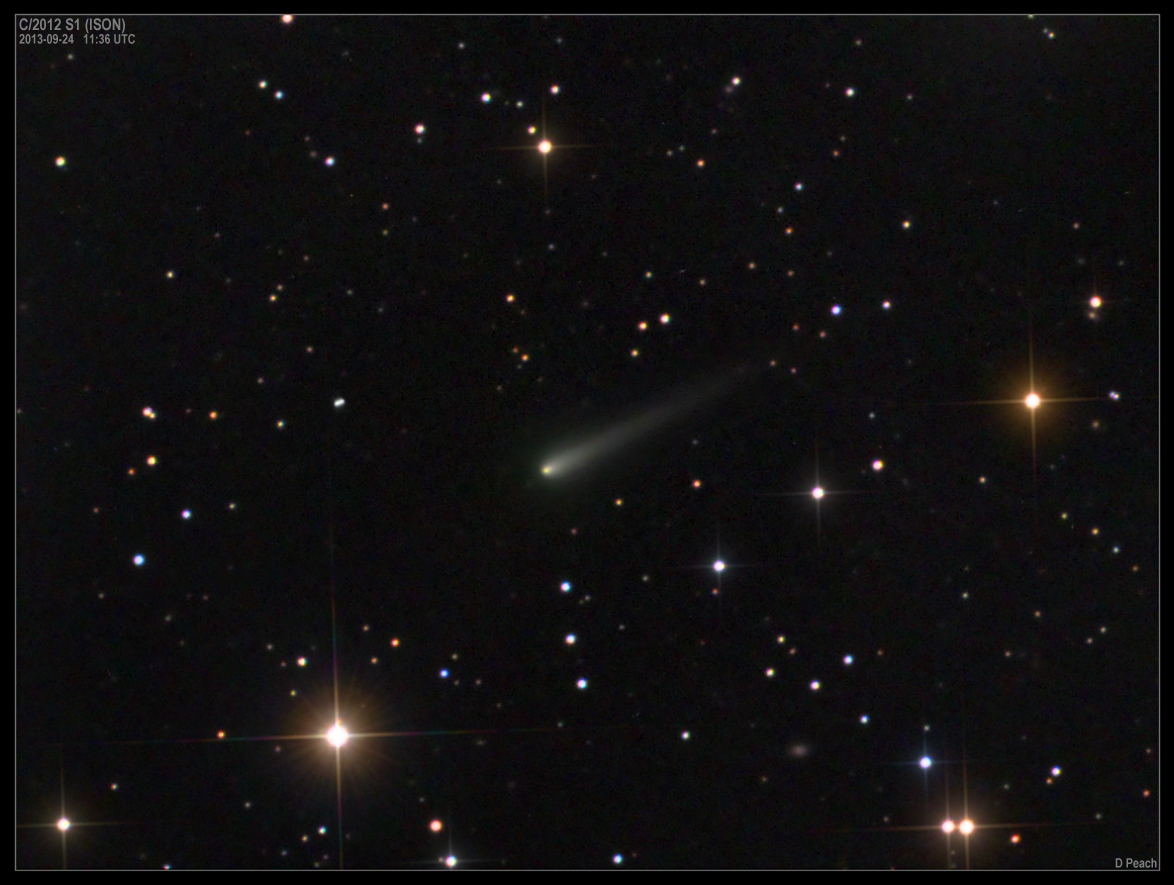
Explanation: How impressive will Comet ISON become? No one is sure, but unfortunately, as the comet approaches the inner Solar System, it is brightening more slowly than many early predictions.Pictured above, Comet ISON is seen about two weeks ago as >it continued to develop a tail. Last week the comet passed relatively close to Mars, and was directly imaged by the Mars Reconnaissance Orbiter. When Comet ISON dives to within a few solar radii of the Sun's >surface in late November, it may become brighter than the Moon and sport a long and >flowing tail -- or it may appear somewhat less spectacular. Either way, sky enthusiasts hope that whatever comet parts survive will put on quite an impressive show, as viewed from Earth, through at least the rest of the year.
Astronomy News:
Scientists
Calculate 40 Billion Earth-Sized Planets Exist In The Milky Way Galaxy.
AIAA Daily Launch 5 November 2013:
The CBS Evening News
broadcast that NASA announced on Monday that there may be “40 billion
Earth-sized planets” in the Milky Way in the habitable zones of their parent
stars, called the “Goldilocks Zone” for being “not too hot, not too cold” for
potential life.
The AP (11/5, Borenstein)
reports the findings are based on years of observations from the “now-crippled”
Kepler telescope. Geoff Marcy of UC Berkeley co-authored the study that found
that about “1 in 5 stars” in our galaxy have Earth-sized planets. Bill Borucki,
NASA’s chief Kepler scientist, “joked” that “you’d probably see a lot of
traffic jams” if humans could travel far enough into space. According to the
article, this is the first calculation, not estimation, of how many Earth-sized
planets are in their stars’ habitable zones. Meanwhile, the article notes that
at a “Kepler science conference,” scientists also announced the Kepler
telescope found “833 new candidate planets,” but most of these were not
“candidates for life.”
The New York Times (11/5, Overbye,
Subscription Publication) calls the new calculation of the number of habitable
planets in the galaxy the result of a “herculean” study led by Erik Petigura of
UC Berkeley. Natalie Batalha of the Ames Research Center said this project was
“the best of humanity rising to the occasion.” The article also credited Petigura
with developing a new way of testing to see how efficient their detection
program was by inserting “fake planets” into the data. According to the
article, Batalha stressed that even with the Kepler telescope “sidelined,”
there is still over a year of data to sift through, so “scientists...are going
to work on Kepler data for decades.” Meanwhile, Sara Seager of MIT said Kepler
was “dead,” so researchers have to be “satisfied” with what it has produced.
The Washington Post (11/5, Achenbach)
reports that Seager said the results should “boost” efforts to develop more
telescopes that could continue Kepler’s work. Meanwhile, SETI “pioneer” Jill
Tarter said the results indicate someone should discover “Earth 2.0” relatively
soon. The article stressed that all this study determined was the number of
planets the same relative size as Earth, but could not say how closely any
resemble Earth.
The CBS News (11/5, Harwood)
website reports Borucki said more research is needed to determine how habitable
these planets are, adding “Planets with CO2 (carbon dioxide) and water vapor,
which is what you need for life, I think we’ll find are probably fairly common
in our galaxy. ... That’s certainly speculation at this point. We need to go
out and make those measurements so we’re not guessing.” He also said, “We’re
celebrating opening a new era in astronomy, we’re beginning the exploration of
our galaxy. ... Imagine what (future) missions will find as we continue that
exploration.”
Meanwhile, Reuters (11/5, Klotz) has
further coverage of the other Kepler study by Jason Rowe of the SETI Institute,
which found that of 3,538 candidate planets, 647 are about the size of Earth.
Also covering the story
are the Los Angeles Times (11/5, Khan) “Science
Now” blog, San Francisco Chronicle (11/5, Perlman), AFP (11/5), Bloomberg News (11/5, Ostrow), NPR (11/5, Neuman) “The
Two-Way” blog, Voice of America (11/5), the Atlantic (11/5, Garber), and
other media sources.
Kepler’s Future Expected
To Be Discussed At Second Kepler Science Conference. In an article for the Space Review (11/4), Space Review
editor Jeff Foust wrote on recent exoplanet discoveries, including Petigura’s
study, as well as the Second Kepler Science Conference. Foust noted that one
issue expected to be discussed at the conference is possible future uses for
Kepler as managers are now reviewing 40 proposals. Batalha said during a
teleconference Friday, “They were subjected to review and scrutiny by the
engineers to try and decide what was feasible and what is scientifically
compelling. ... We will be submitting a report to NASA Headquarters soon, later
this month, to summarize the results of that study.” Batalha added that
researchers also want to continue to refine the collected Kepler data, saying,
“What we’d like to do to make up for not having as much data as we’d thought
we’d have is to really dive down into the weeds and apply innovative techniques
to give Erik [Petigura] better brightness measurement.” Marcy also said Friday
that NASA took a “bold move” launching Kepler in the first place, adding it was
a “joy” to work with the team.
General Calendar:
Colloquia, Lectures, Seminars, Meetings, Open Houses & Tours:
Colloquia: Carnegie (Tues. 4pm), UCLA,
Caltech (Wed. 4pm), IPAC (Wed. 12:15pm) & other Pasadena
|
Carnegie astronomy lectures – only 4 per year in the Spring www.obs.carnegiescience.edu.
Visit www.huntington.org for directions. For more information about the Carnegie
Observatories or this lecture series, please contact Reed Haynie.
|
|
1 Nov
|
SBAS Monthly General Meeting at El Camino
College planetarium. 7:30 PM
Topic: “Spectroscopy 101 – How You Can Almost Touch the
Stars,” Tom Field
|
|
4 Nov
|
LAAS LAAS General Meeting.
|
Griffith
Observatory
Event Horizon Theater 8:00 PM to 10:00 PM |

From IRAS to Spitzer and Beyond: 30 years of Space-Based
Infrared Astronomy
The infrared lies
beyond the red end of the visible spectrum of light. Cool and dusty things
throughout the Universe appear bright in infrared. 2013 is a significant year
in infrared astronomy -- it marks the 30th anniversary of the launch of IRAS,
the Infrared Astronomical Satellite, which revolutionized our view of the
infrared cosmos, increasing the number of known infrared sources by about 70%.
It's also the 10th anniversary of the launch of the Spitzer Space Telescope, at
the time the most sensitive infrared telescope ever built, which has helped
revolutionize our understanding of galaxy evolution, exoplanets, and star
formation. 2013 is also the 4th anniversary of the launch of the infrared
missions Herschel and WISE, the Wide-Field Infrared Survey Explorer. This talk
will review some of the major discoveries from each of these important infrared
astronomy missions.
|
Speaker:
|
Dr. Luisa Rebull
Associate Research Scientist Spitzer Science Center (SSC), Infrared Processing and |
|
Locations:
|
Thursday, Nov 7,
2013, 7pm The von Kármán Auditorium at JPL 4800 Oak Grove Drive Pasadena, CA › Directions Friday, Nov 8, 2013, 7pm The Vosloh Forum at Pasadena City College 1570 East Colorado Blvd. Pasadena, CA › Directions |
|
|
Webcast:
|
We offer two options to
view the live streaming of our webcast on Thursday: › 1) Ustream with real-time web chat to take public questions. › 2) Flash Player with open captioning If you don't have Flash Player, you can download for free here. |
|
|
|
|
|
|
21 Nov 2013
|
Club Meeting
|
A Tour of the new
Aerospace E POD (A6) Telescope & Facility
|
Richard
Rudy
|
A1/1735
|
Observing:
The following
data are from the 2013 Observer’s Handbook, and Sky & Telescope’s 2013 Skygazer’s
Almanac & monthly Sky at a Glance.
A weekly 5 minute video about what’s up in the night sky: www.skyandtelescope.com/skyweek.
Sun,
Moon & Planets for November:

Moon: Nov 3 new, Nov 10 1st
quarter, Nov 17 full, Nov 25 last quarter
Planets: Venus is visible
after sunset in the West. Jupiter rises about 9pm. Mars,
Saturn & Mercury are in the pre-dawn sky in the East.
Other
Events:
1 November Venus at Greatest Eastern
Elongation
|
2 Nov
|
SBAS
out-of-town observing – contact Greg Benecke http://www.sbastro.net/.
|
|
2 Nov
|
LAAS Dark Sky Night :
|
3 Nov Daylight Savings Time ends (set clocks
back 1 hour)
4-7 November
Taurids Meteor
Shower Peak
The Taurids are active from October 12 to December 2. Maximum is also of
long duration and
extends over November 4-7. Maximum hourly rate is about 7.
|
9 Nov
|
Public Star Party:
|
17-24 Nov Comet ISON May first become visible to the
naked eye, about an hour before sunrise near Spica Nov. 17, and
about a half hour before sunrise and near Mercury & Saturn Nov 22-24.
17/18 November
Leonids Meteor
Shower Peak
The Leonids generally begin on November 13 and end on November 21, with
maximum generally
occurring during the night of November 17/18. The Leonids are barely
detectable on the beginning
and ending dates, but observers are generally treated to displays of about
10 meteors per hour on
the night of maximum. There are other, weaker meteor showers going on
around the same time as
the Leonids. The Leonids move very fast.
18 November Mercury at Greatest Western Elongation
26 November Mercury Passes 0.3 Degrees from Saturn
|
23 Nov
|
SBAS Star Party (weather permitting): RPV at
Ridgecrest Middle School 28915 North Bay Rd.
|
|
30 Nov
|
SBAS
out-of-town observing – contact Greg Benecke http://www.sbastro.net/.
|
|
30 Nov
|
LAAS Dark Sky Night :
|
Internet Links:
Link(s) of the Month
Link(s) of the Month
A weekly 5 minute video about what’s up in the night sky: www.skyandtelescope.com/skyweek.
Telescope, Binocular & Accessory Buying Guides
General
About the Club
Club Websites: Internal (Aerospace): https://aeropedia.aero.org/aeropedia/index.php/Astronomy_Club It is updated to reflect this newsletter, in addition to a listing of past club mtg. presentations, astronomy news, photos & events from prior newsletters, club equipment, membership & constitution. We have linked some presentation materials from past mtgs. Our club newsletters are also being posted to an external blog, “An Astronomical View” http://astronomicalview.blogspot.com/.
Club Websites: Internal (Aerospace): https://aeropedia.aero.org/aeropedia/index.php/Astronomy_Club It is updated to reflect this newsletter, in addition to a listing of past club mtg. presentations, astronomy news, photos & events from prior newsletters, club equipment, membership & constitution. We have linked some presentation materials from past mtgs. Our club newsletters are also being posted to an external blog, “An Astronomical View” http://astronomicalview.blogspot.com/.
Membership. For information, current dues & application, contact Alan Olson, or see the club website (or Aerolink folder) where a form is also available (go to the membership link/folder & look at the bottom). Benefits will include use of club telescope(s) & library/software, discounts on Sky & Telescope magazine and Observer’s Handbook, field trips, great programs, having a say in club activities, acquisitions & elections, etc.
Committee Suggestions & Volunteers. Feel free to contact: Mark Clayson, President & Program Committee Chairman (& acting club VP), TBD Activities Committee Chairman (& club Secretary), or Alan Olson, Resource Committee Chairman (over equipment & library, and club Treasurer).
Mark Clayson,
AEA Astronomy Club President