The Hubble Ultra Deep Field Image (see description on the right, below)

The Hubble Ultra Deep Field Image
(10,000 galaxies in an area 1% of the apparent size of the moon -- see description on the right, below)

Wednesday, June 20, 2012

2012 June


AEA Astronomy Club Newsletter, June 2012

Contents
AEA Astronomy Club News & Calendar p.1
Video(s) & Picture(s) of the Month p. 2
Astronomy News p. 5
General Calendar p. 7
    Colloquia, lectures, mtgs. p. 7
    Observing p. 8
Useful Links p. 9

About the Club p. 10

Club News & Calendar.

Calendar

5 June
Venus Transit of the Sun
In L.A. 3:06pm (58 deg. elevation) to sunset (8:07pm) – greatest transit 6:25pm (18 deg elevation).
21 June
Monthly Meeting
Space Radiation Modeling,  Joe Mazur, Aerospace A1/1029A/B
19 July
Monthly Meeting
 Astrophotography & Research at an Amateur Observatory, Francis Longstaff, Polaris Observatory Assn. (amateur/pro collaboration) & UCLA Faculty & Saturn Lodge 0.7m amateur telescope.  A1/1029A/B

AEA Astronomy Club meetings are on 3rd Thursdays at 11:45am.  For 2012, April-May we meet in A1/1026; June-July & Oct.-Dec. in A1/1029A/B;
Aug. in A1/2143 and Sept. in A3/1607A/B.

News:  


May 20 annular solar eclipse.  It was every man for himself, wherever he was – no one went to centerline, but we had some 80% from L.A.  I observed it from S. Torrance, intermittently between & through clouds.  Jim Edwards above clouds from PV & took some photos (see the club Aerolink folder of 2012 activities, https://aerolink.aero.org/cs/llisapi.dll?func=ll&objId=16864908&objAction=browse&sort=name.
).  And others sent in are posted there, including a good bunch of crescents on the ground thru a tree from N. Calif.

May 26 RTMC astronomy expo & club observing night(s).  David Wright & son Gabriel went up Thursday, and was joined on Fri. by Mark Clayson & Phillip Morris, his wife and infant.  There was a steady wind, and temperatures dipped below freezing (teens w. wind chill).  In the auditorium we watched a big screen projection from an outside video camera on a telescope.  Then went out for a closer look at their setup – a Mallincam Extreme – the high-end model we’ve considered for the club, and I’m now sold on.  Few others were set up to observe, and about midnight, as we were about to set up the 10-inch I’d brought, clouds came over and dusted us w. snow.  Just as well – yours truly had forgotten the tripod (but brought all else in our inventory) – note to self:  make a checklist. 

The next morning, we looked at the vendors, and signed up for a rare tour of the Big Bear Solar Observatory – the largest, highest resolution solar telescope on earth.  Holiday traffic getting there was horrendous, and we missed meeting the group at the locked gate.  Not to worry, we slipped thru the barbed wire & shocked the staff by joining the tour late.  I then returned home.  See photos at

David stayed longer, and reported later, “Well, we survived. The wind was less Saturday, but it was very cold (in the 20's) and I just went to bed with Gabriel. On Sunday it was much less windy. At the second raffle night, Gabriel and I won one of the prizes -- unfortunately nothing too exciting: admission for 5 to the Columbia Memorial Space Center in Downey, and a commemorative coin.

“We saw both iridium flashes on Sunday night, a -4 and a -8.

“We spread out your green outdoor carpeting and I set up the 10" on the ground. We looked at a few things, M13 and alberio, and then Gabriel wanted to go to sleep (around 11). I slept for a bit too, and then got up at 2:30am and observed until it started getting light at 4:30, mostly everything I could find in Cygnus, and Since it was near zenith, that meant I was lying on the ground for most of that time, but the outdoor carpeting worked great! I did notice ice on my aluminum camp table before I went to sleep.”

June 5 Venus transit (last in our lifetimes). We knew we could count on the laws of motion, but even the weather cooperated. And there must have been hundred(s) of people in the AGO mall who came & stood in line to view through the club H-alpha scope, Alan Olson’s 8-inch Dobs, and my 90mm ETX, both w. NDF’s.  All in all a very successful event!   There were several sunspots, plages & prominences seen, that can be made out in some H-alpha photos.  But no one noticed any aureole or black drop effect around Venus.  Jim Johansen was also set up at the Pasadena office w. his 8-inch Celestron.

A lot of good shots w. cell phones!  And the movies are incredible, especially for handheld w. a cellphone!  I'm uploading them as they come in to our Aerolink folder where you can access them --
https://aerolink.aero.org/cs/llisapi.dll?func=ll&objId=16864908&objAction=browse&sort=name.

Unfortunately, we were unable to get the CCD imager focused and imaging before the sun started dropping into the trees & buildings around 7pm -- we came frustratingly close for novices.  It didn't help to not have equatorial mounts or working sidereal drives (another item to acquire).  Or to have to spend 20-30 minutes getting the imaging software drivers to be recognized. We have some good lessons learned for future events like the 2017 eclipse or 2016 Mercury transit

I caught the rest of it at the NASA webcast from Hawaii -- incl. 3rd & 4th contact which occured after sunset here -- I can say I saw it from start to end.  I saved screen shots, and may post some of those.

A special thanks to Joe Nemanick & Alan Olson for bringing that great Dobs, and working the crowd, keeping the interest level up and the telescopes pointed, etc.


Astronomy Video(s) & Picture(s) of the Month
(from Astronomy Picture of the Day, APOD: http://apod.nasa.gov/apod/archivepix.html)
Video(s)
A Venus Transit music video from SDO http://apod.nasa.gov/apod/ap120611.html

SpaceX's Falcon 9 Launches to the Space Station  http://apod.nasa.gov/apod/ap120523.html  

Virtual Flight over Asteroid Vesta  http://apod.nasa.gov/apod/ap120514.html

2012 June 9
Venus at the Edge
Image Credit:
JAXA, NASA, Lockheed Martin
Explanation: As its June 6 2012 transit begins Earth's sister planet crosses the edge of the Sun in this stunning view from the Hinode spacecraft. The timing of limb crossings during the rare transits was used historically to triangulate the distance to Venus and determine a value for the Earth-Sun distance called the astronomical unit. Still, modern space-based views like this one show the event against an evocative backdrop of the turbulent solar surface with prominences lofted above the Sun's edge by twisting magnetic fields. Remarkably, the thin ring of light seen surrounding the planet's dark silhouette is sunlight refracted by Venus' thick atmosphere.


2012 May 30
Looking Back at an Eclipsed Earth
Image Credit:
PHL @ UPR Arecibo, NASA, EUMETSAT, NERC Satellite Receiving Station, U. Dundee
Explanation: What's that dark spot on planet Earth? It's the shadow of the Moon. The above image of Earth was taken last week by MTSAT during an annular eclipse of the Sun. The dark spot appears quite unusual as clouds are white and the oceans are blue in this color corrected image. Earthlings residing within the dark spot would see part of the Sun blocked by the Moon and so receive less sunlight than normal. The spot moved across the Earth at nearly 2,000 kilometers per hour, giving many viewers less than two hours to see a partially eclipsed Sun. MTSAT circles the Earth in a geostationary orbit and so took the above image from about three Earth-diameters away. Sky enthusiasts might want to keep their eyes pointed upward this coming week as a partial eclipse of the Moon will occur on June 4 and a transit of Venus across the face of the Sun will occur on June 5.


2012 May 24
All the Water on Europa
Illustration Credit &
Copyright: Kevin Hand (JPL/Caltech),
Jack Cook (
Woods Hole Oceanographic Institution), Howard Perlman (USGS)
Explanation: How much of Jupiter's moon Europa is made of water? A lot, actually. Based on the Galileo probe data acquired during its exploration of the Jovian system from 1995 to 2003, Europa possesses a deep, global ocean of liquid water beneath a layer of surface ice. The subsurface ocean plus ice layer could range from 80 to 170 kilometers in average depth. Adopting an estimate of 100 kilometers depth, if all the water on Europa were gathered into a ball it would have a radius of 877 kilometers. To scale, this intriguing illustration compares that hypothetical ball of all the water on Europa to the size of Europa itself (left) - and similarly to all the water on planet Earth. With a volume 2-3 times the volume of water in Earth's oceans, the global ocean on Europa holds out a tantalizing destination in the search for extraterrestrial life in our solar system.


Astronomy News:

Baby galaxies grew up quickly

Published: Wednesday, May 16, 2012 - 12:34 in Astronomy & Space

Baby galaxies from the young Universe more than 12 billion years ago evolved faster than previously thought, shows new research from the Niels Bohr Institute. This means that already in the early history of the Universe, there was potential for planet formation and life. The research results have been published in the scientific journal, Monthly Notices of the Royal Astronomical Society Letters.


For several thousand years after the Big Bang 13.7 billion years ago, the Universe consisted of a hot, dense primordial soup of gases and particles. But the Universe was expanding rapidly and the primordial soup became less dense and cooled. However, the primordial soup was not evenly distributed, but was denser in some areas than others. The density in some of the densest areas increased due to gravity and began to contract, forming the first stars and galaxies. This took place approximately 500 million years after the Big Bang.
The earliest galaxies were probably composed of primitive, giant stars that consisted of only hydrogen and helium. There were no heavier elements. They first appeared later in the evolution of the Universe, created by nuclear processes in the stars.


Cosmic cycle


A star is a giant ball of glowing gas that produces energy by fusing hydrogen and helium into heavier and heavier elements. When no more energy can be extracted the star dies and massive clouds of dust and gas are flung out into space. These large clouds are condensed and recycled into new stars in a gigantic cosmic cycle. The new stars that are formed will have a higher content of heavier elements than the previous and for each generation of star formation there are more and more of the heavy elements and metals. And heavy elements (especially carbon and oxygen) are necessary for the formation of planets and life, as we know it.


Up until now, researchers thought that it had taken billions of years for stars to form and with that, galaxies with a high content of elements heavier than hydrogen and helium. But new research from the Niels Bohr Institute shows that this process went surprisingly quickly in some galaxies.


"We have studied 10 galaxies in the early Universe and analysed their light spectra. We are observing light from the galaxies that has been on a 10-12 billion year journey to Earth, so we see the galaxies as they were then. Our expectation was that they would be relatively primitive and poor in heavier elements, but we discovered somewhat to our surprise that the gas in some of the galaxies and thus the stars in them had a very high content of heavier elements. The gas was just as enriched as our own Sun," explains Professor Johan Fynbo from the Dark Cosmology Centre at the Niels Bohr Institute, University of Copenhagen.


Lighthouses of the Universe


The galaxies are so far away that you normally do not have the opportunity to observe them directly, but the researchers have used a special method.


"There are some extreme objects in the Universe called quasars. Quasars are gigantic black holes that are active and when matter falls into them, they emit light that is as strong as thousands of galaxies. They are like a kind of lighthouse that lights up in the Universe and can be seen very far away," explains Jens-Kristian Krogager, PhD student at the Dark Cosmology Centre at the Niels Bohr Institute, University Copenhagen. He explains that in order to use quasars as light sources the quasar must lie behind the galaxy you want to observe.


"We then look at the light from the quasar and can see that some light is missing. The missing quasar light in the image has been absorbed by the chemical elements in the galaxy in front of it. By analysing the spectral lines we can see which elements there are and by measuring the strength of each line we can see the amount of the elements," explains Jens-Kristian Krogager.


Life in the early Universe


They discovered not only that the galaxies from the very early Universe had a surprisingly large quantity of heavier elements, but also that one of the galaxies in particular was especially interesting.


"For one of the galaxies, we observed the outer regions and here there was also a high element content. This suggests that large parts of the galaxy are enriched with a high content of heavier elements and that means that already in the early history of the Universe there was potential for planet formation and life," says Johan Fynbo.

General Calendar:

Colloquia, Lectures, Seminars, Meetings, Open Houses & Tours:


Note:  The South Bay Astronomical Society website has changed from www.sbastro.org to http://www.sbastro.net/.

Colloquia:  Carnegie (Tues. 4pm), UCLA, Caltech (Wed. 4pm), IPAC (Wed. 12:15pm) & other Pasadena (daily 12-4pm):  http://obs.carnegiescience.edu/seminars/ 

Carnegie astronomy lectures – only 4 per year in the Spring www.obs.carnegiescience.edu.    Visit www.huntington.org for directions.  For more information about the Carnegie Observatories or this lecture series, please contact Reed Haynie.

1 June
SBAS Monthly General Meeting at El Camino College planetarium. 7:30 PM
Topic: TBD Guest Speaker:.  http://www.sbastro.net/.  

11 June
Griffith Observatory
Event Horizon Theater
8:00 PM to 10:00 PM

21 June
AEA Astronomy Club Monthly Meeting
Space Radiation Modeling,  Joe Mazur, Aerospace A1/1029A/B

Jun. 21 & 22 The von Kármán Lecture Series:

Melting Snows: The Threatened Lifeblood of the Western US

Snowmelt from the Sierra Nevada and the mountains of the Upper Colorado River Basin provides the water upon which Western society is built. In recent years, increases in population and drought have pushed water demand past snowmelt-dominated supply. Climate change and dust deposition from disturbed lands have already begun the encroachment on this precious resource. Drops of lake levels on Lake Mead have threatened unprecedented domestic and international reductions in deliveries and the threat to southern California’s water supply of a seismic breach of levies in the Sacramento-San Joaquin River Delta hangs like the Sword of Damocles. JPL is developing the Airborne Snow Observatory and other systems to bring the nation to a mature monitoring of our snow resource to anchor cutting edge science and water management in an uncertain future.
Speaker:
Dr. Thomas Painter
Research Scientist in the Water and Carbon Cycles Group, in the Earth Sciences Section, JPL
Locations:
Thursday, June 21, 2012, 7pm
The von Kármán Auditorium
at JPL
4800 Oak Grove Drive
Pasadena, CA
› Directions

Friday, June 22, 2012, 7pm
The Vosloh Forum at Pasadena City College
1570 East Colorado Blvd.
Pasadena, CA
› Directions
Webcast:
For the webcast on Thursday at 7 p.m. PST, click here Video Icon
If you don't have RealPlayer, you can download the free
RealPlayer 8 Basic.


Observing:
The following data are from the 2012 Observer’s Handbook, and Sky & Telescope’s 2012 Skygazer’s Almanac & monthly Sky at a Glance.

A weekly 5 minute video about what’s up in the night sky:  www.skyandtelescope.com/skyweek.

Sun, Moon & Planets for June:


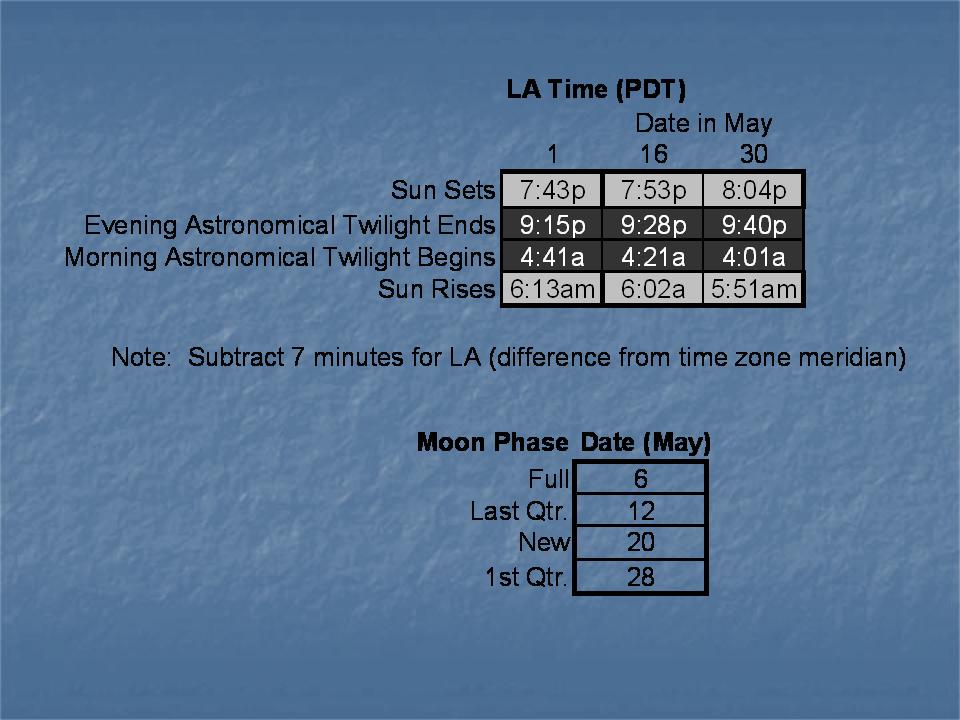
   Moon:  4 Full,  11 Last quarter,  19 New,   27  First Quarter                             

Planets:  Venus and Jupiter are visible in the pre-dawn sky.  Mercury, Mars and Saturn are all Evening planets. “After June 10 will be the best time to see Mercury in the evening for the rest of 2012. Red Mars and golden Saturn come out as darkness falls, ornamenting the nighttime until late evening or after midnight.”  (From http://earthsky.org/astronomy-essentials/visible-planets-tonight-mars-jupiter-venus-saturn-mercury)


Other Events:


9 June
SBAS Star Party (weather permitting): RPV at Ridgecrest Middle School 28915 North Bay Rd.

16 June
LAAS Dark Sky Night : Lockwood Valley (Steve Kufeld Astronomical Site; LAAS members and their guests only)
16 June
SBAS out-of-town observing – contact Greg Benecke http://www.sbastro.net/.  

23 June
Public  Star Party: Griffith Observatory Grounds 2-10pm


Internet Links:

Link(s) of the Month

A weekly 5 minute video about what’s up in the night sky:  www.skyandtelescope.com/skyweek.

General
Regional (esp. Southern California)
Mt. Wilson Institute (www.mtwilson.edu/), including status for visits & roads


About the Club

Club Websites:
 Internal (Aerospace): https://aeropedia.aero.org/aeropedia/index.php/Astronomy_Club  It is updated to reflect this newsletter, in addition to a listing of past club mtg. presentations, astronomy news, photos & events from prior newsletters, club equipment, membership & constitution.  We have linked some presentation materials from past mtgs.  Our club newsletters are also being posted to an external blog, “An Astronomical View” http://astronomicalview.blogspot.com/. 
 
Membership.  For information, current dues & application, contact Jim Johansen, or see the club website where a form is also available.  Benefits will include use of club telescope(s) & library/software, discounts on Sky & Telescope magazine and Observer’s Handbook, field trips, great programs, having a say in club activities, acquisitions & elections, etc.

Committee Suggestions & Volunteers.  Feel free to contact:  Paul Rousseau, Program Committee Chairman (& club VP), TBD, Activities Committee Chairman (& club Secretary), or Jim Johansen, Resource Committee Chairman (over equipment & library, and club Treasurer).

Mark Clayson,
AEA Astronomy Club President 

Sunday, May 13, 2012

2012 May


AEA Astronomy Club Newsletter, May 2012

Contents
AEA Astronomy Club News & Calendar p.1
Video(s) & Picture(s) of the Month p. 2
Astronomy News p. 5
General Calendar p. 7
    Colloquia, lectures, mtgs. p. 7
    Observing p. 8
Useful Links p. 9

About the Club p. 10

Club News & Calendar.

Calendar

17 May
Monthly Meeting
“IR Airglow Images,” Lynette Gelinas, Aerospace.  A1/ 1026
20 May
Annular Solar Eclipse
Central line thru Reno & Albuquerque – closest ~ Zion NP, Utah – max eclipse there ~ 6:40pm (elevation ~10 deg), begins ~5:30pm, ends at sunset (~ 8pm) (LA:  begins 5:25pm, max (13 deg elevation) at 6:38pm, ends 7:43pm)
26 May
Field Trip
RTMC Astronomy Expo, Big Bear.  Online registration cutoff May 10 http://www.rtmcastronomyexpo.org/ .
5 June
Venus Transit of the Sun
In L.A. 3:06pm (58 deg. elevation) to sunset (8:07pm) – greatest transit 6:25pm (18 deg elevation).
21 June
Monthly Meeting
Space Radiation Modeling,  Joe Mazur, Aerospace A1/1029A/B
19 July
Monthly Meeting
 Astrophotography & Research at an Amateur Observatory, Francis Longstaff, Polaris Observatory Assn. (amateur/pro collaboration) & UCLA Faculty & Saturn Lodge 0.7m amateur telescope.  A1/1029A/B

AEA Astronomy Club meetings are on 3rd Thursdays at 11:45am.  For 2012, April-May we meet in A1/1026; June-July & Oct.-Dec. in A1/1029A/B;
Aug. in A1/2143
and Sept. in A3/1607A/B.

News:  

Jim Johansen has stepped forward as Treasurer (thanks!).  He’s appointed until the next election.  We’re still looking for a secretary. 

Musical Meeting Rooms.  Our Aug. room just changed again.  For 2012, April-May we meet in A1/1026; June-July & Oct.-Dec. in A1/1029A/B; Aug. in A1/2143 and Sept. in A3/1607A/B.  Hopefully next year we’ll get a stable room again.

Upcoming observing opportunities.  3 big events in the next 30 days:  May 20 annular solar eclipse, May 26 RTMC astronomy expo (online registration cutoff is May 10 http://www.rtmcastronomyexpo.org/) & club observing night, and June 5 Venus transit (last in our lifetimes).  Anyone seriously considering joining with fellow club members & equipment for any of these, please let me know to help in planning. 

For the solar events, we’ll need to watch the weather forecast for whether we observe locally or head for the hills (Mt. Wilson?).  The transit could be observed at Aerospace (the AGO mall?) as it’s a Tuesday afternoon/evening, although low elevation could be a problem.  The eclipse is on a Sunday, so off-campus.  We hope to get CCD images of the eclipse & transit thru the H-alpha scope.  I also have a neutral density filter for my 90mm Meade for possible viewing (but tracking drive isn't working).  David Wright (& son) for one is planning on the RTMC, & Jim Edwards the nearby SAS Symposium the preceding weekdays.


Paul Rousseau’s report on the April 28 Griffith star party:

Here are some photos from the Griffith Star Party last night. I just used the Orion 8 inch Dobsonian in manual mode and looked at the Moon, Venus, Mars, and Saturn. The public really enjoyed our telescope and were amazed to hear that this type of telescope (without the computer) is relatively affordable. 

We also watched with our eyes the International Space Station fly over, which was very cool. There was even an Iridium satellite spotting. All in all, it was a good time. 


 The May issue of Westways Magazine (AAA) is dedicated to all things space in So. Calif. (& New Mexico), incl. the Columbia Memorial Space Center in Downey that I was not aware of – “Home of Apollo.”  Or the Frank & Son Collectible Show in Industry – where you can find all things Star Wars, on this 35th anniversary of the movie.  

Astronomy Video(s) & Picture(s) of the Month
(from Astronomy Picture of the Day, APOD: http://apod.nasa.gov/apod/archivepix.html)
Video(s)
Incredible time-lapse music video from moving cameras for 3-D effect (at Canary Islands) http://apod.nasa.gov/apod/ap120508.html

Matter, Higgs Boson & CERN LHC explained by cartoon video http://apod.nasa.gov/apod/ap120501.html

Rosetta approaches asteroid Lutetia http://apod.nasa.gov/apod/ap120424.html

Geostationary satellites above the Swiss Alps http://apod.nasa.gov/apod/ap120411.html

A weekly 5 minute video about what’s up in the night sky:  www.skyandtelescope.com/skyweek.

2012 April 23

Evaporating Blobs of the Carina Nebula
Image Credit:
ESA/Hubble, NASA
Explanation: No, they are not alive -- but they are dying. The unusual blobs found in the Carina nebula, some of which are seen floating on the upper right, might best be described as evaporating. Energetic light and winds from nearby stars are breaking apart the dark dust grains that make the iconic forms opaque. Ironically the blobs, otherwise known as dark molecular clouds, frequently create in their midst the very stars that later destroy them. The floating space mountains pictured above by the orbiting Hubble Space Telescope span a few light months. The Great Nebula in Carina itself spans about 30 light years, lies about 7,500 light years away, and can be seen with a small telescope toward the constellation of Keel (Carina).
2012 April 20

M57: The Ring Nebula
Credit: Composite Image Data -
Subaru Telescope (NAOJ), Hubble Legacy Archive;
Processing and additional imaging -
Robert Gendler
Explanation: Except for the rings of Saturn, the Ring Nebula (M57) is probably the most famous celestial band. Its classic appearance is understood to be due to perspective - our view from planet Earth looks down the center of a roughly barrel-shaped cloud of glowing gas. But expansive looping structures are seen to extend far beyond the Ring Nebula's familiar central regions in this intriguing composite of ground based and Hubble Space Telescope images with narrowband image data from Subaru. Of course, in this well-studied example of a planetary nebula, the glowing material does not come from planets. Instead, the gaseous shroud represents outer layers expelled from the dying, once sun-like star at the nebula's center. Intense ultraviolet light from the hot central star ionizes atoms in the gas. Ionized oxygen atoms produce the characteristic greenish glow and ionized hydrogen the prominent red emission. The central ring of the Ring Nebula is about one light-year across and 2,000 light-years away. To accompany tonight's shooting stars it shines in the northern constellation Lyra.
2012 April 22

Flowing Barchan Sand Dunes on Mars
Image Credit:
HiRISE, MRO, LPL (U. Arizona), NASA
Explanation: When does Mars act like a liquid? Although liquids freeze and evaporate quickly into the thin atmosphere of Mars, persistent winds may make large sand dunes appear to flow and even drip like a liquid. Visible on the above image right are two flat top mesas in southern Mars when the season was changing from Spring to Summer. A light dome topped hill is also visible on the far left of the image. As winds blow from right to left, flowing sand on and around the hills leaves picturesque streaks. The dark arc-shaped droplets of fine sand are called barchans, and are the interplanetary cousins of similar Earth-based sand forms. Barchans can move intact a downwind and can even appear to pass through each other. When seasons change, winds on Mars can kick up dust and are monitored to see if they escalate into another of Mars' famous planet-scale sand storms.

Astronomy News:

Hubble to use moon as mirror to see Venus transit

Published: Friday, May 4, 2012 - 15:04 in Astronomy & Space

Related images
(click to enlarge)


NASA/ESA/D. Ehrenreich
This mottled landscape showing the impact crater Tycho is among the most violent-looking places on our Moon. Astronomers didn't aim NASA's Hubble Space Telescope to study Tycho, however. The image was taken in preparation to observe the transit of Venus across the Sun's face on June 5-6. Hubble cannot look at the Sun directly, so astronomers are planning to point the telescope at Earth's moon, using it as a mirror to capture reflected sunlight and isolate the small fraction of the light that passes through Venus's atmosphere. Imprinted on that small amount of light are the fingerprints of the planet's atmospheric makeup.


These observations will mimic a technique that is already being used to sample the atmospheres of giant planets outside our solar system passing in front of their stars. In the case of the Venus transit observations, astronomers already know the chemical makeup of Venus's atmosphere, and that it does not show signs of life on the planet. But the Venus transit will be used to test whether this technique will have a chance of detecting the very faint fingerprints of an Earth-like planet, even one that might be habitable for life, outside our solar system that similarly transits its own star. Venus is an excellent proxy because it is similar in size and mass to our planet.


The astronomers will use an arsenal of Hubble instruments, the Advanced Camera for Surveys, Wide Field Camera 3, and Space Telescope Imaging Spectrograph, to view the transit in a range of wavelengths, from ultraviolet to near-infrared light. During the transit, Hubble will snap images and perform spectroscopy, dividing the sunlight into its constituent colors, which could yield information about the makeup of Venus's atmosphere.
Hubble will observe the Moon for seven hours, before, during, and after the transit so the astronomers can compare the data. Astronomers need the long observation because they are looking for extremely faint spectral signatures. Only 1/100,000th of the sunlight will filter through Venus's atmosphere and be reflected off the Moon.

Cassini sees new objects blazing trails in Saturn ring

Published: Tuesday, April 24, 2012 - 13:22 in Astronomy & Space
Queen Mary scientists working with images from NASA's Cassini spacecraft have discovered strange half-mile-sized objects punching through parts of Saturn's F ring, leaving glittering trails behind them. These trails in the rings, which scientists are calling 'mini-jets', fill in a missing link in our understanding of the curious behaviour of the F ring. The results were presented April 24 at the European Geosciences Union meeting in Vienna, Austria.
Scientists have known that relatively large objects like the moon Prometheus (as long as 92 miles across) can create channels, ripples and snowballs in the F ring. But until recently they didn't know what happened to these snowballs after they were created.


Now Professor Carl Murray, Nick Attree, Nick Cooper and Gareth Williams from Queen Mary's Astronomy Unit have found evidence that some of the smaller snowballs survive, and their differing orbits mean they go on to strike through the F ring on their own.


Professor Murray's group happened to see a tiny trail in an image from 30 January 2009 and tracked it over eight hours. The long footage confirmed the small object originated in the F ring, so they went back through the Cassini image catalogue to see if the phenomenon was frequent.


"The F ring has a circumference of 550,000miles (881,000kilometers) and these mini-jets are so tiny they took quite a bit of time and serendipity to find," said Nick Attree, a Cassini imaging associate at Queen Mary. "We combed through 20,000 images and were delighted to find 500 examples of these rogues during just the seven years Cassini has been at Saturn."


The small objects appear to collide with the F ring at gentle speeds -- something on the order of about 4 mph (2 meters per second). The collisions drag glittering ice particles out of the F ring with them, leaving a trail 20 to 110 miles (40 to 180 kilometers) long.


Professor Murray commented: "I think the F ring is Saturn's weirdest ring, and these latest Cassini results go to show how the F ring is even more dynamic than we ever thought. These findings show us that the F ring region is like a bustling zoo of objects from a half mile to moons like Prometheus a hundred miles in size, creating a spectacular show," he added.


In some cases, the objects travelled in packs, creating mini-jets that looked quite exotic, like the barb of a harpoon. Other new images show grand views of the entire F ring, showing the swirls and eddies that ripple around the ring from all the different kinds of objects moving through and around it.


Linda Spilker, Cassini project scientist based at NASA's Jet Propulsion Laboratory, commented: "Beyond just showing us the strange beauty of the F ring, Cassini's studies of this ring help us understand the activity that occurs when solar systems evolve out of dusty disks that are similar to, but obviously much grander than, the disk we see around Saturn. We can't wait to see what else Cassini will show us in Saturn's rings."
The Science and Technology Facilities Council is the UK sponsor of astronomy.

Source: Queen Mary, University of London


General Calendar:

Colloquia, Lectures, Seminars, Meetings, Open Houses & Tours:

Note:  The South Bay Astronomical Society website (www.sbastro.org.) is temporarily not functional (due to recent death of the webmaster). Nor have I received the usual hardcopy mailing recently.  So I have no dates for their current observing events.

Colloquia:  Carnegie (Tues. 4pm), UCLA, Caltech (Wed. 4pm), IPAC (Wed. 12:15pm) & other Pasadena (daily 12-4pm):  http://obs.carnegiescience.edu/seminars/

Carnegie astronomy lectures – only 4 per year in the Spring www.obs.carnegiescience.edu.    Visit www.huntington.org for directions.  For more information about the Carnegie Observatories or this lecture series, please contact Reed Haynie.

4 May
SBAS Monthly General Meeting at El Camino College planetarium. 7:30 PM
Topic: TBD Guest Speaker:.  www.sbastro.org.  

7 May
Griffith Observatory
Event Horizon Theater
8:00 PM to 10:00 PM

May 10 & 11 The von Kármán Lecture Series: The Quest for Other Worlds Like Earth
The centuries-old quest for other worlds like our Earth has been rejuvenated by the intense excitement surrounding the discovery of hundreds of planets orbiting other stars. The challenge now is to find terrestrial planets, especially those in the habitable zone of their stars where liquid water might exist on the surface of the planet. The Kepler mission, which launched in March 2009, is specifically designed to survey our region of the Milky Way galaxy to discover Earth-size and smaller planets in or near the habitable zone and determine the fraction of the hundreds of billions of stars in our galaxy that might have such planets. To date, 26 Kepler planets have been confirmed and nearly 2,000 planet candidates have been found. This talk will cover many of Kepler's discoveries, including several planets orbiting two stars, and will try to explain how Kepler's discoveries help define humanity's place in the universe.
Speaker:
Dr. Thomas Gautier, JPL

Locations:
Thursday, May 10, 2012, 7pm
The von Kármán Auditorium
at JPL
4800 Oak Grove Drive
Pasadena, CA
› Directions


Friday, May 11, 2012, 7pm
The Vosloh Forum at Pasadena City College
1570 East Colorado Blvd.
Pasadena, CA
› Directions
Webcast:
For the webcast on Thursday at 7 p.m. PST, click here Video Icon
If you don't have RealPlayer, you can download the free
RealPlayer 8 Basic
.


17 May
AEA Astronomy Club Monthly Meeting
“IR Airglow Images,” Lynette Gelinas, Aerospace.  A1/ 1026


Observing:
The following data are from the 2012 Observer’s Handbook, and Sky & Telescope’s 2012 Skygazer’s Almanac & monthly Sky at a Glance.

A weekly 5 minute video about what’s up in the night sky:  www.skyandtelescope.com/skyweek.

Sun, Moon & Planets for April:


Planets:  Jupiter & Mercury are hidden by the sun all month.  Mars transits ~ 8pm.  Saturn transits 12pm May 1, 9pm May 31.   Venus sets 11:30pm May 1, 9:00pm May 31.  Neptune & Uranus are visible low just before dawn.


Other Events:

5 May – The largest full moon of 2012 occurs at 9:35pm PDT.


19 May
LAAS Dark Sky Night: Lockwood Valley (Steve Kufeld Astronomical Site; LAAS members and their guests only)
?
SBAS Star Party (weather permitting): RPV at Ridgecrest Middle School 28915 North Bay Rd.

20 May
Annular Solar Eclipse
Center line thru Reno & Albuquerque – closest ~ Zion NP, Utah – max eclipse ~ 6:40pm (elevation ~10 deg), begins ~5:30pm, ends at sunset (~ 8pm)  (LA:  begins 5:25pm, max (13 deg elevation) at 6:38pm, ends 7:43pm)

26 May
LAAS Public Star Party: Griffith Observatory Grounds 2-10pm
?
SBAS out-of-town observing – contact Greg Benecke www.sbastro.org.  

5 June
Venus Transit of the Sun
In L.A. 3:06pm (58 deg elevation) to sunset (8:07pm) – greatest transit 6:25pm, 18 deg elevation

Internet Links:

Link(s) of the Month

A weekly 5 minute video about what’s up in the night sky:  www.skyandtelescope.com/skyweek.

General
Regional (esp. Southern California)
Mt. Wilson Institute (www.mtwilson.edu/), including status for visits & roads


About the Club

Club Websites:  Internal (Aerospace): https://aeropedia.aero.org/aeropedia/index.php/Astronomy_Club  It is updated to reflect this newsletter, in addition to a listing of past club mtg. presentations, astronomy news, photos & events from prior newsletters, club equipment, membership & constitution.  We expect to link some presentation materials from past mtgs.  Our club newsletters are also being posted to an external blog, “An Astronomical View” http://astronomicalview.blogspot.com/. 
 
Membership.  For information, current dues & application, contact TBD, or see the club website where a form is also available.  Benefits will include use of club telescope(s) & library/software, discounts on Sky & Telescope magazine and Observer’s Handbook, field trips, great programs, having a say in club activities, acquisitions & elections, etc. 


Committee Suggestions & Volunteers.  
Feel free to contact:  Paul Rousseau, Program Committee Chairman (& club VP), TBD, Activities Committee Chairman (& club Secretary), or TBD, Resource Committee Chairman (over equipment & library, and club Treasurer). 

Mark Clayson,
AEA Astronomy Club President