The Hubble Ultra Deep Field Image (see description on the right, below)

The Hubble Ultra Deep Field Image
(10,000 galaxies in an area 1% of the apparent size of the moon -- see description on the right, below)

Thursday, May 2, 2013

2013 May


AEA Astronomy Club Newsletter May 2013

Contents
AEA Astronomy Club News & Calendar p.1
Video(s) & Picture(s) of the Month p. 2
Astronomy News p. 5
General Calendar p.6
    Colloquia, lectures, mtgs. p. 6
    Observing p. 8
Useful Links p. 9

About the Club p. 10

Club News & Calendar.

Calendar

Club Meeting Schedule:

16 May 2013
Club Meeting
Cassini Update
Dave Doody, JPL
A1/1735
20 June 2013
Club Meeting & Pizza Party
The Chemical Makeup of Exosolar Planets
Dr. Steven Naftilan, Claremont College
A1/1735

AEA Astronomy Club meetings are on 3rd Thursdays at 11:45am.  For all of 2013, the meeting room is A1/1735.

News:  

Equipment.  We’ve received the smartphone eyepiece bracket for photography, as well as a light shroud for the 16-inch truss Dobsonian.  The Meade ETX-90 and rechargeable battery pack are still on backorder but expected shortly.

The 45th annual RTMC Astronomy Expo will take place from Thursday, May 23 through Monday, May 27, 2013. It will be held at YMCA Camp Oakes, five miles southeast of Big Bear City, California on State Route 38 at Lake Williams Road between mileposts 44 and 45. This location is about 50 miles northeast of Riverside in the San Bernardino.  For more information & to pre-register (reduced price), go to mountains.http://www.rtmcastronomyexpo.org/.  And let us know if you plan to go – we can put you in touch with others going (already a couple I’m aware of).

Field Trip.  There have been few responses so far on the survey of interests in candidate club field trips for the year.  Unless additional responses come in, we will probably table it for now. Ideas include:  Mt. Palomar tour & star party/camping, JPL tour (or open house in June), Griffith Observatory, Calif. Science Museum (incl. Endeavor, IMAX,...), the Columbia Memorial Space Center in Downey (Apollo & Shuttle history),.... Other suggestions?

Membership Renewals.  Some still need to renew their club membership.  See the club website for the many benefits of membership.  Please submit the renewal form (available on Aerolink at https://aerolink.aero.org/cs/llisapi.dll?func=ll&objId=13659520&objAction=browse&viewType=1, or attached) with your payment ($12 check made out to AEA Astronomy Club) to Alan Olson at M1-107.


Astronomy Video(s) & Picture(s) of the Month

(from Astronomy Picture of the Day, APOD: http://apod.nasa.gov/apod/archivepix.html)

Three years of Solar Dynamics Observatory images are compressed into this short video.


Wringing a Wet Towel in Orbit Click here
Video Credit:
CSA, ASC, Expedition 35
Explanation: What happens if you wring out a wet towel while floating in space? The water shouldn't fall toward the floor because while orbiting the Earth, free falling objects will appear to float. But will the water fly out from the towel, or what? The answer may surprise you. To find out and to further exhibit how strange being in orbit can be, Expedition 35 Commander Chris Hadfield did just this experiment last week in the microgravity of the Earth orbiting International Space Station. As demonstrated in the above video, although a few drops do go flying off, most of the water sticks together and forms a unusual-looking cylindrical sheath in and around the towel. The self-sticking surface tension of water is well known on Earth, for example being used to create artistic water cascades and, more generally, raindrops.


The Horsehead Nebula in Infrared from Hubble
Image Credit:
NASA, ESA, and The Hubble Heritage Team (STSci/AURA)
Explanation: While drifting through the cosmos, a magnificent interstellar dust cloud became sculpted by stellar winds and radiation to assume a recognizable shape. Fittingly named the Horsehead Nebula, it is embedded in the vast and complex Orion Nebula (M42). A potentially rewarding but difficult object to view personally with a small telescope, the above gorgeously detailed image was recently taken in infrared light by the orbiting Hubble Space Telescope in honor of the 23rd anniversary of Hubble's launch. The dark molecular cloud, roughly 1,500 light years distant, is cataloged as Barnard 33 and is seen above primarily because it is backlit by the nearby massive star Sigma Orionis. The Horsehead Nebula will slowly shift its apparent shape over the next few million years and will eventually be destroyed by the high energy starlight.


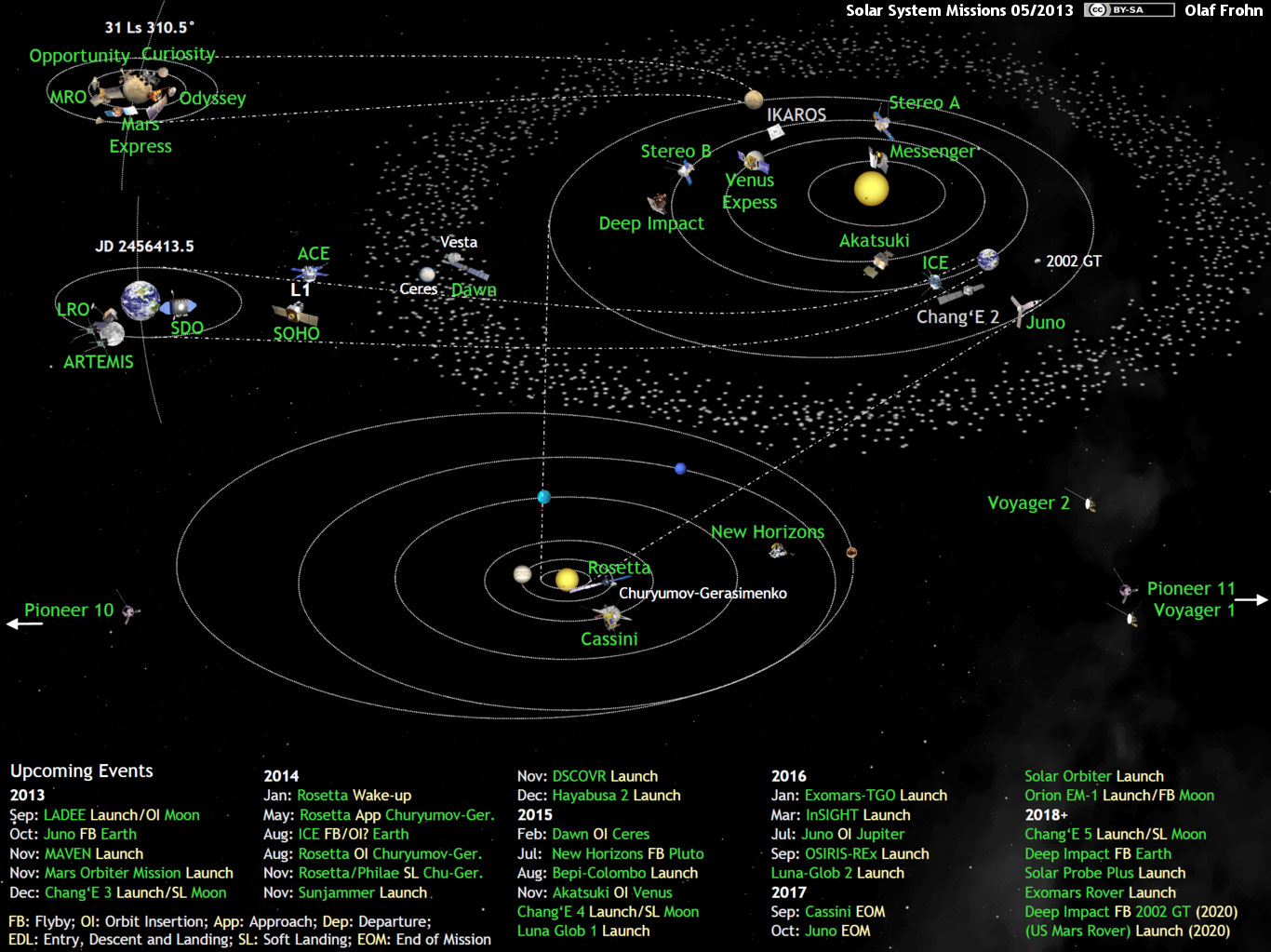
Humanity Explores the Solar System
Illustration Credit &
License: Olaf Frohn (The Planetary Society)
Explanation: What spacecraft is humanity currently using to explore our Solar System? Presently, every inner planet has at least one robotic explorer, while several others are monitoring our Sun, some are mapping Earth's Moon, a few are chasing asteroids and comets, one is orbiting Saturn, and several are even heading out into deep space. The above illustration gives more details, with the inner Solar System depicted on the upper right and the outer Solar System on the lower left. Given the present armada, our current epoch might become known as the time when humanity first probed its own star system. Sometimes widely separated spacecraft act together as an InterPlanetary Network to determine the direction of distant explosions by noting when each probe detects high energy photons. Future spacecraft milestones, as indicated along the bottom of the graphic, include Dawn reaching Ceres, the largest object in the asteroid belt, and New Horizons reaching Pluto, both in 2015.


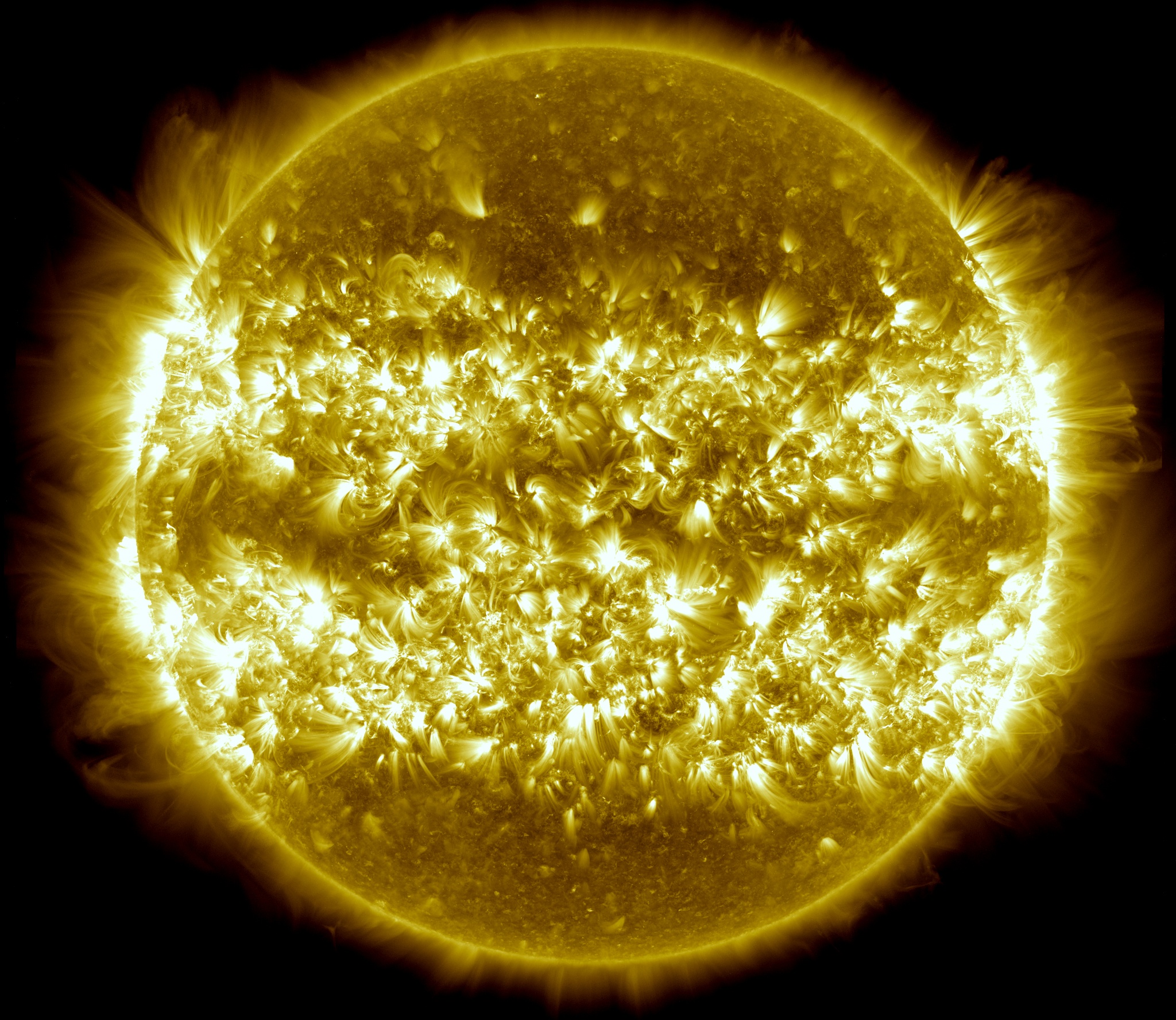
A Year on the Sun
Image Credit:
NASA, Error! Hyperlink reference not valid.
Explanation: Our solar system's miasma of incandescent plasma, the Sun may look a little scary here. The picture is a composite of 25 images recorded in extreme ultraviolet light by the orbiting Solar Dynamics Observatory between April 16, 2012 and April 15, 2013. The particular wavelength of light, 171 angstroms, shows emission from highly ionized iron atoms in the solar corona at a characteristic temperatures of about 600,000 kelvins (about 1 million degrees F). Girdling both sides of the equator during approach to maximum in the 11-year solar cycle, the solar active regions are laced with bright loops and arcs along magnetic field lines. Of course, a more familiar visible light view would show the bright active regions as groups of dark sunspots. Three years of Solar Dynamics Observatory images are compressed into this short video.

Astronomy News:

VLA gives deep, detailed image of distant universe

Published: Tuesday, April 30, 2013 - 12:04 in Astronomy & Space
Staring at a small patch of sky for more than 50 hours with the ultra-sensitive Karl G. Jansky Very Large Array (VLA), astronomers have for the first time identified discrete sources that account for nearly all the radio waves coming from distant galaxies. They found that about 63 percent of the background radio emission comes from galaxies with gorging black holes at their cores and the remaining 37 percent comes from galaxies that are rapidly forming stars. "The sensitivity and resolution of the VLA, following its decade-long upgrade, made it possible to identify the specific objects responsible for nearly all of the radio background emission coming from beyond our own Milky Way Galaxy," said Jim Condon, of the National Radio Astronomy Observatory (NRAO). "Before we had this capability, we could not detect the numerous faint sources that produce much of the background emission," he added.

Previous studies had measured the amount of radio emission coming from the distant Universe, but had not been capable of attributing all the radio waves to specific objects. In earlier observations, emission from two or more faint objects often was blurred or blended into what appeared to be a single, stronger source of radio waves.
"Advancing technology has revealed more and more of the Universe to us over the past few decades, and our study shows individual objects that account for about 96 percent of the background radio emission coming from the distant Universe," Condon said. "The VLA now is a million times more sensitive than the radio telescopes that made landmark surveys of the sky in the 1960s," he added.

"What radio astronomers have accomplished over the past few decades is analogous to advancing from the early Greek maps of the world that showed only the Mediterranean basin to the maps of today that show the whole world in exquisite detail," Condon said.

[Read more details at:  http://esciencenews.com/articles/2013/04/30/vla.gives.deep.detailed.image.distant.universe]

Source: National Radio Astronomy Observatory

Looking for life by the light of dying stars

Published: Wednesday, April 24, 2013 - 11:03 in Astronomy & Space
Because it has no source of energy, a dead star -- known as a white dwarf -- will eventually cool down and fade away. But circumstantial evidence suggests that white dwarfs can still support habitable planets, …[a] "simulated spectrum" demonstrates that the James Webb Space Telescope (JWST), set to be launched by NASA in 2018, will be capable of detecting oxygen and water in the atmosphere of an Earth-like planet orbiting a white dwarf after only a few hours of observation time -- much more easily than for an Earth-like planet orbiting a sun-like star.

Faint light, clear signals

"In the quest for extraterrestrial biological signatures, the first stars we study should be white dwarfs," said Prof. Loeb. Prof. Maoz agrees, noting that if "all the conditions are right, we'll be able to detect signs of life" on planets orbiting white dwarf stars using the much-anticipated JWST.
An abundance of heavy elements already observed on the surface of white dwarfs suggest rocky planets orbit a significant fraction of them. The researchers estimate that a survey of 500 of the closest white dwarfs could spot one or more habitable planets.

The unique characteristics of white dwarfs could make these planets easier to spot than planets orbiting normal stars, the researchers have shown. Their atmospheres can be detected and analyzed when a star dims as an orbiting planet crosses in front of it. As the background starlight shines through the planet's atmosphere, elements in the atmosphere will absorb some of the starlight, leaving chemical clues of their presence -- clues that can then be detected from the JWST.

When an Earth-like planet orbits a normal star, "the difficulty lies in the extreme faintness of the signal, which is hidden in the glare of the 'parent' star," Prof. Maoz says. "The novelty of our idea is that, if the parent star is a white dwarf, whose size is comparable to that of an Earth-sized planet, that glare is greatly reduced, and we can now realistically contemplate seeing the oxygen biomarker."

In order to estimate the kind of data that the JWST will be able to see, the researchers created a "synthetic spectrum," which replicates that of an inhabited planet similar to Earth orbiting a white dwarf. They demonstrated that the telescope should be able to pick up signs of oxygen and water, if they exist on the planet.

A critical sign of life

The presence of oxygen biomarkers would be the most critical signal of the presence of life on extraterrestrial planets. Earth's atmosphere, for example, is 21 percent oxygen, and this is entirely produced by our planet's plant life as a result of photosynthesis. Without the existence of plants, an atmosphere would be entirely devoid of oxygen.

The JWST will be ideal for hunting out signs of life on extraterrestrial planets because it is designed to look into the infrared region of the light spectrum, where such biomarkers are prominent. In addition, as a space-based telescope, it will be able to analyze the atmospheres of Earth-like planets outside our solar system without weeding out the similar signatures of Earth's own atmosphere.

Source: American Friends of Tel Aviv University

[Critical question:  Aren’t white dwarves typically the remains of novae (after red giant phase) that can fry life on nearby planets, and blow away much of their atmosphere?  Would there be any (or sufficient) biomarkers left to detect?  If the planets are farther away, aren’t they likely beyond the “Goldilocks Zone” of habitability?]

General Calendar:

Colloquia, Lectures, Seminars, Meetings, Open Houses & Tours:


Colloquia:  Carnegie (Tues. 4pm), UCLA, Caltech (Wed. 4pm), IPAC (Wed. 12:15pm) & other Pasadena (daily 12-4pm):  http://obs.carnegiescience.edu/seminars/ 

Carnegie astronomy lectures – only 4 per year in the Spring www.obs.carnegiescience.edu.  This year April 8 & 22, May 6 & 20.    Visit www.huntington.org for directions.  For more information about the Carnegie Observatories or this lecture series, please contact Reed Haynie.
Monday, May 6th 2013
The Elements and Astronomy


Dr. Jeff Rich
Postdoctoral Associate,
Carnegie Observatories
The star stuff we are made of has an interesting history. Astronomy has contributed to fundamental knowledge about the elements that make up our everyday life while using the same elements to understand the properties of the cosmos. This talk discusses the connection between the elements and Astronomy past, present and future.


Monday, May 20th 2013
Stars and the Atomic Age

Dr. Ian Roederer
Carnegie Fellow,
Carnegie Observatories
The course of human history may have unfolded quite differently if not for a small impurity in one of the rarest elements on Earth. Dr. Roederer will revisit the story of how stardust from ancient supernovae became the key ingredient in the nuclear arms race.

3 May
SBAS Monthly General Meeting at El Camino College planetarium. 7:30 PM
Topic: “Spectroscopy of White Dwarfs
Speaker: Dr. Stephen Naftilan, Claremont College

May 9 & 10 The von Kármán Lecture Series: 2013

Radar Imaging of Near Earth Asteroids

Radar is a very powerful astronomical technique for studying the physical properties and refining the orbits of near-Earth asteroids. The world’s only two radar telescopes for imaging asteroids are at Arecibo, Puerto Rico, and Goldstone, California. These telescopes can image near-Earth asteroids with resolutions as fine as several meters, which greatly exceeds the finest resolution available from any ground- or space-based optical telescope (even the Hubble Space Telescope). Radar images reveal an object’s size, shape, rotation state, and features on its surface such as craters, ridges, and even large boulders, and have discovered that 1/6 of near-Earth asteroids larger than 200 meters in diameter are double systems that revolve around each other, like miniature versions of the Earth and Moon, and that 10% of near-Earth asteroids look like gigantic peanuts, while others resemble muffins and potatoes!
Speaker:
Dr. Lance Benner, Research Scientist
Jet Propulsion Laboratory

Locations:
Thursday, May 9, 2013, 7pm
The von Kármán Auditorium
at JPL
4800 Oak Grove Drive
Pasadena, CA
› Directions

Friday, May 10, 2013, 7pm
The Vosloh Forum at Pasadena City College
1570 East Colorado Blvd.
Pasadena, CA
› Directions


Webcast:
We offer two options to view the live streaming of our webcast on Thursday:
› 1) Ustream with real-time web chat to take public questions.
› 2)
Flash Player with open captioning
If you don't have Flash Player, you can download for free
here.

13 May
Griffith Observatory
Event Horizon Theater
8:00 PM to 10:00 PM


16 May 2013
Club Meeting
Cassini Update
Dave Doody, JPL
A1/1735


Observing:
The following data are from the 2013 Observer’s Handbook, and Sky & Telescope’s 2013 Skygazer’s Almanac & monthly Sky at a Glance.

A weekly 5 minute video about what’s up in the night sky:  www.skyandtelescope.com/skyweek.

Sun, Moon & Planets for March:


Moon: May 2 last quarter, May 10 new, May 18 1st quarter, May 25 full                             
PlanetsJupiter, Mercury & Venus are close and visible in the West for about an hour after sunset. Saturn is visible all night.  Mars is too near the sun to be visible.


Other Events:


4 May
SBAS Star Party (weather permitting): RPV at Ridgecrest Middle School 28915 North Bay Rd.

5-6 May Eta Aquarid Meteor Shower Peak
The Eta Aquarid meteor shower is the first of two showers that occur each year as a result of Earth
passing through dust released by Halley's Comet, with the second being the Orionids. The point
from where the Eta Aquarid meteors appear to radiate is located within the constellation Aquarius.
Sadly, this location is a bit of a detriment to observers, because this area of this sky only rises an
hour or so before morning twilight begins. observers in the Northern Hemisphere are likely to see
about 10 meteors every hour, while Southern Hemisphere observers will see about 30 per hour.

11 May
SBAS out-of-town observing – contact Greg Benecke http://www.sbastro.net/.  

11 May
LAAS Dark Sky Night : Lockwood Valley (Steve Kufeld Astronomical Site; LAAS members and their guests only)

18 May
Public  Star Party: Griffith Observatory Grounds 2-10pm

25 May Mercury 1.4 deg N of Venus

27 May Mercury 2 deg N of Jupiter

28 May Venus 1.0 deg N of Jupiter

Internet Links:

Link(s) of the Month

A weekly 5 minute video about what’s up in the night sky:  www.skyandtelescope.com/skyweek.


Telescope, Binocular & Accessory Buying Guides


General
Regional (esp. Southern California)

About the Club

Club Websites:  Internal (Aerospace): https://aeropedia.aero.org/aeropedia/index.php/Astronomy_Club  It is updated to reflect this newsletter, in addition to a listing of past club mtg. presentations, astronomy news, photos & events from prior newsletters, club equipment, membership & constitution.  We have linked some presentation materials from past mtgs.  Our club newsletters are also being posted to an external blog, “An Astronomical View” http://astronomicalview.blogspot.com/
 
Membership.  For information, current dues & application, contact Alan Olson, or see the club website (or Aerolink folder) where a form is also available (go to the membership link/folder & look at the bottom).  Benefits will include use of club telescope(s) & library/software, discounts on Sky & Telescope magazine and Observer’s Handbook, field trips, great programs, having a say in club activities, acquisitions & elections, etc.

Committee Suggestions & Volunteers.  Feel free to contact:  Mark Clayson, Program Committee Chairman (& acting club VP), TBD, Activities Committee Chairman (& club Secretary), or Alan Olson, Resource Committee Chairman (over equipment & library, and club Treasurer).

Mark Clayson,
AEA Astronomy Club President 

Wednesday, April 10, 2013

2013 April


AEA Astronomy Club Newsletter April  2013

Contents
AEA Astronomy Club News & Calendar p.1
Video(s) & Picture(s) of the Month p. 3
Astronomy News p. 7
General Calendar p.8
    Colloquia, lectures, mtgs. p. 8
    Observing p. 10
Useful Links p. 11

About the Club p. 12

Club News & Calendar.

Calendar

Club Meeting Schedule:
16 April 2013
Corporate Colloquium
Einstein for Everyone
Robert Piccioni, UCLA
A1/Titan IV A
16 May 2013
Club Meeting
Cassini Update
Dave Doody, JPL
A1/1735
20 June 2013
Club Meeting & Pizza Party
The Chemical Makeup of Exosolar Planets
Dr. Steven Naftilan, Claremont College
A1/1735

AEA Astronomy Club meetings are on 3rd Thursdays at 11:45am.  For all of 2013, the meeting room is A1/1735.

News:  

The April club mtg. that would normally have been April 18 is being combined w. the April 16 Corporate Colloquium.  We may have some of our new equipment on display, also.

New club equipment:  This past week we have begun receiving the items ordered below that will be available for your use (if your dues are up to date).  Some smaller apertures for those desiring portability or intimidated by size or complexity.


We already received the 15x70 waterproof binoculars & case, and the adjustable binocular mount that goes on the Paragon tripod we already have.  Also a smart phone bracket that attaches to the binoculars, so that you can use your sky app to display and identify what you're looking at.  And a scope cloak for the LX-200.  I also have & checked out the the Meade ETX80-AT (80mm) GoTo refractor with tripod.  We got the ETX-80 backpack observatory package that comes with its own backpack.

In the next day or 2, we should have the Meade ETX90-AT (90mm) GoTo Maksutov with portable tripod.  The portable observatory model we got comes in a hard shell case.  The ETX’s are small and very easy to port anywhere -- even as carry-on luggage. 

One nice thing about the ETX's is that their GoTo hand controller & computer menu navigation is the same as our LX200's -- so if you learn one, you've learned them all.  Of course the ETX's don't have the auto-alignment of the LX200.

We’re also eyeing the Orion SkyScanner 100mm TableTop Reflector (Newtonian) as another easy, basic, grab-and-go scope to add a 4-inch to our 8- and 16-inch reflector inventory (a nice geometric series), and to add a 100mm aperture to our 70, 80 & 90mm small apertures (an arithmetic series, not including the 40mm H-alpha).

A smart phone eyepiece photography bracket is also on backorder.

Still haven't decided on a portable equatorial drive mount for the H-alpha scope (& for cameras or small scopes) -- inputs are appreciated.  Or a quality wide-field eyepiece -- inputs also appreciated.  Otherwise, we're continuing to make progress down the already-shared wish list, having spent nearly half of our AEA allotment for the year.  I'm taking the lack of voiced preferences so far as consent to the decisions made & items on the wish list.

Telescope, Binocular & Accessory Buying Guides – see the new links added to the links collection towards the end of this newsletter & the club website.  In response to requests.


The 45th annual RTMC Astronomy Expo will take place from Thursday, May 23 through Monday, May 27, 2013. It will be held at YMCA Camp Oakes, five miles southeast of Big Bear City, California on State Route 38 at Lake Williams Road between mileposts 44 and 45. This location is about 50 miles northeast of Riverside in the San Bernardino.  For more information & to pre-register (reduced price), go to mountains.http://www.rtmcastronomyexpo.org/.  And let us know if you plan to go – we can put you in touch with others going (already a couple I’m aware of).

Tom Paige brought us up to date on the proposed cooperative amateur observatory in Palos Verdes.  Suggestions for the facility & equipment, sponsors, etc. are still being collected and are appreciated.

Field Trip.  There have been few responses so far on the survey of interests in candidate club field trips for the year.  Unless additional responses come in, we table it for now. Ideas include:  Mt. Palomar tour & star party/camping, JPL tour (or open house in June), Griffith Observatory, Calif. Science Museum (incl. Endeavor, IMAX,...), the Columbia Memorial Space Center in Downey (Apollo & Shuttle history),.... Other suggestions?

Membership Renewals.  Some still need to renew their club membership.  See the club website for the many benefits of membership.  Please submit the renewal form (available on Aerolink at https://aerolink.aero.org/cs/llisapi.dll?func=ll&objId=13659520&objAction=browse&viewType=1, or attached) with your payment ($12 check made out to AEA Astronomy Club) to Alan Olson at M1-107.


Astronomy Video(s) & Picture(s) of the Month
(from Astronomy Picture of the Day, APOD: http://apod.nasa.gov/apod/archivepix.html)


Flying Over the Earth at Night http://apod.nasa.gov/apod/ap130331.html
Video Credit:
Gateway to Astronaut Photography, NASA ; Compilation: David Peterson (YouTube);
Music: Freedom Fighters (
Two Steps from Hell)
Explanation: Many wonders are visible when flying over the Earth at night. A compilation of such visual spectacles was captured recently from the International Space Station (ISS) and set to rousing music. Passing below are white clouds, orange city lights, lightning flashes in thunderstorms, and dark blue seas. On the horizon is the golden haze of Earth's thin atmosphere, frequently decorated by dancing auroras as the video progresses. The green parts of auroras typically remain below the space station, but the station flies right through the red and purple auroral peaks. Solar panels of the ISS are seen around the frame edges. The ominous wave of approaching brightness at the end of each sequence is just the dawn of the sunlit half of Earth, a dawn that occurs every 90 minutes
2013 March 25

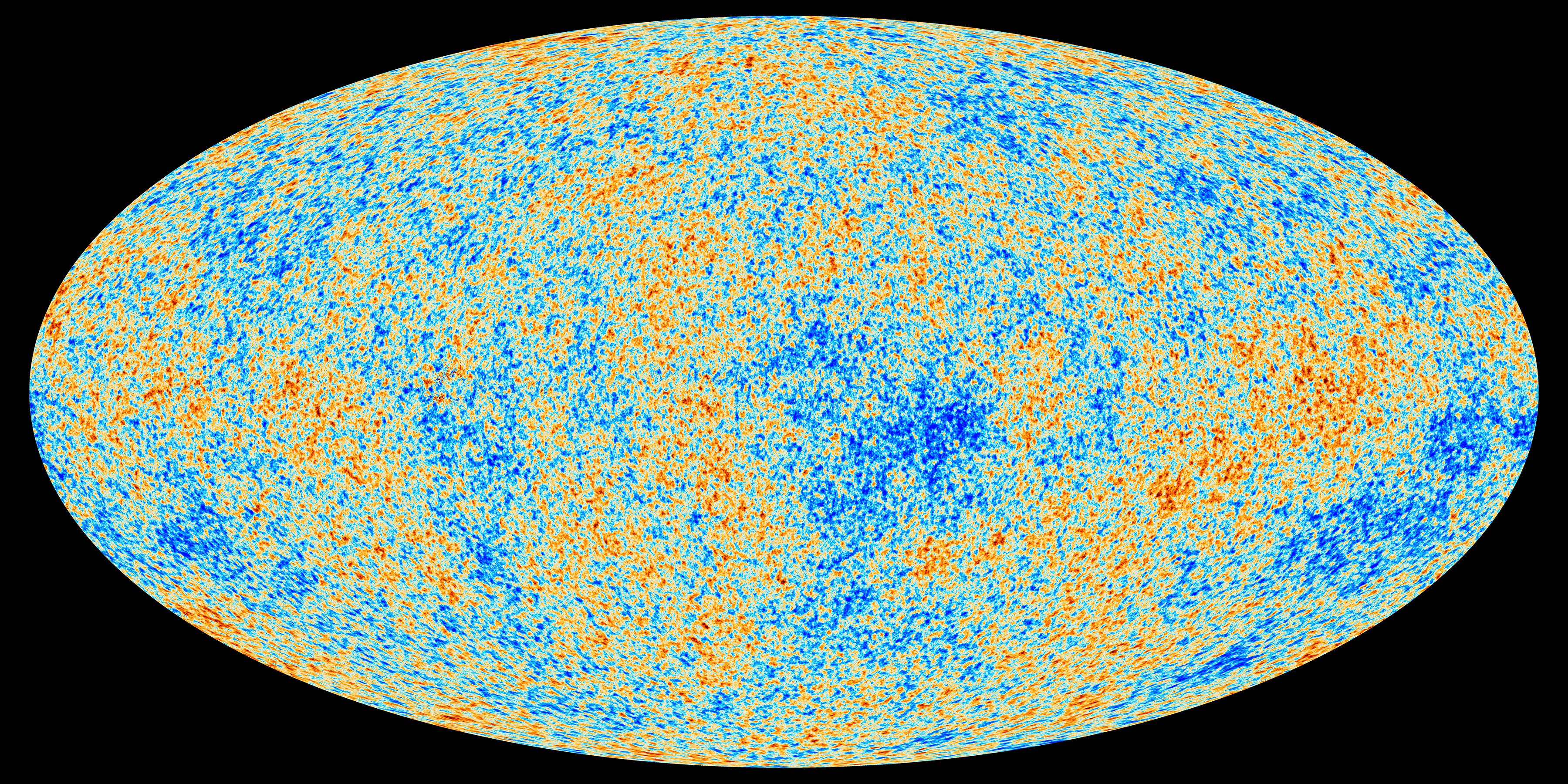
Planck Maps the Microwave Background
Image Credit:
European Space Agency, Planck Collaboration
Explanation: What is our universe made of? To help find out, ESA launched the Planck satellite to map, in unprecedented detail, slight temperature differences on the oldest surface known -- the background sky left billions of years ago when our universe first became transparent to light. Visible in all directions, this cosmic microwave background is a complex tapestry that could only show the hot and cold patterns observed were the universe to be composed of specific types of energy that evolved in specific ways. The results, reported last week, confirm again that most of our universe is mostly composed of mysterious and unfamiliar dark energy, and that even most of the remaining matter energy is strangely dark. Additionally, Planck data impressively peg the age of the universe at about 13.81 billion years, slightly older than that estimated by various other means including NASA's WMAP satellite, and the expansion rate at 67.3 (+/- 1.2) km/sec/Mpc, slightly lower than previous estimates. Some features of the above sky map remain unknown, such as why the temperature fluctuations seem to be slightly greater on one half of the sky than the other.


2013 March 15

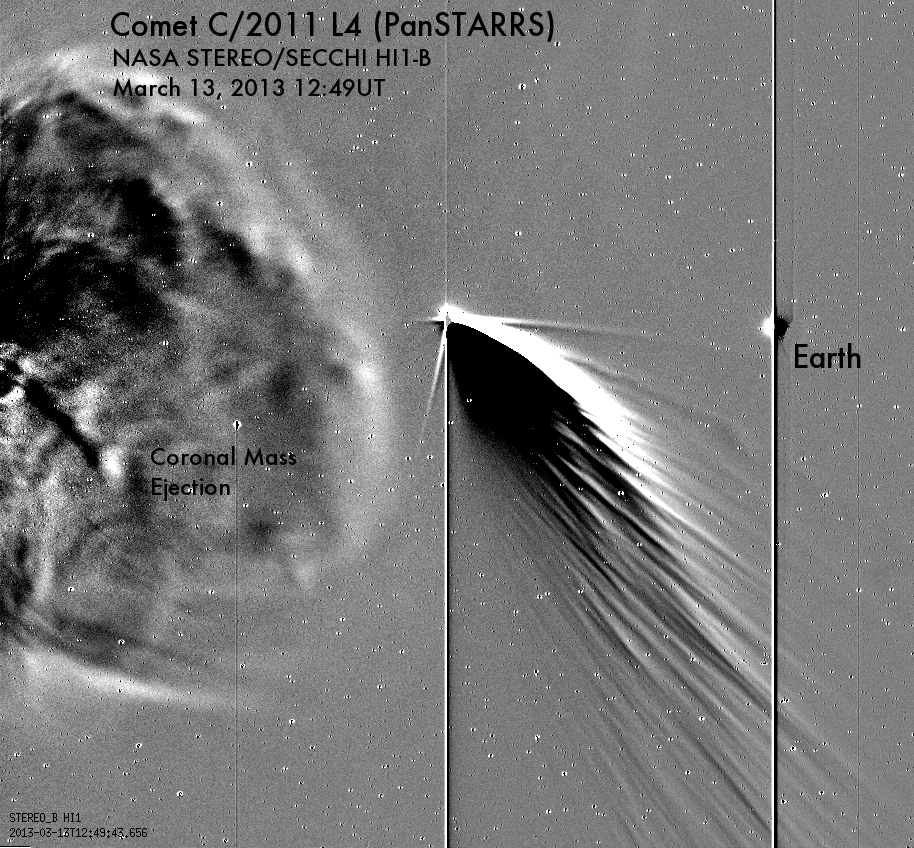
CME, Comet and Planet Earth
Image Credit:
NRL / SECCHI / STEREO / NASA
Processing - Karl Battams (NRL and
@SungrazerComets)
Explanation: After appearing in a popular photo opportunity with a young crescent Moon near sunset, naked-eye Comet PanSTARRS continues to rise in northern hemisphere skies. But this remarkable interplanetary perspective from March 13, finds the comet posing with our fair planet itself - as seen from the STEREO Behind spacecraft. Following in Earth's orbit, the spacecraft is nearly opposite the Sun and looks back toward the comet and Earth, with the Sun just off the left side of the frame. At the left an enormous coronal mass ejection (CME) is erupting from a solar active region. Of course, CME, comet, and planet Earth are all at different distances from the spacecraft. (The comet is closest.) The processed digital image is the difference between two consecutive frames from the spacecraft's SECCHI Heliospheric Imager, causing the strong shadowing effect for objects that move between frames. Objects that are too bright create the sharp vertical lines. The processing reveals complicated feather-like structures in Comet PanSTARRS's extensive dust tail.


2013 March 10

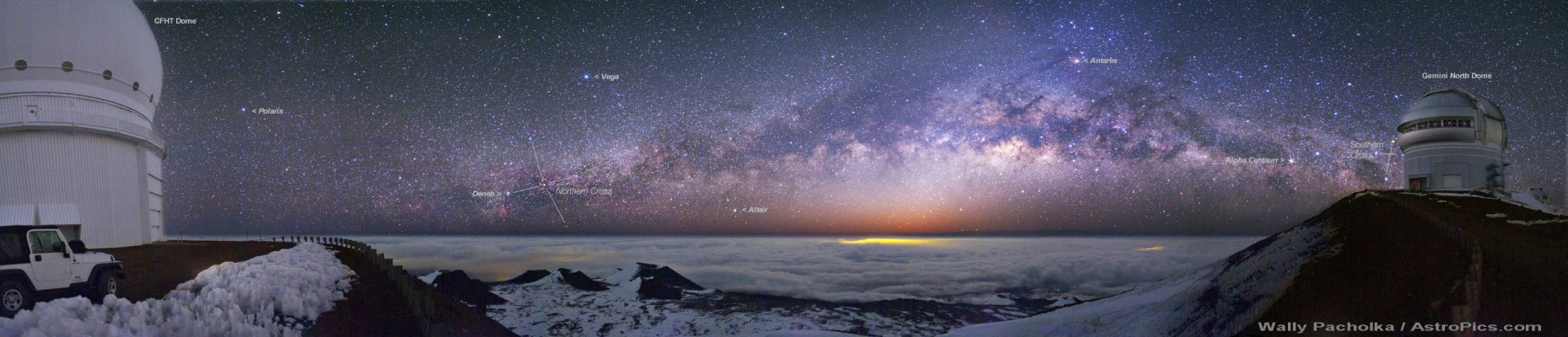
Milky Way Panorama from Mauna Kea
Image Credit &
Copyright: Wally Pacholka (TWAN)
Explanation: Aloha and welcome to a breathtaking skyscape. The dreamlike panoramic view looks out from the 4,200 meter volcanic summit of Mauna Kea, Hawai'i, across a layer of clouds toward a starry night sky and the rising Milky Way. Anchoring the scene on the far left is the dome of the Canada-France-Hawaii Telescope (CFHT), with north star Polaris shining beyond the dome to the right. Farther right, headed by bright star Deneb, the Northern Cross asterism is embedded along the plane of the Milky Way as it peeks above the horizon. Both Northern Cross and brilliant white Vega hang over a foreground grouping of cinder cones. Near the center are the reddish nebulae, stars and dust clouds of the central Milky Way. Below, illumination from the city lights of Hilo creates an eerie, greenish glow in the clouds. Red supergiant star Antares shines above the Milky Way's central bulge while bright Alpha Centauri lies still farther right, along the dusty galactic plane. Finally, at the far right is the large Gemini North Observatory. The compact group of stars known as the Southern Cross is just left of the telescope dome. Need some help identifying the stars? Just slide your cursor over the picture, or download this smaller, labeled panorama.

2013 March 17

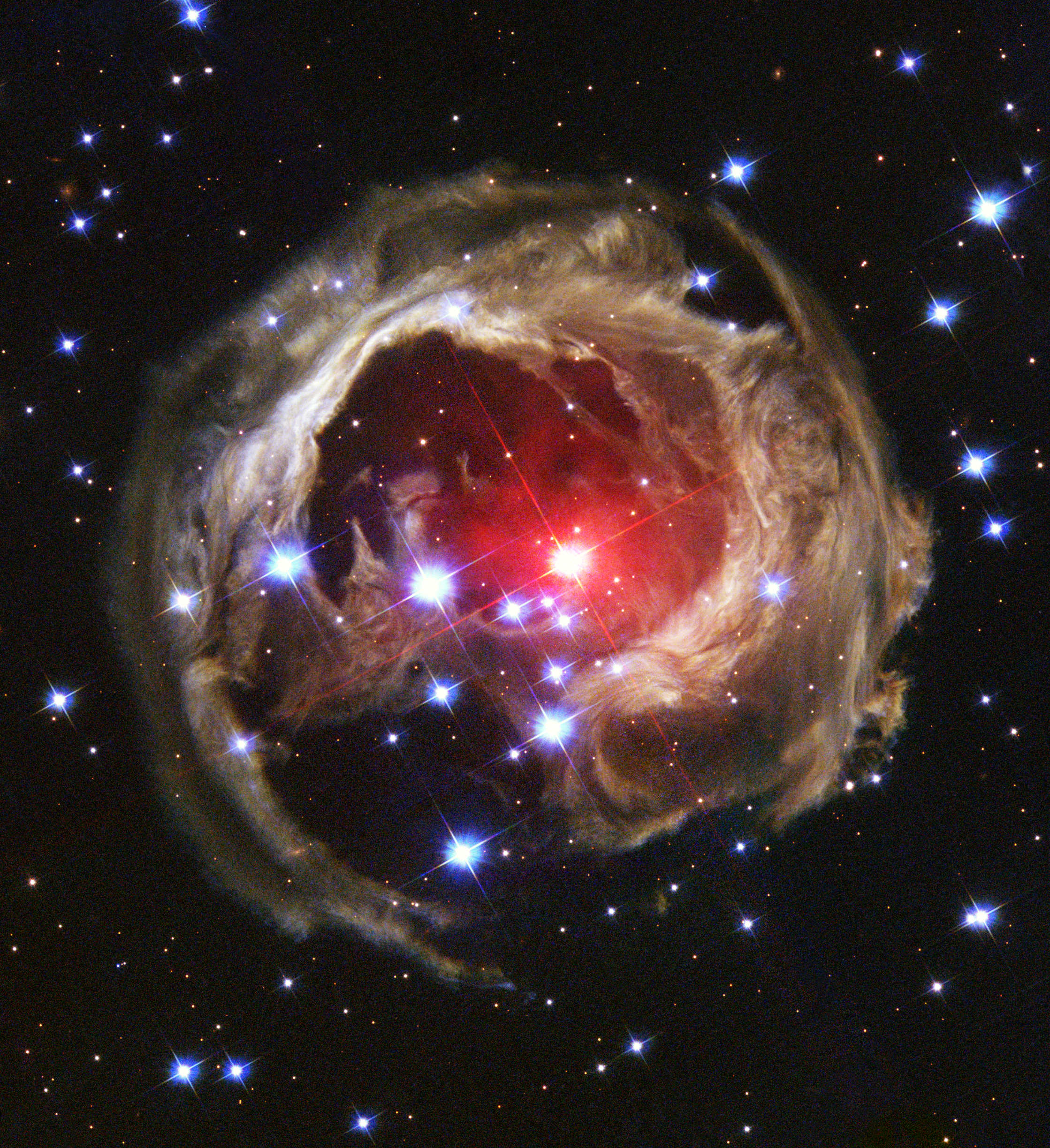
Light Echoes from V838 Mon
Image Credit:
NASA, ESA, H. E. Bond (STScI)
Explanation: What caused this outburst of V838 Mon? For reasons unknown, star V838 Mon's outer surface suddenly greatly expanded with the result that it became the brightest star in the entire Milky Way Galaxy in January 2002. Then, just as suddenly, it faded. A stellar flash like this had never been seen before -- supernovas and novas expel matter out into space. Although the V838 Mon flash appears to expel material into space, what is seen in the above image from the Hubble Space Telescope is actually an outwardly moving light echo of the bright flash. In a light echo, light from the flash is reflected by successively more distant rings in the complex array of ambient interstellar dust that already surrounded the star. V838 Mon lies about 20,000 light years away toward the constellation of the unicorn (Monoceros), while the light echo above spans about six light years in diameter.

2013 April 8

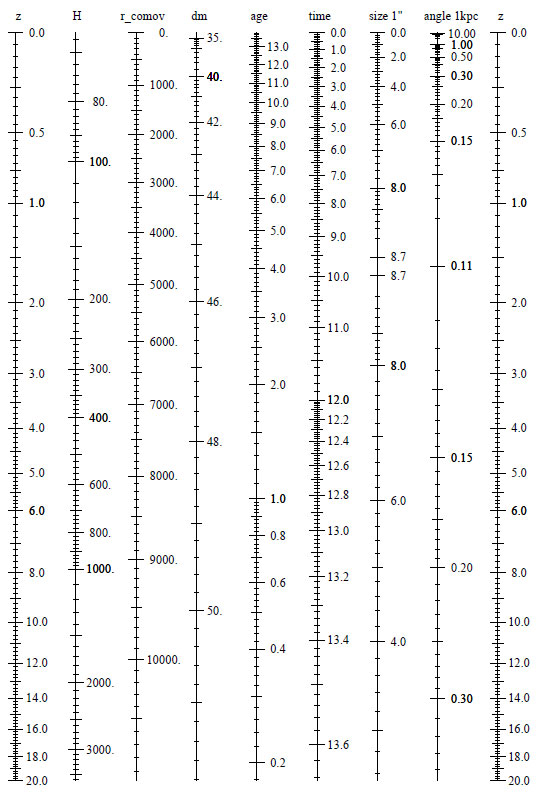
A Redshift Lookup Table for our Universe
Image Credit: Sergey V. Pilipenko (
LPI, MIPT)
Explanation: How far away is "redshift six"? Although humans are inherently familiar with distance and time, what is actually measured for astronomical objects is redshift, a color displacement that depends on exactly how energy density has evolved in our universe. Now since cosmological measurements in recent years have led to a concordance on what energy forms pervade our universe, it is now possible to make a simple table relating observed cosmological redshift, labeled "z", with standard concepts of distance and time, including the extrapolated time since the universe began. One such table is listed above, where redshift z is listed in the first and last columns, while the corresponding universe age in billions of years is listed in the central column. To find the meaning of the rest of the columns, please read the accompanying technical paper. Although stars in our galaxy are effectively at cosmological redshift zero, the most distant supernovae seen occur out past redshift one, which the above chart shows occurred when the universe was approximately half its present age. By contrast, the most distant gamma-ray bursts yet observed occur out past redshift six, occurring when the universe was younger than one billion years old, less than 10 percent of its present age.


Astronomy News:
New insights on how spiral galaxies get their arms
Published: Tuesday, April 2, 2013 - 12:37 in
Astronomy & Space
http://esciencenews.com/files/images/201304027622540.jpg
Thiago Ize & Chris Johnson (Scientific Computing and Imaging Institute)

Spiral galaxies are some of the most beautiful and photogenic residents of the universe. Our own Milky Way is a spiral. Our solar system and Earth reside somewhere near one of its filamentous arms. And nearly 70 percent of the galaxies closest to the Milky Way are spirals. But despite their common shape, how galaxies like ours get and maintain their characteristic arms has proved to be an enduring puzzle in astrophysics. How do the arms of spiral galaxies arise? Do they change or come and go over time?

The answers to these and other questions are now coming into focus as researchers capitalize on powerful new computer simulations to follow the motions of as many as 100 million "stellar particles" as gravity and other astrophysical forces sculpt them into familiar galactic shapes. A team of researchers from the University of Wisconsin-Madison and the Harvard-Smithsonian Center for Astrophysics reports simulations that seem to resolve long-standing questions about the origin and life history of spiral arms in disk galaxies.

"We show for the first time that stellar spiral arms are not transient features, as claimed for several decades," says UW-Madison astrophysicist Elena D'Onghia, who led the new research along with Harvard colleagues Mark Vogelsberger and Lars Hernquist.

"The spiral arms are self-perpetuating, persistent, and surprisingly long lived," adds Vogelsberger.

The origin and fate of the emblematic spiral arms in disk galaxies have been debated by astrophysicists for decades, with two theories predominating. One holds that the arms come and go over time. A second and widely held theory is that the material that makes up the arms -- stars, gas and dust -- is affected by differences in gravity and jams up, like cars at rush hour, sustaining the arms for long periods.

The new results fall somewhere in between the two theories and suggest that the arms arise in the first place as a result of the influence of giant molecular clouds -- star forming regions or nurseries common in galaxies. Introduced into the simulation, the clouds act as "perturbers" and are enough to not only initiate the formation of spiral arms but to sustain them indefinitely.

"We find they are forming spiral arms," explains D'Onghia. "Past theory held the arms would go away with the perturbations removed, but we see that (once formed) the arms self-perpetuate, even when the perturbations are removed. It proves that once the arms are generated through these clouds, they can exist on their own through (the influence of) gravity, even in the extreme when the perturbations are no longer there."

The new study modeled stand-alone disk galaxies, those not influenced by another nearby galaxy or object. Some recent studies have explored the likelihood that spiral galaxies with a close neighbor (a nearby dwarf galaxy, for example) get their arms as gravity from the satellite galaxy pulls on the disk of its neighbor.

According to Vogelsberger and Hernquist, the new simulations can be used to reinterpret observational data, looking at both the high-density molecular clouds as well as gravitationally induced "holes" in space as the mechanisms that drive the formation of the characteristic arms of spiral galaxies.


General Calendar:

Colloquia, Lectures, Seminars, Meetings, Open Houses & Tours:


Colloquia:  Carnegie (Tues. 4pm), UCLA, Caltech (Wed. 4pm), IPAC (Wed. 12:15pm) & other Pasadena (daily 12-4pm):  http://obs.carnegiescience.edu/seminars/ 

Carnegie astronomy lectures – only 4 per year in the Spring www.obs.carnegiescience.edu.  This year April 8 & 22, May 6 & 20.    Visit www.huntington.org for directions.  For more information about the Carnegie Observatories or this lecture series, please contact Reed Haynie.

5 April
SBAS Monthly General Meeting at El Camino College planetarium. 7:30 PM
Topic: “Mystery Moon Titan”, Speaker: Dr. Michael J. Malaska, JPL

8 April
Griffith Observatory
Event Horizon Theater
8:00 PM to 10:00 PM

April 11 & 12 The von Kármán Lecture Series: 2013

Regenerative Fuel Cells, Energy Storage Systems for Space Applications

A recent thrust in the development of regenerative fuel cell systems has been led by the National Aeronautics and Space Administration (NASA). Regenerative fuel cell systems provide energy storage at a scale that is larger than what is practical with advanced batteries. In a regenerative fuel cell system, energy storage is achieved via the electrolysis of water to hydrogen and oxygen gas during the storage phase. Consumption of gases then occurs during the energy generation phase, with the subsequent generation of water. It is envisioned that the energy for the electrolysis of water be supplied via solar power. The regenerative fuel cell systems can be used to power robots, mobility systems, and human habitats. This talk will provide an introduction of fuel cells and regenerative fuel cell systems and highlight the features of this technology for enabling future NASA missions to the moon, near-Earth asteroids, and Mars.
Speaker:
Thomas Valdez, Senior Member Engineering Staff, Fuel Cell Group Lead
Jet Propulsion Laboratory

Locations:
Thursday, April 11, 2013, 7pm
The von Kármán Auditorium
at JPL
4800 Oak Grove Drive
Pasadena, CA
› Directions

Friday, April 12, 2013, 7pm
The Vosloh Forum at Pasadena City College
1570 East Colorado Blvd.
Pasadena, CA
› Directions
Webcast:
We offer two options to view the live streaming of our webcast on Thursday:
› 1) Ustream with real-time web chat to take public questions.
› 2)
Flash Player with open captioning
If you don't have Flash Player, you can download for free
here.


16 April 2013
AEA Astronomy Club mtg. & Corporate Colloquium
Einstein for Everyone
Robert Piccioni, UCLA
A1/1735


Observing:
The following data are from the 2013 Observer’s Handbook, and Sky & Telescope’s 2013 Skygazer’s Almanac & monthly Sky at a Glance.

A weekly 5 minute video about what’s up in the night sky:  www.skyandtelescope.com/skyweek.

Sun, Moon & Planets for March:


Moon: Apr 3 last quarter, Apr 10 new, Apr 18 1st quarter, Apr 25 full                                  
PlanetsJupiter sets a few hours after sunset. Saturn rises shortly after sunset & is visible for the rest of the night.  Mercury is visible briefly in the East before sunrise.  Venus is visible briefly in the West after sunset. Mars is too near the sun to be visible.
Other Events:

6 April
SBAS out-of-town observing – contact Greg Benecke http://www.sbastro.net/.  

13 April
LAAS Dark Sky Night : Lockwood Valley (Steve Kufeld Astronomical Site; LAAS members and their guests only)

14 April Jupiter 2 deg. N of Moon

20 April
Public  Star Party: Griffith Observatory Grounds 2-10pm

22 April Lyrid Meteors peak The Lyrids generally begin on April 16 and end on April 26, with maximum generally occurring during the night of April 21/22. At maximum, hourly rates can reach about 10
meteors per hour. The Lyrids are particularly interesting for two reason. First, observations
have been identified back to at least 2600 years, which is longer than any other meteor
shower. Second, the meteor shower occasionally experiences an outburst of about 100
meteors per hour and the reason is basically unknown.

27 April
SBAS Star Party (weather permitting): RPV at Ridgecrest Middle School 28915 North Bay Rd.

28 April Saturn at opposition & closest to earth for 2013

Internet Links:

Link(s) of the Month

A weekly 5 minute video about what’s up in the night sky:  www.skyandtelescope.com/skyweek.

Telescope, Binocular & Accessory Buying Guides


General
Regional (esp. Southern California)
Mt. Wilson Institute (www.mtwilson.edu/), including status for visits & roads


About the Club
Club Websites:  Internal (Aerospace): https://aeropedia.aero.org/aeropedia/index.php/Astronomy_Club  It is updated to reflect this newsletter, in addition to a listing of past club mtg. presentations, astronomy news, photos & events from prior newsletters, club equipment, membership & constitution.  We have linked some presentation materials from past mtgs.  Our club newsletters are also being posted to an external blog, “An Astronomical View” http://astronomicalview.blogspot.com/
 
Membership.  For information, current dues & application, contact Alan Olson, or see the club website (or Aerolink folder) where a form is also available (go to the membership link/folder & look at the bottom).  Benefits will include use of club telescope(s) & library/software, discounts on Sky & Telescope magazine and Observer’s Handbook, field trips, great programs, having a say in club activities, acquisitions & elections, etc.

Committee Suggestions & Volunteers.  Feel free to contact:  Mark Clayson, Program Committee Chairman (& acting club VP), TBD, Activities Committee Chairman (& club Secretary), or Alan Olson, Resource Committee Chairman (over equipment & library, and club Treasurer).

Mark Clayson,
AEA Astronomy Club President