The Hubble Ultra Deep Field Image (see description on the right, below)

The Hubble Ultra Deep Field Image
(10,000 galaxies in an area 1% of the apparent size of the moon -- see description on the right, below)

Friday, July 8, 2016

2016 July

AEA Astronomy Club Newsletter July 2016

Contents 
AEA Astronomy Club News & Calendar p.1
Video(s) & Picture(s) of the Month p. 2
Astronomy News p. 6
General Calendar p. 9
    Colloquia, lectures, mtgs. p. 9
    Observing p. 11
Useful Links p. 12
About the Club p. 13

Club News & Calendar. 

Club Calendar

Club Meeting Schedule:

7 July AEA Astronomy Club Meeting
Pizza & “Meteor Swarms & Satellites,” Glenn Peterson
(A1/1735)

AEA Astronomy Club meetings are now on 1st  Thursdays at 11:45am.  For all of 2016, the meeting room is A1/1735.  


Club News:   


2017 (Aug. 21) Solar Eclipse Expedition.  We have reserved viewing sites in & near Rexburg, Idaho, within a few miles of eclipse centerline (losing only 1 second of totality).  Rexburg is 25 miles north of Idaho Falls, and about an hour and a half from both West Yellowstone & Jackson Hole, Wyoming.  The in-town site is on the campus of BYU-Idaho, and the other a gun club 9 miles west of town.  Additionally, in case of local cloud cover that morning, state road 33 running thru & east & west of Rexburg provides over 50 miles of flexibility in each direction, following closely the eclipse centerline and losing no more than several seconds of totality.

12 survey respondents stepped forward to join the photo pool, which will be making arrangements on best use of club and personal equipment for photographing/videographing the partial phases, diamond ring, totality (corona, prominences), events on the ground, etc.

The travel committee is researching lodging in Rexburg, Idaho Falls, West Yellowstone & Jackson Hole.  And air travel to Idaho Falls and Pocatello.

Sept. 1 Mt. Wilson Night preparations are on track for the tours of the Aerospace facility & Mt. Wilson, and observing on the 60-inch telescope as well as the club’s 10-inch Meade SCT.  There is a waiting list for those not in the group limit of 25.


Astronomy Video(s) & Picture(s) of the Month 
(from Astronomy Picture of the Day, APOD: http://apod.nasa.gov/apod/archivepix.html 

VIDEO:  Juno Mission Trailer http://apod.nasa.gov/apod/ap160628.html 
Video Credit: NASA, JPL, Juno Mission
Explanation: What will NASA's Juno spacecraft find when it reaches Jupiter next Monday? Very little, if Juno does not survive Jupiter Orbit Insertion, a complex series of operations in an unknown environment just above Jupiter's cloud tops. If successful, as explained in the featured video, Juno will swoop around Jupiter, passing closer than any previous spacecraft. The goal is to decelerate, enter into a highly elliptical orbit, and begin two years of science operations. Juno's science mission objectives include mapping Jupiter's deep structure, determining how much water is in Jupiter's atmosphere, and exploring Jupiter's powerful magnetic field and how it creates auroras around Jupiter's poles. These lessons hold promise to help humanity better understand the history of our Solar System and the dynamics of our Earth. Juno is powered predominantly by three large solar panels, each measuring a side of small truck. Launched in 2011, Juno's planned mission will take it around the Jovian giant 37 times, after which, to avoid contaminating Europa with microbes, it will be directed to dive into Jupiter's thick atmosphere, where it will break apart and melt.

VIDEO:  GW151226: A Second Confirmed Source of Gravitational Radiation http://apod.nasa.gov/apod/ap160615.html  
Illustration Credit: LIGO, NSF
Explanation: A new sky is becoming visible. When you look up, you see the sky as it appears in light -- electromagnetic radiation. But just over the past year, humanity has begun to see our once-familiar sky as it appears in a different type of radiation -- gravitational radiation. Today, the LIGO collaboration is reporting the detection of GW151226, the second confirmed flash of gravitational radiation afterGW150914, the historic first detection registered three months earlier. As its name implies, GW151226 was recorded in late December of 2015. It was detected simultaneously by both LIGO facilities inWashington and Louisiana, USA. In the featured video, an animated plot demonstrates how the frequency of GW151226 changed with time during measurement by the Hanford, Washington detector. This GW-emitting system is best fit by two merging black holes with initial masses of about 14 and 8 solar masses at a redshift of roughly 0.09, meaning, if correct, that it took roughly 1.4 billion years for this radiation to reach us. Note that the brightness and frequency -- here mapped into sound -- of the gravitational radiation peaks during the last second of the black hole merger. As LIGO continues to operate, as its sensitivity continues to increase, and as other gravitational radiation detectors come online in the next few years, humanity's new view of the sky will surely change humanity's understanding of the universe

VIDEO:  Tycho's Supernova Remnant Expands http://apod.nasa.gov/apod/ap160601.html 
Video Credit: NASA, CXC, GSFC, B. Williams et al.
Explanation: What star created this huge expanding puffball? Featured here is the first expansion movie ever created for Tycho's supernova remnant, the result of a stellar explosion first recorded over 400 years ago by the famous astronomer Tycho Brahe. The 2-second video is a time-lapse composite of X-ray images taken by the orbiting Chandra X-ray Observatory between the years 2000 and 2015, added to a stock optical frame. The expanding gas cloud is extremely hot, while slightly different expansion speeds have given the cloud a puffy appearance. Although the star that created SN 1572, is likely completely gone, a star dubbed Tycho G, too dim to be discerned here, is thought to be a companion. Finding progenitor remnants of Tycho's supernova is particularly important because the supernova is of Type Ia, an important rung in the distance ladder that calibrates the scale of the visible universe. The peak brightness of Type Ia supernovas is thought to be well understood, making them quite valuable in exploring the relationship between faintness and farness in the distant universe.


The New World Atlas of Artificial Sky Brightness 
Image Credit & License: F. Falchi et al., Light Pollution Atlas, ISTIL
Explanation: How far are you from a naturally dark night sky? In increasing steps, this world map (medium | large) shows the effect of artificial night sky brightness on the visual appearance of the night sky. The brightness was modeled using high resolution satellite data and fit to thousands of night sky brightness measurements in recent work. Color-coded levels are compared to the natural sky brightness level for your location. For example, artificial sky brightness levels in yellow alter the natural appearance of the night sky. In red they hide the Milky Way in an artificial luminous fog. The results indicate that the historically common appearance of our galaxy at night is now lost for more than one-third of humanity. That includes 60% of Europeans and almost 80% of North Americans, along with inhabitants of other densely populated, light-polluted regions of planet Earth.


Northern Lights above Lofoten 
Image Credit & Copyright: Alex Conu
Explanation: The Aurora Borealis or northern lights are familiar visitors to night skies above the village of Reine in the Lofoten Islands, Norway, planet Earth. In this scene, captured from a mountaintop camp site, the auroral curtains do seem to create an eerie tension with the coastal lights though. A modern perspective on the world at night, the stunning image was chosen as the over all winner in The World at Night's 2016 International Earth and Sky Photo Contest. Selections were made from over 900 entries highlighting the beauty of the night sky and its battle with light pollution.


Galaxy and Planets Beyond Bristlecone Pines 
Image Credit & Copyright: Brad Goldpaint (Goldpaint Photography)
Explanation: What's older than these ancient trees? Nobody you know -- but almost everything in the background of this picture. The trees are impressively old -- each part of the Ancient Bristlecone Pine Forest located in eastern California, USA. There, many of the oldest trees known are located, some dating as far back as about 5,000 years. Seemingly attached to tree branches, but actually much farther in the distance, are the bright orbs of Saturn (left) and Mars. These planets formed along with the Earth and the early Solar System much earlier -- about 4.5 billion years ago. Swooping down diagonally from the upper left is the oldest structure pictured: the central band of our Milky Way Galaxy -- dating back around 9 billion years. The featured image was built from several exposures all taken from the same location -- but only a few weeks ago.


Sunrise Solstice over Stonehenge 
Image Credit & Copyright: Max Alexander, STFC, SPL
Explanation: Today the Sun reaches its northernmost point in planet Earth's sky. Called a solstice, the date astronomically marks a change of seasons -- from spring to summer in Earth's Northern Hemisphere and from fall to winter in Earth's Southern Hemisphere. The featured image was taken during the week of the 2008 summer solstice at Stonehenge in United Kingdom, and captures a picturesque sunrise involving fog, trees, clouds, stones placed about 4,500 years ago, and a 4.5 billion year old large glowing orb. Even given the precession of the Earth's rotational axis over the millennia, the Sun continues to rise over Stonehenge in an astronomically significant way.


Astronomy News: 
(from http://esciencenews.com/topics/astronomy.space) 

A new look at the galaxy-shaping power of black holes
Published: Wednesday, July 6, 2016 - 14:04 in Astronomy & Space
Related images


University of Waterloo


Data - Hubble Legacy Archive, ESA, NASA; Processing - Al Kelly


University of Waterloo

Data from a now-defunct X-ray satellite is providing new insights into the complex tug-of-war between galaxies, the hot plasma that surrounds them, and the giant black holes that lurk in their centres. Launched from Japan on February 17, 2016, the Japanese space agency (JAXA) Hitomi X-ray Observatory functioned for just over a month before contact was lost and the craft disintegrated. But the data obtained during those few weeks was enough to paint a startling new picture of the dynamic forces at work within galaxies.

New research, published in the journal Naturetoday, reveals data that shows just how important the giant black holes in galactic centres are to the evolution of the galaxies as a whole.

"We think that supermassive black holes act like thermostats," said Brian McNamara, University Research Chair in Astrophysics at the University of Waterloo. "They regulate the growth of galaxies."
Champagne bubbles of plasma

During its brief life, the Hitomi satellite collected X-ray data from the core of the Perseus cluster, an enormous gravitationally-bound grouping of hundreds of galaxies. Located some 240 million light years from earth, the Perseus cluster is one of the largest known structures in the universe. The cluster includes not only the ordinary matter that makes up the galaxies, but an "atmosphere" of hot plasma with a temperature of tens of millions of degrees, as well as a halo of invisible dark matter.

Earlier studies, going back to the 1960s, have shown that each of the galaxies in the cluster - and indeed most galaxies - likely contains a supermassive black hole in its centre, an object 100 million to more than ten billion times as massive as our sun.

"These giant black holes are among the universe's most efficient energy generators, a hundred times more efficient than a nuclear reactor," said McNamara from Waterloo's Department of Physics and Astronomy in the Faculty of Science. "Matter falling into the black hole is ripped apart, releasing vast amounts of energy in the form of high speed particles and thermal energy."

This heat is released from just outside the black hole's event horizon, the boundary of no return. The remaining matter gets absorbed into the black hole, adding to its mass. The released energy heats up the surrounding gas, creating bubbles of hot plasma that ripple through the cluster, just as bubbles of air rise up in a glass of champagne.

The research is shedding light on the crucial role that this hot plasma plays in galactic evolution. Researchers are now tackling the foremost issue in the formation of structure in the universe and asking: why doesn't most of the gas cool down, and form stars and galaxies? The answer seems to be that bubbles created by blasts of energy from the black holes keep temperatures too high for such structures to form.

"Any time a little bit of gas falls into the black hole, it releases an enormous amount of energy," said McNamara. "It creates these bubbles, and the bubbles keep the plasma hot. That's what prevents galaxies from becoming even bigger than they are now."

Because plasma is invisible to the eye, and to optical telescopes, it wasn't until the advent of X-ray astronomy that the full picture began to emerge. In visible light, the Perseus cluster appears to contain many individual galaxies, separated by seemingly-empty space. In an X-ray image, however, the individual galaxies are invisible, and the plasma atmosphere, centred on the cluster's largest galaxy, known as NGC 1275, dominates the scene.

Although the black hole at the heart of NGC 1275 has only one-thousandth of the mass of its host galaxy, and has a much smaller volume, it seems to have a huge influence on how the galaxy and how the surrounding hot plasma atmosphere evolve.

"It's as though the galaxy somehow knows about this black hole sitting at the centre," said McNamara. "It's like nature's thermostat, that keeps these galaxies from growing. If the galaxy tries to grow too fast, matter falls into the black hole, releasing an enormous amount of energy, which drives out the matter and prevents it from forming new stars."

McNamara notes that the actual event horizon of the black hole is about the same size as our solar system, making it as small compared to its host galaxy as a grape is to the Earth. "What's going on in this tiny region is affecting a vast volume of space," he said.

Thanks to the black hole's regulatory effect, the gas that would have formed new stars instead remains a hot plasma - whose properties Hitomi was designed to measure.
Doomed satellite missions

Hitomi employed an X-ray spectrometer which measures the Doppler shifts in emissions from the plasma; those shifts can then be used to calculate the speed at which different parts of the plasma are moving. At the heart of the spectrometer is a microcalorimeter; cooled to just one-twentieth of a degree above absolute zero, the device records the precise energy of each incoming X-ray photon.
Getting an X-ray satellite equipped with a microcalorimeter into space has proved daunting: McNamara was deeply involved with NASA's Chandra X-ray Observatory, launched in 1999, that was initially set to include a microcalorimeter, but the project was scaled back due to budget constraints, and the calorimeter was dropped. Another mission with the Japanese space agency known as ASTRO-E was equipped with a microcalorimeter; it was set for launch in 2000, but the rocket exploded shortly after liftoff. A third effort, Japan's Suzaku satellite, launched in 2005, but a leak in the cooling system destroyed the calorimeter. Hitomi launched and deployed perfectly, but a series of problems with the attitude control system caused the satellite to spin out of control and break up.

The data from Hitomi, limited as it is, is enough to make astronomers re-think the role of plasma in galactic evolution, according to McNamara. "The plasma can be thought of forming an enormous atmosphere that envelopes whole clusters of galaxies. These hot atmospheres represent the failure of the past -- the failure of the universe to create bigger galaxies," he said. "But it's also the hope for the future. This is the raw material for the future growth of galaxies - which is everything: stars, planets, people. It's the raw material that in the next several billion years is going to make the next generation of suns and solar systems. And how rapidly that happens is governed by the black hole."
The observations give researchers, for the first time, a direct measurement of the turbulent speed of the hot plasma. "This measurement tells us how the enormous energy released by supermassive black holes regulates the growth of the galaxy and the black hole itself," said McNamara.
Source: University of Waterloo

General Calendar: 

Colloquia, Lectures, Seminars, Meetings, Open Houses & Tours: 

Colloquia:  Carnegie (Tues. 4pm), UCLA, Caltech (Wed. 4pm), IPAC (Wed. 12:15pm) & other Pasadena (daily 12-4pm):  http://obs.carnegiescience.edu/seminars/  
Carnegie astronomy lectures – only 4 per year in the Spring www.obs.carnegiescience.edu.  Visit www.huntington.org for directions.  For more information about the Carnegie Observatories or this lecture series, please contact Reed Haynie.  . Click here for more information.
7 July AEA Astronomy Club Meeting
Pizza & “Meteor Swarms & Satellites,” Glenn Peterson
(A1/1735)

8 July Friday Night 7:30PM SBAS  Monthly General Meeting
in the Planetarium at El Camino College (16007 Crenshaw Bl. In Torrance)
Friday Night 7:30PM Monthly General Meeting 
Topic:    “The Texas Star Party” Greg Benecke & Steve Lindsey

11 July LAAS LAAS General Meeting. 
Griffith Observatory
Event Horizon Theater
8:00 PM to 10:00 PM

17 July 2:30 PM UCLA Meteorite Gallery Lecture Series “Geysers and Plate Motions onSaturn’s Icy moon Encyladus An Yin, Professor of Geology and Tectonics, UCLA 4863 Slichter Hall, 595 Charles E. Young Drive East, Los Angeles
July 14 & 15  The von Kármán Lecture Series: 2016


To Boldly Go… Well, You Know: NASA’s Dawn Mission to the Asteroid Belt

The ambitious and exciting Dawn mission, launched in September 2007, is one of NASA's most remarkable ventures into the solar system. The spacecraft completed a spectacular exploration of Vesta in 2011-2012 and arrived in orbit around Ceres last year. These were among the last uncharted worlds in the inner solar system prior to Dawn. They are the two most massive residents of the main asteroid belt, that vast collection of bodies between Mars and Jupiter. Ceres is so large that it is included in the category of dwarf planets, along with Pluto. The alien landscapes Dawn reveals provide humankind with a new perspective on the solar system. Remnants from the time that planets were formed, Ceres and Vesta hold clues that will help scientists understand the dawn of the solar system.

Dawn is the only spacecraft ever to orbit a dwarf planet and is the only one ever to orbit any two extraterrestrial destinations. This year it has been orbiting closer to the surface of Ceres than the International Space Station is to Earth. Such a mission would be impossible without the use of ion propulsion, a technology that has largely been in the domain of science fiction, but which was tested extensively on the Deep Space 1 mission, paving the way for Dawn.
Dr. Marc Rayman will give a fascinating and entertaining presentation on the Dawn mission and its use of ion propulsion as well as its two exotic destinations. He also will share the excitement and profundity of controlling a spacecraft in deep space.

Speaker:
Dr. Marc Rayman, Mission Director and Chief Engineer, Dawn Mission, JPL

Webcast:
Click here to watch the event live on Ustream (or archived after the event)
Locations: Thursday, July 14, 2016, 7pm
The von Kármán Auditorium at JPL
4800 Oak Grove Drive
Pasadena, CA
› Directions 

Friday, July 15, 2016, 7pm
The Vosloh Forum at Pasadena City College
1570 East Colorado Blvd.
Pasadena, CA
› Directions

Webcast: We offer two options to view the live streaming of our webcast on Thursday:
› 1) Ustream with real-time web chat to take public questions. 
› 2) Flash Player with open captioning 
If you don't have Flash Player, you can download for free here.


Observing: 

The following data are from the 2016 Observer’s Handbook, and Sky & Telescope’s 2016 Skygazer’s Almanac & monthly Sky at a Glance.

Current sun & moon rise/set/phase data for L.A.:  http://www.timeanddate.com/astronomy/usa/los-angeles

Sun, Moon & Planets for July:


Moon: July 4 new, July 11 1st quarter, July 19 full, July 26 last quarter
Planets: Saturn & Mars are up from sunset until after midnight.  Jupiter is up until about 10 pmMercury & Venus are visible briefly after sunset in the west.
Other Events:


2 July SBAS out-of-town Dark Sky observing – contact Greg Benecke to coordinate a location. http://www.sbastro.net/.   

2 July LAAS Private dark sky  Star Party


6, 13, 20, 27 July LAAS The Garvey Ranch Observatory is open to the public every Wednesday evening from 7:30 PM to 10 PM. Go into the dome to use the 8 Inch Refractor or observe through one of our telescopes on the lawn. Visit our workshop to learn how you can build your own telescope, grind your own mirror, or sign up for our free seasonal astronomy classes. 
Call 213-673-7355 for further information.
Time: 7:30 PM - 10:00 PM
Location: Garvey Ranch Obs. , 781 Orange Ave., Monterey Park, CA 91755

9 July LAAS Public  Star Party: Griffith Observatory Grounds 2-10pm 


9 July Jupiter 0.9deg N of Moon, occultation

 16 July Mercury 0.6 deg S of Moon, occultation

  
23 July SBAS Saturday Night In Town Dark Sky Observing Session at Ridgecrest Middle School– 28915 North Bay Rd. RPV, Weather Permitting: Please contact Greg Benecke to confirm that the gate will be opened! http://www.sbastro.net/


29 July Southern Delta-Aquarid Meteor Shower Peak The Southern Delta Aquarids are a meteor shower visible from mid July to mid August each year with peak activity on July 28 or 29 July. The shower originated from the breakup of what are now the Marsden and Kracht Sungrazing comets The Delta Aquariids get their name because their radiant appears to lie in the constellation Aquarius, near one of the constellation's brightest stars, Delta Aquarii. Expect to see 15-20 meteors per hours.

30 July SBAS out-of-town Dark Sky observing – contact Greg Benecke to coordinate a location. http://www.sbastro.net/.   

30 July LAAS Private dark sky  Star Party


Internet Links: 

Telescope, Binocular & Accessory Buying Guides 
Sky & Telescope Magazine -- Choosing Your Equipment 
Orion Telescopes & Binoculars -- Buying Guides 
Telescopes.com -- Telescopes 101 

General 

Getting Started in Astronomy & Observing
The Astronomical League
 e! Science News Astronomy & Space
NASA Gallery 
Astronomical Society of the Pacific (educational, amateur & professional) 
Amateur Online Tools, Journals, Vendors, Societies, Databases 
The Astronomy White Pages (U.S. & International Amateur Clubs & Societies) 
American Astronomical Society (professional) 
More... 

Regional (Southern California, Washington, D.C. & Colorado) 
Southern California & Beyond Amateur Astronomy Organizations, Observatories & Planetaria 
Mt. Wilson Observatory description, history, visiting 
Los Angeles Astronomical Society (LAAS) 
South Bay Astronomical Society (SBAS) 
Orange County Astronomers 
The Local Group Astronomy Club (Santa Clarita) 
Ventura County Astronomical Society 
The Astronomical Society of Greenbelt 
National Capital Astronomers 
Northern Virginia Astronomy Club 
Colorado Springs Astronomical Society 
Denver Astronomical Society 


About the Club 

Club Websites:  Internal (Aerospace): https://aeropedia.aero.org/aeropedia/index.php/Astronomy_Club  It is updated to reflect this newsletter, in addition to a listing of past club mtg. presentations, astronomy news, photos & events from prior newsletters, club equipment, membership & constitution.  We have linked some presentation materials from past mtgs.  Our club newsletters are also being posted to an external blog, “An Astronomical View” http://astronomicalview.blogspot.com/.  
  
Membership.  For information, current dues & application, contact Alan Olson, or see the club website (or Aerolink folder) where a form is also available (go to the membership link/folder & look at the bottom).  Benefits will include use of club telescope(s) & library/software, membership in The Astronomical League, discounts on Sky & Telescope magazine and Observer’s Handbook, field trips, great programs, having a say in club activities, acquisitions & elections, etc. 

Committee Suggestions & Volunteers.  Feel free to contact:  Mark Clayson, President & Program Committee Chairman (& acting club VP), TBD Activities Committee Chairman (& club Secretary), or Alan Olson, Resource Committee Chairman (over equipment & library, and club Treasurer). 

Mark Clayson, 
AEA Astronomy Club President 

Tuesday, June 7, 2016

2016 June

AEA Astronomy Club Newsletter June 2016

Contents
AEA Astronomy Club News & Calendar p.1
Video(s) & Picture(s) of the Month p. 2
Astronomy News p. 6
General Calendar p. 10
    Colloquia, lectures, mtgs. p. 10
    Observing p. 12
Useful Links p. 13
About the Club p. 14

Club News & Calendar.

Club Calendar

Club Meeting Schedule:
2 June
AEA Astronomy Club Meeting
Carnegie Lecture:  “Bright Galaxies, Dark Universe Part I: The Dawn of Galaxies“
(A1/1735)

7 July
AEA Astronomy Club Meeting

Pizza & “Meteor Swarms & Satellites,” Glenn Peterson
(A1/1735)

AEA Astronomy Club meetings are now on 1st  Thursdays at 11:45am.  For all of 2016, the meeting room is A1/1735. 


Club News:  

July 7 Club Mtg. & Pizza Party  Pizza & “Meteor Swarms & Satellites,” by Glenn Peterson, author of “Dynamics of Meteor Outbursts and Satellite Mitigation Strategies.”  Be sure to RSVP with your preference for pizza & drink to Mark Clayson, and be sure your membership dues are paid, or bring $5 for pizza.

May 9 Mercury Transit.  A few dedicated club members waited patiently for a 5 minute break in the clouds, and did indeed see the transit through our 8-inch Dobs. 

Mt. Wilson Trip Sept. 1.  We have reached the 25-person group size limit, and have 9 on the waiting list.

2017 (Aug. 21) Solar Eclipse Expedition.  We are extending the survey another 2 weeks.  So far 59 have responded to the survey.  About half are definitely committed to going to centerline, and the rest seriously thinking about it.  Most seem to lean towards the eastern Idaho area, near Yellowstone & Teton National Parks. We’ll be looking now into group lodging in the area, and possible group air travel.  If you haven’t visited this site or taken the survey, please do so:  https://aeropedia.aero.org/aeropedia/index.php/Astronomy_Club/Eclipse_2017

Here is a request by the Aerospace American Indian Alaskan Native Council (AAIANC) that could involve our club’s expertise/interests.  Let me know if you’re interested in being involved.

“I am writing to find out if you would be interested in participating in an event with Aerospace American Indian Alaskan Native Council (AAIANC) this summer. Our current plan is to book either A1 1029A/B or the Cafeteria rooms A and B and host a “Poetry Reading.” For AAIANC, we plan to select poems (the number of which will depend on how many other groups wish to participate) written by Native Americans or Alaskan Natives that focus on the cultural significance of the stars. The theme for this would be along the lines of storytelling as a means to pass on cultural knowledge and link that to how we perceive the stars through science today. We think it would be a great opportunity for your clubs to recruit new members, also! We intend to open this up to the other AGs also, but wanted to give you first dibs. We’re hoping that if at least a couple of the AGs join in on this, we can pool our resources sufficiently to cover light snacks and beverages for the attendees.

“A possible agenda would be:
11:15 set up room
11:30 AAIANC introduce event (if we have light snacks, people can get them at this time and settle in)
11:35 AAIANC lead with poem reading
11:41 Book Club reading? Offer suggestions for good books on these topics?
11:47 Astronomy Club reading?
11:53 ABC reading?
11:59 ALA reading?
12:05 ALMA reading?
12:11 AAPAA reading?
12:17 AAIANC closing remarks

“We would change this up depending on participation. All groups would be welcome to bring their brochures, etc. to recruit members and we will set them out on a table. Lisa Barnum and her group are looking into what other ADAC activities might be happening around that time so we don’t conflict. If you are interested, I will let you know what come up as possible dates.

Thanks!

Ginni Machamer
AAIANC President

Suggestions for how to best spend our AEA budget allotment are welcome, especially in preparation for the 2017 total solar eclipse.


Astronomy Video(s) & Picture(s) of the Month
(from Astronomy Picture of the Day, APOD: http://apod.nasa.gov/apod/archivepix.html


VIDEO:   Webb Telescope Mirror Rises after Assembly http://apod.nasa.gov/apod/ap160509.html 
Explanation: Move over Hubble -- here comes the James Webb Space Telescope (JWST). JWST promises to be the new most powerful telescope in space. In the last month, the 18-segment gold-plated primary mirror for JWST was unveiled. In the featured time-lapse video taken last week, the 6.5-meter diameter mirror was raised to a vertical position. The dramatic 30-second sequence shows NASA engineers monitoring the test as room lights glint brightly off the mirror's highly reflective surface. The beryllium mirrors have been coated with a thin film of gold to make them more reflective to infrared light. The science goals of JWST include studying the workings of the early universe and the properties of planets orbiting nearby stars. Because of the mirror's great size, it will be folded for launch and then, assuming all goes as planned, dramatically unfolded againin space. The JWST, a joint mission of the space agencies of the USA, Europe, and Canada, is currently scheduled to be launched in late 2018.


VIDEO:  A Mercury Transit Music Video from SDO http://apod.nasa.gov/apod/ap160511.html
Video Credit: 
NASA's Goddard Space Flight Center, Genna Duberstein; Music: Encompass by Mark Petrie
Explanation: What's that small black dot moving across the Sun? Mercury. Possibly the clearest view of Mercury crossing in front of the Sun earlier this week was from Earth orbit. The Solar Dynamics Observatory obtained an uninterrupted vista recording it not only in optical light but also in bands of ultraviolet light. Featured here is a composite movie of the crossing set to music. Although the event might prove successful scientifically for better determining components of Mercury' ultra-thin atmosphere, the event surely proved successful culturally by involving people throughout the world in observing a rare astronomical phenomenon. Many spectacular images of this Mercury transit from around (and above) the globe are being proudly displayed.


VIDEO:  Galaxy Evolution Tracking Animation http://apod.nasa.gov/apod/ap160530.html
Video Credit: 
Donna Cox (AVL NCSA/U. Illinois) et al., NASA's GSFC, AVL, NCSA
Explanation: How did the universe evolve from such a smooth beginning? To help understand, computational cosmologists and NASA produced the featured time-lapse animated video depicting a computer simulation of part of the universe. The 100-million light-year simulation starts about 20 million years after the Big Bang and runs until the present. After a smooth beginning, gravity causes clumps of matter to form into galaxies which immediately begin falling toward each other. Soon, many of them condense into long filaments while others violently merge into a huge and hotcluster of galaxies. Investigating of potential universe attributes in simulations like this have helped shape the engineering design the James Webb Space Telescope, currently scheduled for launch in late 2018.

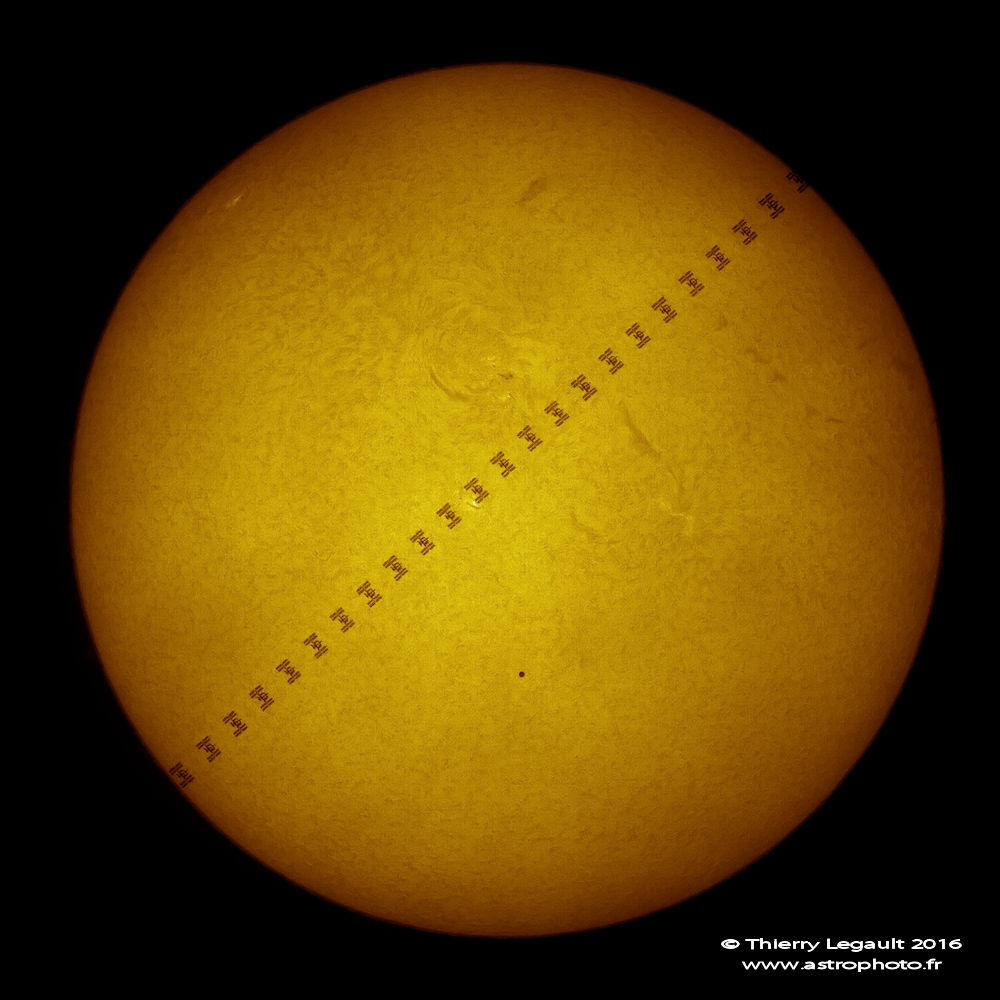
ISS and Mercury Too 
Image Credit & 
Copyright: Thierry Legault
Explanation: Transits of Mercury are relatively rare. Monday's leisurely 7.5 hour long event was only the 3rd of 14 Mercury transits in the 21st century. If you're willing to travel, transits of the International Space Station can be more frequent though, and much quicker. This sharp video frame composite was taken from a well-chosen location in Philadelphia, USA. It follows the space station, moving from upper right to lower left, as it crossed the Sun's disk in 0.6 seconds. Mercury too is included as the small, round, almost stationary silhouette just below center. In apparent size, the International Space Station looms larger from low Earth orbit, about 450 kilometers from Philadelphia. Mercury was about 84 million kilometers away. (Editor's note: The stunning video includes another double transit, Mercury and a Pilatus PC12 aircraft. Even quicker than the ISS to cross the Sun, the aircraft was about 1 kilometer away.)

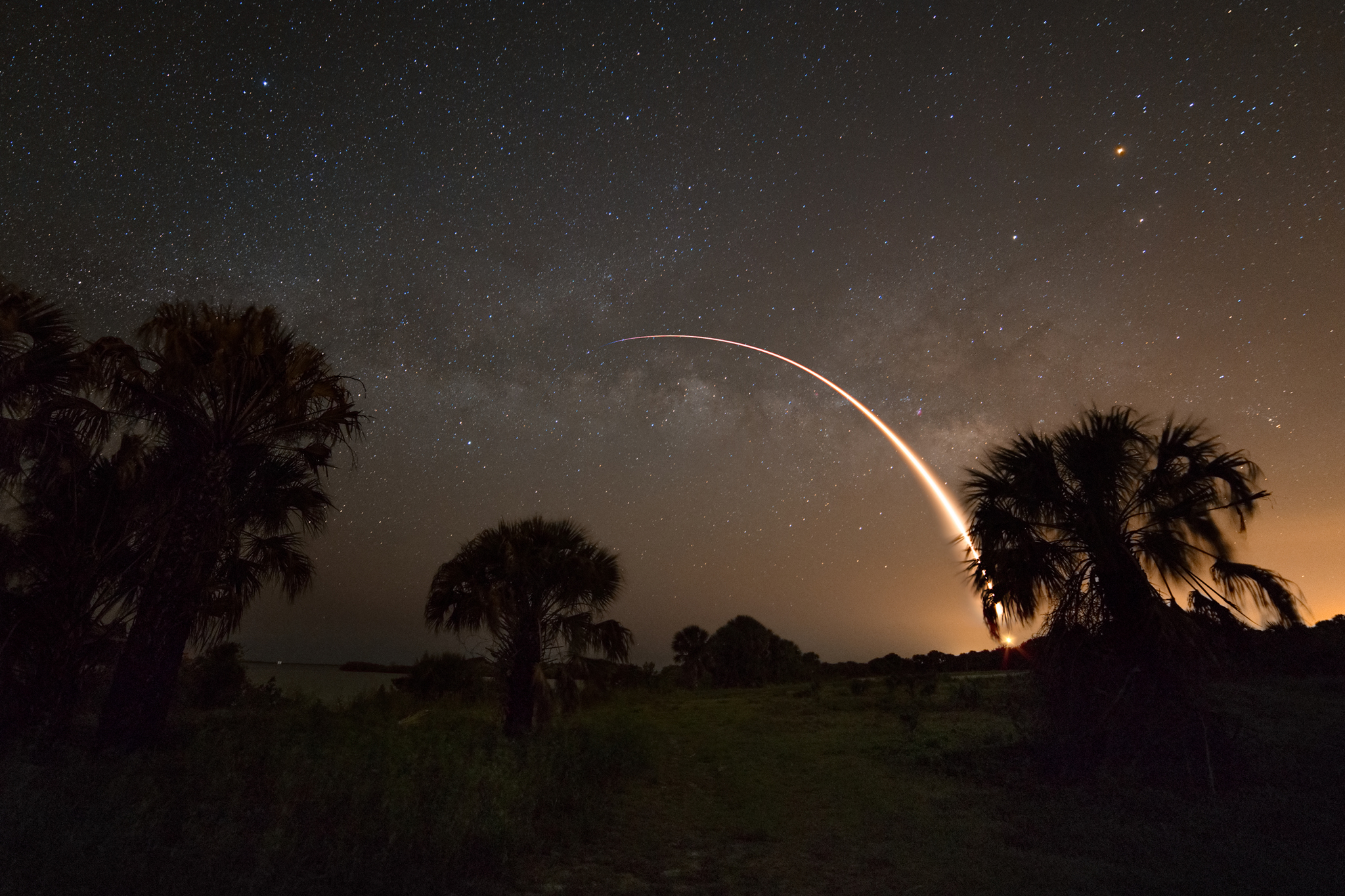
Falcon 9 and Milky Way 
Image Credit & 
Copyright: Derek Demeter (Emil Buehler Planetarium)
Explanation: On May 6, the after midnight launch of a SpaceX Falcon 9 rocket lit up dark skies over Merritt Island, planet Earth. Its second stage bound for Earth orbit, the rocket's arc seems to be on course for the center of the Milky Way in this pleasing composite image looking toward the southeast. Two consecutive exposures made with camera fixed to a tripod were combined to follow rocket and home galaxy. A 3 minute long exposure at low sensitivity allowed the rocket's first stage burn to trace the bright orange arc and a 30 second exposure at high sensitivity captured the stars and the faint Milky Way. Bright orange Mars dominates the starry sky at the upper right. A few minutes later, booster engines were restarted and the Falcon 9's first stage headed for a landing on the autonomous spaceport drone ship Of Course I Still Love You, patiently waiting in the Atlantic 400 miles east of the Cape Canaveral launch site.

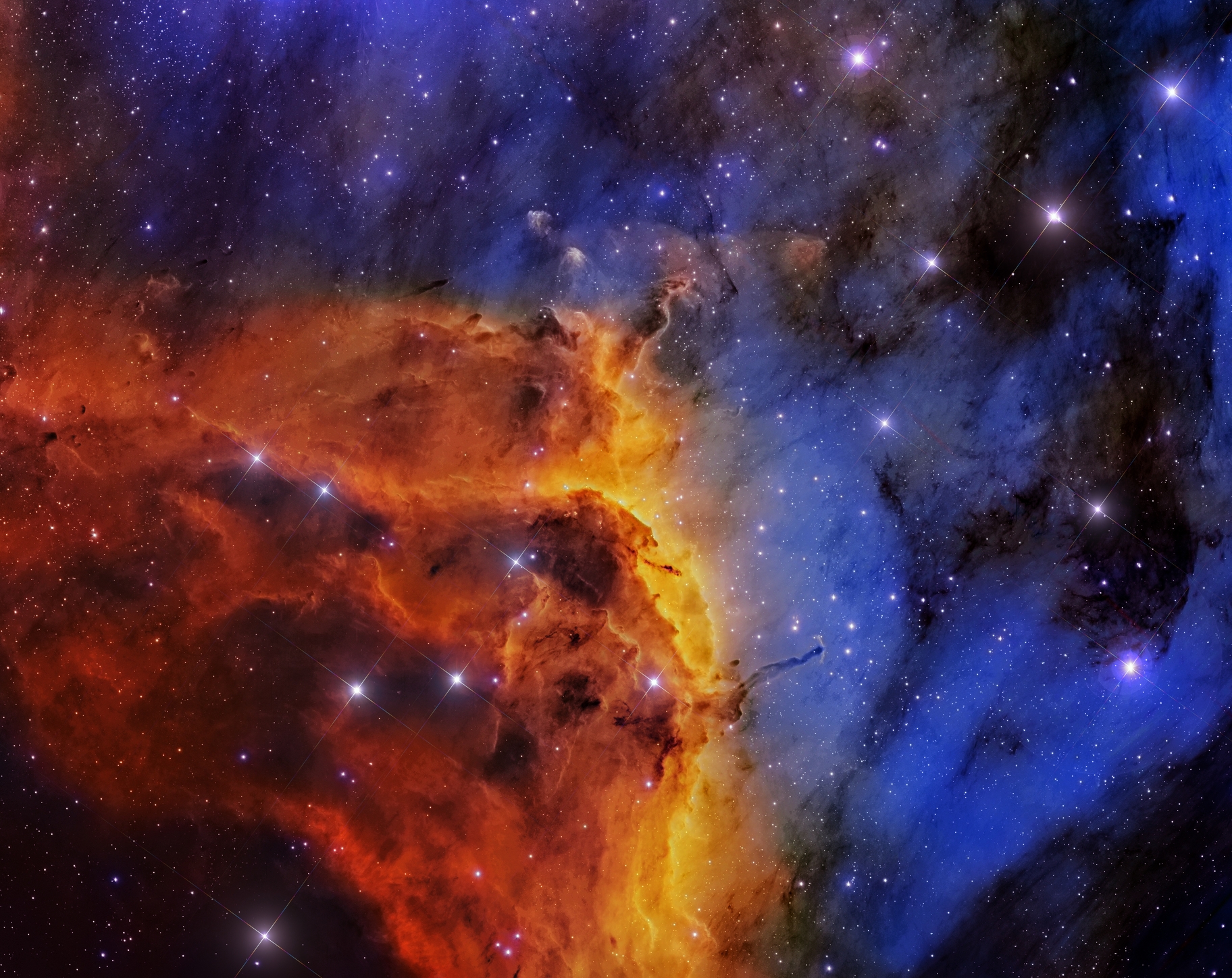
IC 5067 in the Pelican Nebula 
Image Credit & 
Copyright: Data - Subaru Telescope (NAOJ), R. Colombari, Processing - Roberto Colombari
Explanation: The prominent ridge of emission featured in this sharp, colorful skyscape is cataloged as IC 5067. Part of a larger emission nebula with a distinctive shape, popularly called The Pelican Nebula, the ridge spans about 10 light-years following the curve of the cosmic pelican's head and neck. This false-color view also translates the pervasive glow of narrow emission lines from atoms in the nebula to a color palette made popular in Hubble Space Telescope images of star forming regions. Fantastic, dark shapes inhabiting the 1/2 degree wide field are clouds of cool gas and dust sculpted by the winds and radiation from hot, massive stars. Close-ups of some of the sculpted clouds show clear signs of newly forming stars. The Pelican Nebula, itself cataloged as IC 5070, is about 2,000 light-years away. To find it, look northeast of bright star Deneb in the high flying constellation Cygnus.

Inside a Daya Bay Antineutrino Detector 
Image Credit & Copyright: 
DOE, Berkeley Lab - Roy Kaltschmidt, photographer
Explanation: Why is there more matter than antimatter in the Universe? To better understand this facet of basic physics, energy departments in China and the USA led in the creation of the Daya Bay Reactor Neutrino Experiment. Located under thick rock about 50 kilometers northeast ofHong Kong, China, eight Daya Bay detectors monitor antineutrinos emitted by six nearby nuclear reactors. Featured here, a camera looks along one of the Daya Bay detectors, imaging photon sensors that pick up faint light emitted by antineutrinos interacting with fluids in the detector. Early results indicate an unexpectedly high rate of one type of antineutrino changing into another, a rate which, if confirmed, could imply the existence of a previously undetected type of neutrino as well as impact humanity's comprehension of fundamental particle reactions that occurred within thefirst few seconds of the Big Bang.


Astronomy News:

Mega Tsunamis Rocked Mars Oceans Billions of Years Ago

By Charles Q. Choi, Space.com Contributor | May 19, 2016 09:00am ET

These visible-light views of Mars show lobe-like deposits probably caused by tsunamis (top image) and the bouldery material the huge wave deposited (bottom image).
Credit: Alexis Rodriguez

Traces of tsunamis on Mars are the newest clues yet that the Red Planet once had oceans, which could have supported life, researchers said.
These killer waves might have been triggered by giant meteor impacts, scientists added.
Although the surface of Mars is now cold and dry, there is a great deal of evidence suggesting that an ocean's worth of water covered the Red Planet billions of years ago. Since life is found on Earth virtually wherever there is liquid water, some researchers have suggested that life might have evolved on Mars when the planet was wet. Life could survive there even now, hidden underground, some scientists have said.

Still, there remains much debate over the existence and extent of ancient seas on Mars. For example, until now, scientists lacked concrete evidence of ancient shorelines cut by waves on the Red Planet. [The Search for Water on Mars in Pictures]
But new thermal images of the northern plains of Mars reveal what may be ancient scars left by two mega tsunamis about 3.4 billion years ago, researchers said. That was back when the Red Planet may have possessed a cold, salty, icy ocean.
"Our work provides definitive evidence for the presence of large and long-lived oceans on Mars," studyhttp://images.intellitxt.com/ast/adTypes/icon1.png co-author Alberto Fairén, a planetary scientist at the Center of Astrobiology in Madrid and Cornell Universityhttp://images.intellitxt.com/ast/adTypes/icon1.png in New York, told Space.com.

On an ancient Martian shore

The scientists examined ancient Martian shorelines for anomalies and discovered lobes modifying portions of these coasts. "Lobes are curved, roundish projections formed by deposits of sediments," Fairén said.
These objects are huge, reaching up to hundreds of miles long and wide, said study lead author Alexis Rodriguez, a planetary scientist at the Planetary Science Institute in Tucson, Arizona. Similar but smaller lobes are seen on Earth after catastrophic waves.
The researchers suggested that the Martian lobes were caused by two giant tsunamis, which extended over a wide range of elevations, from gently sloping plains to cratered highlands. The older tsunami inundated an area about 309,000 square miles (800,000 square kilometers) in size, while the younger one drowned a region about 386,000 square miles (1 million sq. km) large, the researchers said.
The older tsunami dragged boulders up to about 33 feet (10 meters) large along with it. As gravity rapidly pulled water from the wave back to where it came from, the water carved numerous channels ranging between up to about 655 feet (200 m) wide and about 12.4 miles (20 km) long. Similar channels are seen from the backwash of tsunamis on Earth, the researchers said.
In the time between the older and younger tsunami, the researchers said, the Martian climate apparently became significantly colder, since the second tsunami's lobes were rich in ice. "These lobes froze on the land as they reached their maximum extent, and the ice never went back to the ocean, which implies the ocean was at least partially frozen at that time," Fairén said in a statement.

Left: Color-coded digital elevation model of the study area showing the two proposed shoreline levels of an early Mars ocean that existed about 3.4 billion years ago. Right: Areas covered by the documented tsunami events extending from these shorelines.
Credit: Alexis Rodriguez
The scientists suggested that these two mega tsunamis were caused by two meteor strikes. The researchers' calculations estimated that such cosmic impacts would have generated craters about 18 miles (30 km) wide and triggered tsunamis with onshore heights of about 165 feet (50 m). Previous research suggested that about 3.4 billion years ago, impacts of this size happened about every 30 million years on Mars.

A beach on Mars?

Ancient Martian beaches would have been far from ideal for tropicalhttp://images.intellitxt.com/ast/adTypes/icon1.png resorts. "When imagining oceans on early Mars, don't picture Californian beaches, but instead a particularly cold and long winter in the Great Lakes," Fairén said.
These findings may provide further evidence that ancient Mars could have supported life, the researchers said. "Cold, salty waters may offerhttp://images.intellitxt.com/ast/adTypes/icon1.png a refuge for life in extreme environments, as the salts could help keep the water liquid," Fairén said in a statement. "If life existed on Mars, these icy tsunami lobes are very good candidates to search for biosignatures."
The researchers are exploring the possibility that some tsunamis may have struck glacier-rimmed shores, "triggering the release of big ice chunks that would drift in coastal waters as wandering icebergs," Fairén said. "We have some preliminary evidence for such a process, so stay tuned."
Futurehttp://images.intellitxt.com/ast/adTypes/icon1.png research will closely inspect other portions of Martian shorelines, looking for additional tsunami deposits, the researchers said. "We would like to characterize landing sites that will allow us to sample ice from the tsunami to investigate the original composition of the ocean," Rodriguez told Space.com.
The scientists detailed their findings online May 19 in the journal Scientific Reports.
Scientists discover a huge new galaxy orbiting our Milky Way

Like a silent congregation of stealth gemstones, astronomers have discovered a gigantic galaxy lurking right outside the Milky Way’s front door. Researchers at the University of Cambridge submitted a recent report in the Monthly Notices of the Royal Astronomical Society introducing humanity to the Crater 2 ultra-dwarf galaxy, an extremely dim and dark galaxy determined to be one of the feeblest, faintest galaxies ever spotted in the universe.
Now nicknamed “the feeble giant,” this fantastic collection of stars just around the cosmic corner has somehow escape detection despite being in such close proximity to the Milky Way. It’s cataloged as the fourth largest satellite of the Milky Way, surpassed only by the Large Magellanic Cloud (LMC), the Small Magellanic Cloud (SMC) and the Sagittarius Dwarf Spheroidal Galaxy (Sgr dSph).

One of the main reasons for its secret existence is that it falls under the nominal detection boundary in sky surveys and compares in relative obscurity to the recently discovered Tuc 2 and Tuc IV and UMa II. Crater 2 is 391,000 light-years from the sun and officially measures 3,500 half-light years across. It appears to be in alignment with the globular cluster Crater, the pair of ultra-faint dwarf galaxies Leo IV and Leo V, and the dwarf galaxy Leo II. Dwarf galaxies have no clear boundaries due to the density of their stars gradually decreasing toward the outer borders, so they’re measured by their half-light radius, the distance from their observed center.
Possibly formed by a series of galactic mergers, Crater 2 should give scientists a clearer window into the evolution of the Milky Way, and its discovery allows for the possibility that a healthy number of extremely low surface brightness dwarf galaxies may still be out there somewhere in the darkness.


General Calendar:

Colloquia, Lectures, Seminars, Meetings, Open Houses & Tours:

Colloquia:  Carnegie (Tues. 4pm), UCLA, Caltech (Wed. 4pm), IPAC (Wed. 12:15pm) & other Pasadena (daily 12-4pm):  http://obs.carnegiescience.edu/seminars/ 
Carnegie astronomy lectures – only 4 per year in the Spring www.obs.carnegiescience.edu.  Visit www.huntington.org for directions.  For more information about the Carnegie Observatories or this lecture series, please contact Reed Haynie.  . Click here for more information.
2 June
AEA Astronomy Club Meeting
Carnegie Lecture:  “Bright Galaxies, Dark Universe Part I: The Dawn of Galaxies“
(A1/1735)


3 June
Friday Night 7:30PM SBAS  Monthly General Meeting
in the Planetarium at El Camino College (16007 Crenshaw Bl. In Torrance)
Friday Night 7:30PM Monthly General Meeting
Topic:   The Ancient Art of Celestial Navigation…in Space!
Speaker: Ken Munson


4-5 June
JPL Open House See the JPL website for more information: http://www.jpl.nasa.gov/events/open-house.php


13 June
Griffith Observatory
Event Horizon Theater
8:00 PM to 10:00 PM
June 16 & 17 The von Kármán Lecture Series: 2016

2015-2016 El Niño Winter and California Water: What did we see from space?

El Niño and La Niña refer to changes in the patterns of sea surface temperatures across the Equatorial Pacific Ocean west of Peru. These changes can significantly influence ocean conditions and weather patterns the world over, creating extreme events from floods along the Pacific Coast of the United States to droughts in Southeast Asia and Australia. And although every El Niño event is different, in general the effects of El Niño in California are most noticeable as winter floods. The 2015-2016 winter, with such large temperature anomalies over broad areas of the eastern Pacific, was predicted to be, if not hoped to be, in a word, “wet” in California.
NASA’s Jet Propulsion Laboratory (JPL) observes many aspects of water on the Earth using cutting edge sensors on satellites and airplanes that include new insights into the Sierra snowpack and groundwater. Can these observations help to improve our understanding of the impacts of El Niño and La Niña on water resources critical to California? A panel of experts will be on hand to describe measurements over the past season in California focused on groundwater and mountain snowpack results and to discuss what these measurements might tell us of the future.

Speaker:
Dr. Tom Painter
Dr. Tom Farr
Dr. Jay Famiglietti
Dr. Duane Waliser

Webcast:
Click here to watch the event live on Ustream (or archived after the event)
Locations:
Thursday, June 16, 2016, 7pm
The von Kármán Auditorium
at JPL
4800 Oak Grove Drive
Pasadena, CA
› Directions

Friday, June 17, 2016, 7pm
The Vosloh Forum at Pasadena City College
1570 East Colorado Blvd.
Pasadena, CA
› Directions
Webcast:
We offer two options to view the live streaming of our webcast on Thursday:
› 1) Ustream with real-time web chat to take public questions.
› 2)
Flash Player with open captioning
If you don't have Flash Player, you can download for free
here.


7 July
AEA Astronomy Club Meeting

Pizza & Meteor Swarms & Satellites, Glenn Peterson
(A1/1735)


8 July SBAS Friday Evening 7:30 PM Monthly General Meeting Topic: TBD


Observing:

The following data are from the 2016 Observer’s Handbook, and Sky & Telescope’s 2016 Skygazer’s Almanac & monthly Sky at a Glance.

Current sun & moon rise/set/phase data for L.A.:  http://www.timeanddate.com/astronomy/usa/los-angeles

Sun, Moon & Planets for July:


Moon: June 4 new, June 12 1st quarter, June 20 full, June 27 last quarter             
Planets: Saturn & Mars are up from sunset to a few hours after midnight.  Jupiter is up until midnight.  Venus is hidden in the Sun’s glare all month. Mercury is visible shortly before sunrise.


Other Events:

2-3 June Saturn reaches opposition

4 June
SBAS out-of-town Dark Sky observing – contact Greg Benecke to coordinate a location. http://www.sbastro.net/.  

5 June Mercury at its Greatest Western Elongation

1,8,15,22,29 June
LAAS The Garvey Ranch Observatory is open to the public every Wednesday evening from 7:30 PM to 10 PM. Go into the dome to use the 8 Inch Refractor or observe through one of our telescopes on the lawn. Visit our workshop to learn how you can build your own telescope, grind your own mirror, or sign up for our free seasonal astronomy classes.

Call 213-673-7355 for further information.
Time: 7:30 PM - 10:00 PM
Location: Garvey Ranch Obs. , 781 Orange Ave., Monterey Park, CA 91755

11 June
LAAS Public  Star Party: Griffith Observatory Grounds 2-10pm

19 June 2:30 PM UCLA Meteorite Gallery Lecture Series Oriented Meteorites: Sculpted by Fire Nick Gessler, Professor at Duke University 4863 Slichter Hall, 595 Charles E. Young Drive East, Los Angeles
20 June Summer Solstice

25 June
LAAS Private dark sky  Star Party

 
25 June
SBAS Saturday Night In Town Dark Sky Observing Session at Ridgecrest Middle School– 28915 North Bay Rd. RPV, Weather Permitting: Please contact Greg Benecke to confirm that the gate will be opened! http://www.sbastro.net/

2 July SBAS Saturday Night Out of Town Dark Sky Observing Session Contact Greg Benecke to coordinate a location.

Internet Links:

Telescope, Binocular & Accessory Buying Guides


General


Regional (Southern California, Washington, D.C. & Colorado)


About the Club

Club Websites:  Internal (Aerospace): https://aeropedia.aero.org/aeropedia/index.php/Astronomy_Club  It is updated to reflect this newsletter, in addition to a listing of past club mtg. presentations, astronomy news, photos & events from prior newsletters, club equipment, membership & constitution.  We have linked some presentation materials from past mtgs.  Our club newsletters are also being posted to an external blog, “An Astronomical View” http://astronomicalview.blogspot.com/. 

 
Membership.  For information, current dues & application, contact Alan Olson, or see the club website (or Aerolink folder) where a form is also available (go to the membership link/folder & look at the bottom).  Benefits will include use of club telescope(s) & library/software, membership in The Astronomical League, discounts on Sky & Telescope magazine and Observer’s Handbook, field trips, great programs, having a say in club activities, acquisitions & elections, etc.

Committee Suggestions & Volunteers.  Feel free to contact:  Mark Clayson, President & Program Committee Chairman (& acting club VP), TBD Activities Committee Chairman (& club Secretary), or Alan Olson, Resource Committee Chairman (over equipment & library, and club Treasurer).

Mark Clayson,
AEA Astronomy Club President